

Audio By Carbonatix
Ghana’s Extractive Sector Multi-Stakeholder Group (MSG) has urged Parliament to summon State agencies over delays in disbursing mineral royalties to mining host communities.
The Group said the delays were stalling development projects, disrupting local planning and undermining the objectives of the Minerals Development Fund Act.
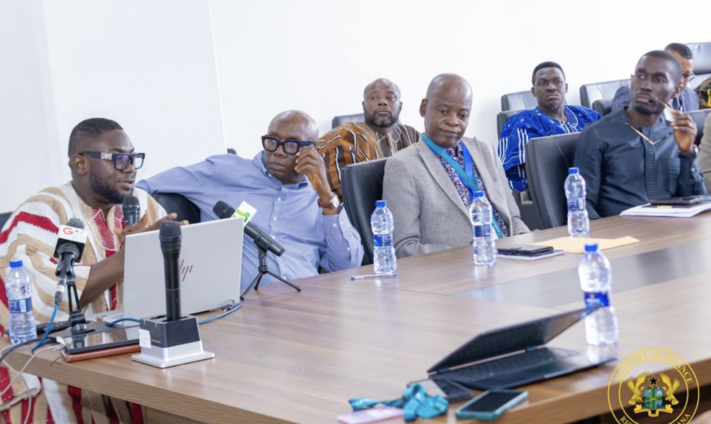
Dr Emmanuel Steve Asare Manteaw, a member of the MSG, made the call at a media engagement to disseminate the findings of the 2023 Ghana Extractive Industries Transparency Initiative (GHEITI) Report in Accra.
He attributed the persistent delays to weak oversight, saying Parliament should ensure compliance with the Minerals Development Fund Act, 2016 (Act 912), by holding State institutions accountable for the timely release of approved funds.
“A lot of development projects in some of these beneficiary communities have come to a standstill, and the uncertainty over the timing of disbursements makes it difficult for communities to plan development activities with any confidence.
“What is more worrying is the role of Parliament in all this because they passed the law mandating that certain percentages of mineral royalties be disbursed to mining host communities,”Dr Manteaw said.
He said Parliament should ensure that information on delayed payments, including the institutions responsible and the amounts outstanding, was made public to strengthen
transparency and accountability.
In a speech read on his behalf, Mr Patrick Nomo, Co-Chair of the GHEITI Multi-Stakeholder Group and Chief Director at the Ministry of Finance, said reforms to the mineral royalty regime had improved the management of extractive revenues.
He said GHEITI advocacy had contributed to reforms, including changes to the mineral royalty regime and the institutionalisation of subnational royalty transfers through the Minerals Development Fund to enable mining communities to benefit more directly from mineral resources.
Mr Nomo, however, said revenue leakages and weak inter-institutional coordination continued to constrain the sector’s contribution to national and local development.
He called for stronger institutional collaboration and improved data management to enhance transparency and ensure that resource revenues translated into tangible benefits for mining communities.
Mr Nomo reaffirmed the Government’s commitment to using evidence generated through GHEITI to inform policy reforms and strengthen accountability in the extractive sector.
Under the Minerals Development Fund Act, mineral royalties are distributed through a statutory formula, with district assemblies receiving 55 per cent of the allocation to local government, mining-affected communities 25 per cent and traditional councils 20 per cent.
Latest Stories
-
Ofori-Sarpong named Alumni President of the Year, honoured for PRESEC dormitory project
26 minutes -
Germany commits $132m to Ghana for skills development and training university – Pelpuo
27 minutes -
‘Influence should go beyond visibility’ – Taadi Banyinba GH launches The TB Impact
31 minutes -
Videos: Government announces emergency LEAP package for Hohoe flood victims
35 minutes -
Salomey Baffoe’s children are crying for their mother – Family appeals for her release
37 minutes -
Shortage of trained investigators and prosecutors hampers Ghana’s fight against money laundering – Report
38 minutes -
GoldBod generates US$1.87bn in September FX operations, exceeding monthly target
38 minutes -
Roads Minister says it is time to change one-year defect liability period for contractors, consultants
39 minutes -
Nana Asamoah takes Highlife across five West African languages
45 minutes -
UNICEF Ghana launches first Children’s Film Festival to amplify children’s voices
50 minutes -
Ghana must close gaps that allow drug trafficking – Dr Pelpuo
58 minutes -
Emmanuel Osei: President Mahama, dissolve GFA and save our soul
1 hour -
Uganda Airlines to launch direct Accra-Entebbe flights from October 27
1 hour -
Ghana records surge in 2025 tourism receipts as Ahafo Region honors top industry players
1 hour -
I don’t have an official car, I use my own – Pelpuo
1 hour