

Audio By Carbonatix
The Police Academy is set for an unprecedented expansion as the Ghana Police Service activates both residential and non-residential training models to accommodate more than 700 cadet officers for the historic Course 54 intake.
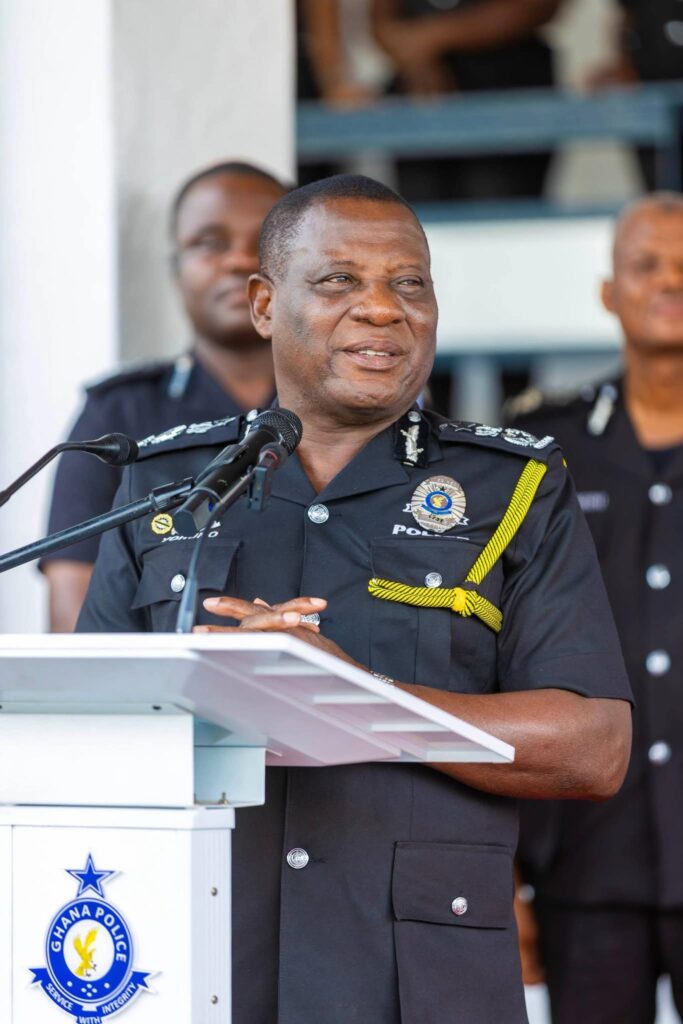
The move, being championed by the Inspector-General of Police (IGP), Mr Christian Tetteh Yohuno, together with the Police Management Board (POMAB), marks the largest single cadet admission in the history of the academy.
The Police Administration says the bold intervention is aimed at ensuring that accommodation challenges do not deny hardworking and qualified Chief Inspectors who many have stagnated in their ranks for years, the opportunity to rise into senior leadership positions within the service.
Even though some critics have attempted to portray the arrangement as unusual, the administration insists there is absolutely nothing new about the residential and non-residential model.
History
According to the administration, similar arrangements were introduced years ago whenever cadet numbers exceeded accommodation capacity.
Historical records indicate that under retired IGP Paul Tawiah Quaye in 2011, both residential and non-residential models were adopted, while retired IGP P.K. Acheampong also distributed cadet officers across training institutions in Accra, Winneba and Pwalugu to deal with accommodation pressures — despite the fact that cadet numbers at the time were far lower.
“The immediate past IGP also employed both residential and non-residential models during cadet training exercises. So there is nothing strange about the current arrangement,” a source close to the administration disclosed.
The Police Administration has therefore dismissed attempts by sections of the public and media to create the false impression that the arrangement is problematic.

Rather, many officers within the service are praising the foresight and progressive leadership of IGP Yohuno and POMAB for refusing to use infrastructure limitations as an excuse to block career progression opportunities for deserving officers.
“This administration believes opportunities must be created for qualified officers and not restricted because of accommodation limitations,” the source stressed.
International trend
Globally, police institutions are shifting from residential-based training to non-residential model of training.
Unlike the training of fresh recruits, which emphasises on bonding, espirit de corps, institutional culture and de-individualisation, continuous training in the shape of career progression is apt for a blend of residential and non-residential model of training.
Statistics
Statistics from previous intakes at the academy reveal the dramatic scale of the current expansion.
Course 51 admitted 308 officers, Course 52 recorded 344 officers, while Course 53 admitted 432 officers.
However, under the current administration, all 7,500 Chief Inspectors in the service were, for the first time, allowed to sit for the Police Academy Entrance Examination — a major break from previous restrictive systems.
Following the amnesty granted by the President of the Republic to candidates who scored between 50 and 52 marks, in addition to those who scored between 53 and 75 marks, a total of 1,063 officers successfully qualified for admission.
Additional officers promoted as under-cadets, as well as personnel who distinguished themselves in operational duties and crime-fighting activities, have also been recommended for admission.
The Police Administration further assured officers that all qualified personnel placed under Courses 54, 55 and 56 would eventually undergo cadet training.
To support the massive intake, additional accommodation facilities have been secured within Accra, while officers residing within the Police Depot and Tesano enclaves would have the option of participating as non-residential cadets while fully taking part in all training activities.
The administration also assured officers that transportation and logistical arrangements are being put in place to ensure no officer suffers any inconvenience during the training period.
In another major intervention, the IGP has approved the expansion of academy staff strength, including kitchen staff and support personnel, to adequately cater for the welfare and operational demands of the large intake.
"Fully furnished lecture halls and training facilities have also been prepared to ensure effective instruction, discipline and a conducive learning environment throughout the six-to-nine-month programme.
"At the end of the day, we will not compromise standards as adequate preparations have been made to ensure efficiency, discipline and high-quality training delivery," it added.
Meanwhile, the Police Administration has strongly dismissed allegations of bribery, examination malpractice and irregularities surrounding the recent entrance examinations.
According to the administration, no candidate has officially petitioned the service over the results, insisting that allegations circulating in sections of the media are baseless attempts to undermine the credibility of what has been described as a transparent and merit-based process.
“Such allegations have no grounds and should be treated with the contempt they deserve,” the administration stressed.
As preparations intensify for the largest cadet intake in the history of the Ghana Police Service, many officers and stakeholders are calling on the public to support what they describe as one of the boldest and most transformational reforms introduced by the current police leadership.
Latest Stories
-
Labour Minister wants SOEs to help shape new public pay system
1 hour -
IPEC will ensure Equity and Sustainability in SOEs Compensation
2 hours -
White House bars CNN from travelling with Trump on Air Force One
3 hours -
Fennis wins second consecutive ITF J60 title in Accra
3 hours -
Spain beat England in thriller after Kane penalty miss
3 hours -
GPL 2026/27: Zaidan’s late goal ends Hearts of Oak unbeaten start
3 hours -
CEOs demand clarity on pay harmonisation, board autonomy as FWSC engages SOEs bosses over IPEC transition
3 hours -
2026 Women’s Super Cup: FC Savannah, Epiphany Warriors maintain top spots ahead of final group games
3 hours -
‘Is EOCO responsible for determining lawyers’ fees?’ – Baffour Awuah
3 hours -
David Beckles claims second J60 Accra title
4 hours -
No France cocaine suspect linked to Mahama, Vice President’s security details – NACOC
4 hours -
Anwelle Foundation launched in Jirapa to tackle poverty, youth unemployment
4 hours -
Joy Sports Editor Fentuo Tahiru Fentuo to moderate inaugural Music Meets Football Summit in Zambia
4 hours -
Court premises too volatile for Baffour Awuah’s attempted arrest by EOCO – Inusah Fuseini
4 hours -
Drug bust: Under no circumstances will NACOC leadership be compromised – Twum-Barimah
4 hours