

Audio By Carbonatix
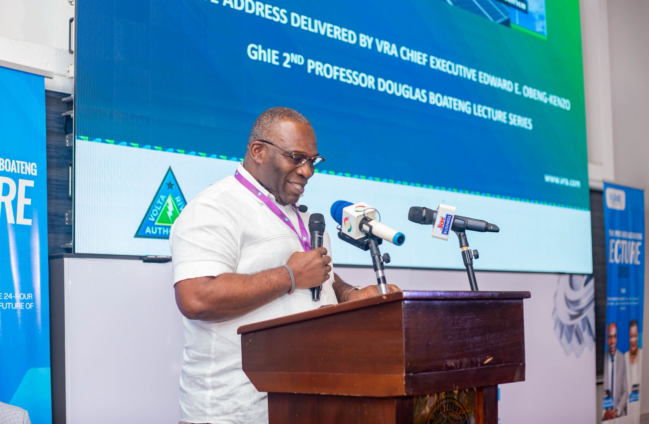
The Chief Executive of the Volta River Authority (VRA), Edward E. Obeng-Kenzo, has underscored the critical role of reliable, affordable and sustainable electricity in the successful implementation of Ghana's 24-Hour Economy.
He stressed that the country's industrial transformation agenda cannot be realised without uninterrupted power supply.
He said the Government's 24-Hour Economy and Accelerated Export Development Programme presented a historic opportunity to transform Ghana into a competitive, industrial, export-driven economy, but warned that factories, hospitals, transport systems, data centres, and businesses could not operate around the clock without dependable electricity.
Delivering the keynote address at the 2nd Ghana Institution of Engineering (GhIE)-Professor Douglas Boateng Lecture Series in Accra, Ing Obeng-Kenzo said reliable power remained the lifeblood of every successful economy.
"The success of the 24-hour economy will be determined largely by the reliability, affordability and availability of power," he stated.
Speaking on the theme, "Power Never Sleeps: VRA, the 24-Hour Economy and the Industrial Future of Ghana," he explained that the Volta River Authority had remained at the centre of Ghana's energy development for more than six decades.
He said VRA had evolved from hydroelectric generation at Akosombo and Kpong to thermal and renewable energy, with a current installed generation capacity of about 2,547 megawatts, supplying electricity to Ghana and neighbouring countries.
Obeng-Kenzo said the Authority was investing in renewable energy, modernising generation facilities, and deploying smart technologies to build a cleaner, more resilient, and more reliable power system capable of supporting continuous industrial production.
He noted that although Ghana had made significant progress in expanding electricity access, substantial investments were still required in grid modernisation, battery storage systems, digital monitoring technologies and other critical energy infrastructure to meet future demand.
The VRA Chief Executive said the energy sector was no longer merely a support system for economic development but the principal driver of industrialisation, job creation, investment and regional integration.
Reaffirming VRA's commitment to powering Ghana's economic transformation, Ing Obeng-Kenzo said: “Just as the Volta River continues to flow day and night, season after season, so too must our commitment to powering Ghana's development remain unwavering. People may rest, but progress cannot sleep; neither can power.”
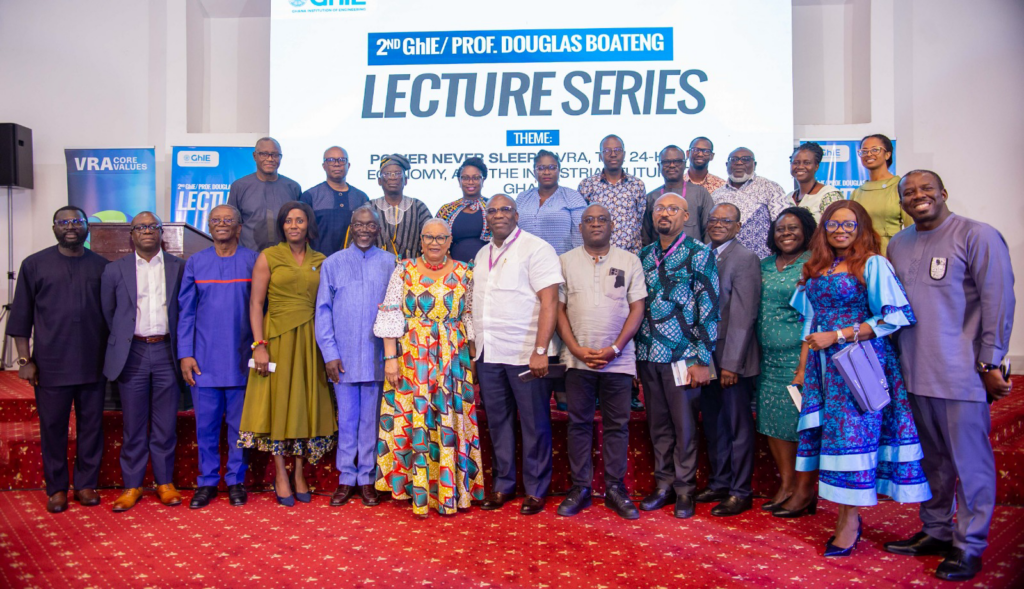
In a welcome address delivered on behalf of the President of the Ghana Institution of Engineering, Ludwig Annang Hesse, by the Executive Director, Dr Enyonam Kpekpena, the Institution said this year’s lecture series sought to examine how the experience, infrastructure and strategic position of VRA could support Ghana's transition to a productive 24-hour economy and a more competitive industrial future.
The address noted that the lecture also provided an opportunity to explore the investments, policies, technologies and engineering leadership required to build an energy sector that is reliable, sustainable and responsive to Ghana's evolving development needs.
The annual GhIE-Professor Douglas Boateng Lecture Series brings together engineering professionals, policymakers, academia and industry leaders to deliberate on engineering solutions that promote sustainable infrastructure development and national economic transformation.
Latest Stories
-
Ghana explores centre of excellence for hearing, communication and cochlear implant care
1 hour -
Schizophrenia-related disorders lead mental health cases recorded in Ghana
1 hour -
Dutch authorities enlist Ghana in hunt for fugitive drug lord Bolle Jos
2 hours -
Ghana housing finance conference adopts communiqué to improve affordable housing access
6 hours -
Special Initiatives Minister urges Wa Technical Institute to enrol more girls as EU-backed solar training lab opens
7 hours -
In the matter of my first year at the Bar
7 hours -
ActionAid Ghana calls for an end to child marriage, greater investment in girls’ rights
7 hours -
Newsfile to tackle World Cup visa scandal, beach demolitions, education strikes, BRICS bid
7 hours -
UK-Ghana Trade & Investment Summit: Trade Resource Centre to help businesses maximise UK-Ghana trade opportunities
8 hours -
Embassy of Denmark celebrates World Maritime Day
8 hours -
Linking LEAP to productive inclusion could cut extreme poverty by 2030 – UNICEF
9 hours -
Trade Ministry backs use of creative arts to rehabilitate prison inmates
9 hours -
Negotiations with government to continue despite strike suspension – GNAT
9 hours -
‘Ghana cannot afford to waste public resources; every cedi has a job’ – Ato Forson
9 hours -
Ghana expects economic boost as World Assemblies of God Congress brings 10,000 delegates to Accra
9 hours