

Audio By Carbonatix
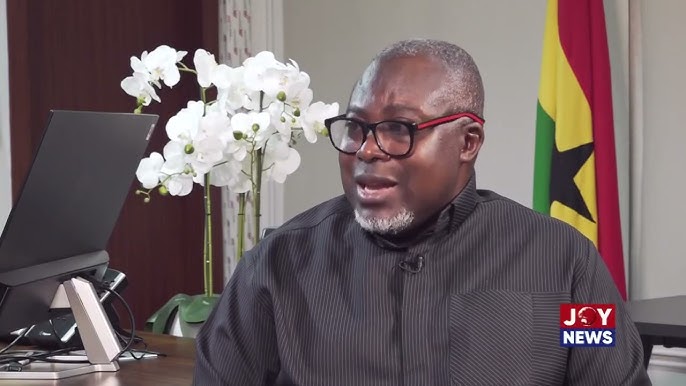
The Ghana Revenue Authority (GRA) has announced that it collected about GH¢1 billion in revenue in April 2026, a performance Commissioner-General, Anthony Kofi Sarpong says reflects ongoing improvements in tax administration efficiency, compliance systems, and digital reforms aimed at strengthening Ghana’s fiscal foundation.
Speaking at the 10th Ghana CEO Summit, Mr. Sarpong said domestic revenue mobilisation remains central to Ghana’s development agenda, particularly at a time when the country is seeking to deepen economic transformation and reduce reliance on external financing.
He revealed that Publican Artificial Intelligence system introduced at the ports helped improved compliance and blocked revenue leakages.
“Education and development of Ghana rest and thrives on the provision of relevant enablers, including infrastructure, energy, well-trained and equipped workforce, and efficient public services,” he stated, underscoring the importance of sustained revenue flows to support national priorities.
He noted that the GH¢1 billion collection in April demonstrates the potential of a more efficient and modernised tax system, but stressed that broader structural reforms are still required to sustain and expand gains in revenue mobilisation.
“Our aspiration for a reset and transform economy is not attainable if we fail to mobilize the needed domestic revenue as one of the most important catalysts for national development,” he said.
Mr. Sarpong said tax reform must be anchored on fairness, technology, productivity, and sovereignty, rather than being viewed solely as a tool for revenue extraction.
“The tax reform that we undertake should not primarily be about extraction,” he noted.
He explained that fairness in the tax system is critical to ensuring that compliant businesses are not placed at a disadvantage compared to non-compliant operators, describing this imbalance as a distortion to competition and economic growth.
“The compliant business pays its share, while the non-compliant business does not. The gap between the two becomes a competitive penalty paid by firms that are actually doing the right thing,” he said.
According to him, Ghana’s tax reforms are now focused on expanding the tax base and improving compliance through digital systems, rather than increasing pressure on existing taxpayers.
“We want this era of tax reform to be about ensuring that those who pay are no longer being competed against by those who do not,” he stated.
Mr. Sarpong highlighted the role of technology in reshaping tax administration, noting that digital tools are enabling efficiency gains that were previously not possible.
“Technology is now available for us to change structurally what was not possible yesterday,” he said.
He also described a strong and credible tax system as a key driver of industrial development and economic competitiveness.
“A credible tax system is in itself a factor of production for the Ghanaian industry,” he noted.
The Commissioner-General warned that reliance on external financing is increasingly uncertain, making domestic revenue mobilisation a matter of economic sovereignty.
“The alternative to mobilizing domestic revenue is dependence on financing that is no longer reliably open or available,” he said.
Mr. Sarpong commended ongoing reforms under the current administration, noting that the focus has been on improving collection efficiency rather than introducing new taxes.
“We are focused on the efficiency of collecting those that are there,” he stated.
He also disclosed that the GRA is undertaking a comprehensive review of tax laws, many of which are over a decade old, to improve relevance and close compliance gaps.
“We are comprehensively revising our tax laws, many of which are over 10 years old, to make them relevant, practical, and up to date with current requirements,” he said.
Mr. Sarpong stressed that modernisation of the tax system is essential to sustaining recent revenue gains and supporting Ghana’s broader economic transformation agenda.
The GRA says the GH¢1 billion April performance is part of early signs of improved fiscal discipline and enhanced compliance systems as reforms deepen across the revenue ecosystem.
Latest Stories
-
Allround Baby Pants launched in Ghana to ease diapering for mothers
2 hours -
Aggrieved Gold Coast Fund Management Company customers to petition Mahama over locked-up funds
2 hours -
NSMQ 2026: PRESEC, Legon dethrones defending champions Mfantsipim in thrilling battle to book semi-final spot
3 hours -
NPP set to overhaul constitution as delegates prepare to vote on sweeping reforms
3 hours -
Ghana’s cashew industry faces processing gap as Côte d’Ivoire moves to capture more value
3 hours -
“Our greatest wealth is not in our soil but our people” — Upper West Minister
3 hours -
Luex Healthcare launches children’s health education book series with Luey the Lion
3 hours -
NAGRAT urges gov’t to communicate early if September deadline cannot be met
4 hours -
We trust government to meet September deadline on teachers’ promotions – NAGRAT
4 hours -
“We dare not fail” – Gov’t promises to honour teachers’ promotion pay deal
4 hours -
The GH¢19.8 billion mirage: Inside Ghana’s state enterprise turnaround
4 hours -
Luv FM High School Debate: KNUST SHS and Osei Adutwum SHS set up thrilling final after dramatic semi-finals
4 hours -
KNUST AI Coordinator urges structured adoption of AI in teacher education
4 hours -
Nepal rescuers blast hillside in search of hydropower workers as families wait anxiously
5 hours -
Teachers who pass promotional exam to get January 2026 start date after gov’t resolves promotion dispute – Dr Apaak assures
5 hours