

Audio By Carbonatix
Al Hilal club is Saudi Arabia's most decorated football team having won 66 trophies. They have also won the AFC Champions League a record four times, making the Riyadh-based club the most successful team in Asia.
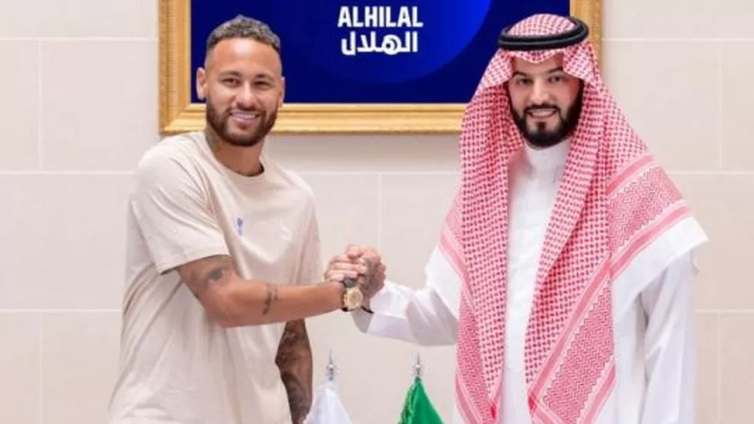
Despite its impressive history, for many supporters, 19 August 2023 marked the beginning of a new era for the club when Neymar Junior was unveiled in front of more than 65,000 ecstatic fans.
A volley of fireworks, followed by a drone show projecting Neymar's face, lit up Riyadh's sky as the Brazilian forward walked onto the pitch wearing the club's traditional dark blue kit.
"It is a very special day for us. Neymar is a mega star. He will bring in a lot of fans to Al Hilal. I think the whole of Brazil will support us now. The club will be known everywhere," Al Hilal fan Abdullah Almutawa told the BBC, who came to witness the ceremony.

The ambitious project to make Saudi Arabia an international football hub started with the arrival of Cristiano Ronaldo at Al Nassr in January on a two-and-a-half-year deal said to be worth over $400m (£318m or 370m euros) in wages.
This opened the floodgates for a jaw-dropping summer transfer window with the Saudi league snapping up some of the biggest names in the sport. Karim Benzema was the next big signing in June when he moved to Jeddah-based Al Ittihad from Real Madrid.
Since then, a host of prominent names including Sadio Mane, Riyad Mahrez, Jordan Henderson, N'Golo Kante, have swapped European leagues for the Saudi Pro League.
During the summer, the Saudi Pro League spent more than $900m on transfer fees to acquire foreign players, making it the second-highest spender after the English Premier League. The figure does not include the eye-watering salaries offered to lure players primarily from top European leagues.
And this is not a one-off splash, according to the league's chief operating officer, Carlo Nohra. The Saudi Arabian government has given a commitment to financially back the league until it achieves its goal of becoming one of the top leagues in the world in terms of revenues and quality.
The Saudi Pro League aims to compete with the likes of the English Premier League, and La Liga.
Mr Nohra says they will continue spending big to attract foreign players until the league achieves its objective, but it is also simultaneously working towards unlocking the commercial value that's on offer.
"While we have the commitment of getting support until however long it takes to achieve our goals, it is important for us to make ourselves commercially viable so that we are responsible for our own financial growth and not completely dependent on government capital," Mr Nohra told the BBC.
Soft power
The world's biggest oil exporter has invested billions of dollars in sport, including revamping the Saudi Pro league, Formula One and the lucrative LIV Golf.
Some critics have described it as "sportswashing" to distract people from its poor human rights record.

But some experts believe that managing image and reputation is not the only reason behind Saudi Arabia's strategy. According to Simon Chadwick, professor of Sport and Geopolitical Economy at Skema Business School in Paris, "nations across the world used sports and entertainment as a policy tool to project soft power".
"It's one element of a policy armoury that Saudi Arabia is currently deploying. We are talking about a contest between nations to win the hearts and minds of people globally. Britain, the United States, France, India and so many other countries have implemented this policy. Now the Saudis are doing the same," adds Prof Chadwick
The second key objective behind Saudi Arabia's spending spree is that it is part of a broader push to reinvent its economy before oil revenues start dwindling. Currently, they make up for more than 40% of the Saudi gross domestic product, or GDP.
Sports is one of the main pillars of the government's Vision 2030 project driven by the kingdom's de facto ruler Crown Prince Mohammed bin Salman. The economic diversification programme is focused on reducing the country's reliance on fossil fuel revenues by building new industries and generating jobs.
"One of the objectives is to deliver entertainment for the Saudi population as part of Vision 2030 and at the same time, also develop local talent that would enhance the level of the Saudi Pro League in the long run," says Mr Nohra.
Saudi Arabia is a football loving nation with 80% of the population either playing, watching, or following the sport. It is still early to judge whether these bold investments will pay off, but the strategy has demonstrated the Gulf nation's strong desire to become a football powerhouse.
Latest Stories
-
Formula 1 to return to Africa with Rwanda Grand Prix in early 2030s
15 seconds -
Mahama says Ghana is safer today as he commissions 85-bed ward at Police Hospital
5 minutes -
LA 2028: Black Queens face Zambia in final Olympic qualifier
13 minutes -
WAFU Zone B: Black Starlets seal semifinal place with 3-1 win over Benin
20 minutes -
Black Queens thrash Mauritius 7-0 to advance 10-0 on aggregate in Olympic Qualifiers
30 minutes -
Kaizen as a strategic pathway for micro business scale-up in Ghana
33 minutes -
Minister orders suspension of Obuasi SHS headmaster over alleged sexual misconduct following JoyNews investigation
37 minutes -
Over 38,000 commercial, 150,000 residential customers unbilled – Ghana Water MD
1 hour -
Several injured as Sprinter bus collides with ‘trotro’ at Odorkor
1 hour -
Ghana records progress on reparatory justice agenda – Ablakwa
1 hour -
Mahama commissions Christian Tetteh Yohuno Ward Complex at Police Hospital
2 hours -
Vice President calls for wider access to Ghana’s political party histories
2 hours -
Republic Bank JoyNews Habitat Fair to connect prospective homeowners with exhibitors in Ho from October 16 to 18
2 hours -
Obaasima Summit: ‘AI is not a spiritual attack’ — Rev. Dr. Ofori-Boateng urges young women to embrace technology
2 hours -
GHS to distribute 80,000 pairs of locally-made protective footwear to health workers
2 hours