

Audio By Carbonatix
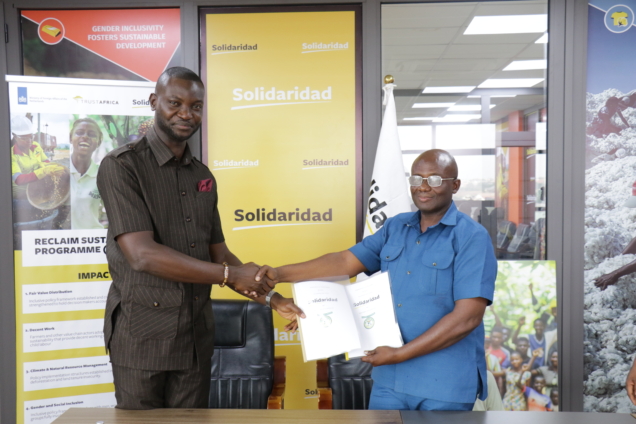
Solidaridad has partnered with the Department of Co-operatives in Ghana to facilitate the establishment of a robust regional and national cooperative association to increase the participation of cocoa farmers in decision-making.
The partnership was formalised with the signing of a Memorandum of Understanding at a brief ceremony on January 24, 2024, at Solidaridad's office in Accra.
Cocoa farmers’ cooperatives in Ghana face significant challenges due to the absence of a legally recognised, national unified front. This lack of representation often leads to formulating policies that don't align with farmers' needs, hindering sustainable cocoa production efforts.
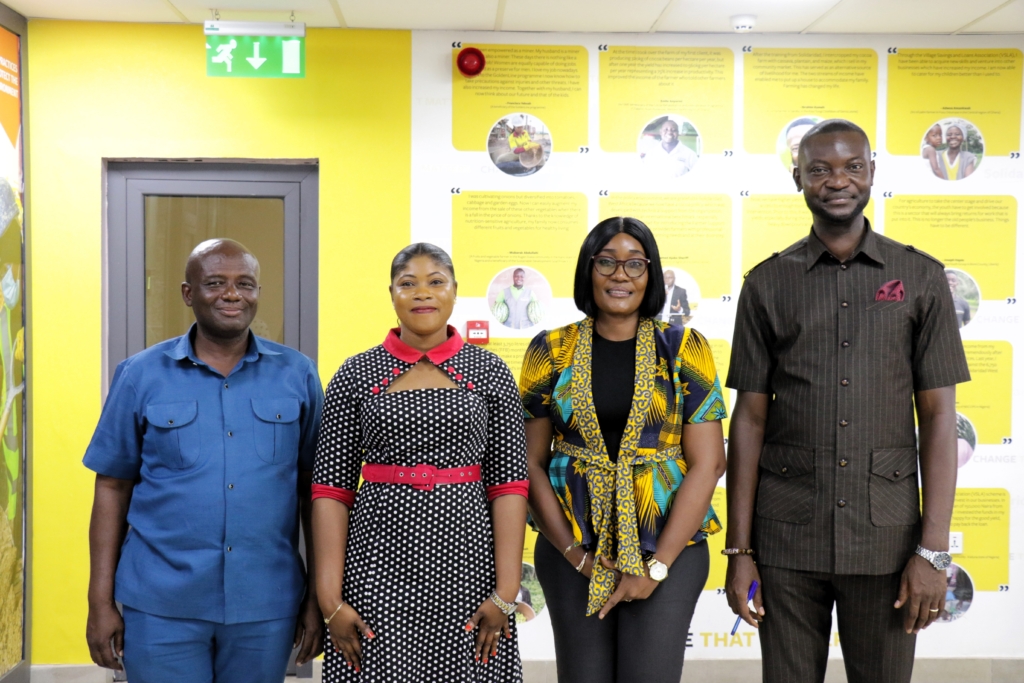
Key roles of both parties under the new partnership
Under the partnership, Solidaridad will enhance the capacity of cooperatives and associations on cocoa sector policies, as well as support the implementation of advocacy actions and the development of advocacy campaigns.
Bossman Owusu, Country Representative for Solidaridad in Ghana, said "We are dedicated to supporting the capacity agenda, to enable farmers to participate in decision-making processes actively."
He emphasised the organization's commitment to empowering farmers.
The Department of Co-operatives, on the other hand, will ensure the registration and regulation of the cocoa cooperative association, provide training in policies and governance, and maintain a database for registered cooperative unions.
Kwabena Apraku Yeboah, Acting Registrar for the Department of Co-operatives, expressed gratitude for Solidaridad's support and affirmed the department’s dedication to strengthening cocoa cooperatives in Ghana through effective collaboration.
Mobilising for change
The partnership is under Solidaridad’s RECLAIM Sustainability! programme and forms part of efforts to strengthen civil society organizations, workers and cooperatives to dialogue with public and private decision-makers and monitor implementations of mechanisms that ensure gender and social inclusion in the value chain.
Over the past two years, the programme has been actively working to enhance the capacity of cocoa cooperative unions on sector regulations. So far, 83 cocoa cooperative unions have been mobilized and strengthened, for the formation of a national cooperative association. The co-operatives have also been enabled to actively engage in advocating for their interests.
Humphrey Ayisi, former president of the Fanteakwa Co-operative Union, shared how Solidaridad’s support has been instrumental in developing cooperatives.
“Our engagements with Solidaridad have brought about a significant improvement in our operations as a cooperative. Last year with support from Solidaridad, the Fanteakwa Co-operative union, together with other cocoa farmers' cooperative unions in the Eastern Region of Ghana, successfully submitted a petition to the Commission on Human Rights and Administrative Justice (CHRAJ) and relevant government institutions to put an end to surface mining in the region,” he said.
Also present at the ceremony were representatives from Suhum KCC Cocoa Farmers Cooperative Union, Sefwi Bekwai Cocoa Farmers Cooperative Union, Baakoye Cocoa Farmers Cooperative Union, Fanteakwa Cocoa Farmers Cooperative Union and World Cocoa Farmers Organization (WCFO).
About the RECLAIM Sustainability! Programme
The RECLAIM Sustainability! (RS!) programme is implemented by six Solidaridad Regional Expertise Centres (REC) and three external consortium partners with funding from the Dutch Ministry of Foreign Affairs. In West Africa, the five (5) year programme is implemented in Ghana, Cote d’Ivoire and Sierra Leone. The programme seeks to promote an inclusive, sustainable trade and value chain in which the interests, voices and rights of farmers, workers and citizens are represented and heard in decision-making.
This will be achieved by supporting cocoa, oil palm farmers and mining companies/organizations to adopt and implement frameworks, models and norms that ensure sustainable sourcing, trade and investment.
Also, the strengthening of civil society organisations, workers and cooperatives to dialogue with public and private decision-makers and monitor implementations of mechanisms that ensure gender and social inclusion in the value chain.
Finally, supporting public institutions to collaborate with the private sector to develop and implement frameworks and systems that ensure sustainable production, trade and consumption
Latest Stories
-
NPP Delegates conference: The wisdom of the masses will prevail – Napo
13 minutes -
NPP Bosome Freho Constituency Chairman reportedly arrested over ballot paper incident
35 minutes -
Happy 76th Birthday to the Daily Graphic!
1 hour -
Amin Adam celebrates Prof. Alhassan Musah on appointment as KAAF University Vice-Chancellor
1 hour -
Mahama reaffirms commitment to Volta development at Asogli Te Za
1 hour -
Bawumia urges NPP aspirants to accept results, reunite party after elections
1 hour -
Double fibre cut disrupts Telecel services, 72,754 subscribers affected
2 hours -
Bawumia demands probe into financiers behind Ghana-linked cocaine shipments
2 hours -
Spain beat Czech Republic to maintain winning run
2 hours -
Ronaldo ‘greatest symbol’ of Portugal – Fernandes
2 hours -
NPP election: We thank NDC for making the attempt; we never expected them to show up – Karbo says after boycott
2 hours -
Tennessee prison chief to resign after Christa Pike’s failed execution
3 hours -
Free SHS suffering under NDC gov’t- Dr Bawumia
3 hours -
NSA cannot manage all Ghana’s sports facilities alone – Ampofo Ankrah
3 hours -
MoH announces mop-up recruitment for health professionals
3 hours