

Audio By Carbonatix
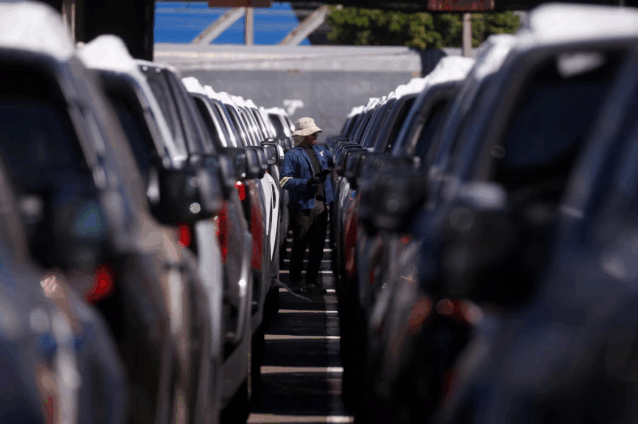
South African car exports to the United States dropped sharply in the first quarter of 2025, and tumbled more than 80% in April and May after import tariffs imposed by U.S. President Donald Trump hit automakers' sales, industry association Naamsa said.
The United States is South Africa's second-largest trading partner and key destination for vehicles manufactured in the country, which have long benefited from duty-free access under the U.S. African Growth and Opportunity Act (AGOA).
Auto exports to the U.S. sank 73% in the first quarter compared to the same period last year, followed by declines of 80% in April and 85% in May, Naamsa said.
The industry body said the sharp decline would be difficult to recover from in the short term.
"This is not just a trade issue - it's a socio-economic crisis in the making," Naamsa CEO Mikel Mabasa said.
Trump has this month escalated the global trade offensive he launched in April, announcing tariffs on more than a dozen countries, including South Africa, which faces a 30% rate from August 1.
This is separate from the 25% duty imposed on cars in April, which has since May also applied to automotive parts.
Before the July tariff announcement from Trump, South Africa had proposed a trade package including a duty-free quota of 40,000 vehicles per year to be exported from South Africa and duty-free access for automotive components sourced locally for U.S. production.
In 2024, South Africa's automotive sector accounted for 64% of all AGOA trade with the U.S., generating 28.6 billion rand ($1.60 billion) in export revenue, Naamsa said.
Mabasa said the tariffs threaten thousands of jobs and risk economic devastation in communities reliant on the sector, such as East London, a coastal city where the auto industry is central to the economy.
"If we cannot retain export markets like the U.S., we risk turning vibrant industrial hubs into ghost towns," Mabasa said, warning of ripple effects across the automotive supply chain, from component manufacturers to logistics providers.
Export diversification is critical but cannot happen overnight, Mabasa added, noting that global competitors are already redirecting their exports into markets traditionally served by South Africa.
This mounting pressure will force South Africa-based automakers exporting to U.S., including Mercedes-Benz, to absorb rising costs, scale back production, and reconsider future investments, Mabasa said.
Latest Stories
-
Anti-LGBTQ Bill: NDC’s arrogance is worrying – Hassan Tampuli
4 minutes -
Let’s give OSP time to mature, not to scrap it – Hassan Tampuli
8 minutes -
Nigeria convicts 386 Islamist militants in mass trials
13 minutes -
Djibouti president wins election with 97.8% of vote, state media says
18 minutes -
We don’t have mandate to deduct tax from rent allowance of security services personnel – Interior Ministry clarifies
32 minutes -
Ablakwa receives Presidential Special Envoy on Reparations to advance global agenda
50 minutes -
Christina Koch becomes first woman to travel around the moon on Artemis II
1 hour -
Epstein survivors’ calls to meet King Charles and Queen harder to ignore as US visit approaches
1 hour -
UN Secretary-General names Ghana’s Anita Kiki Gbeho as South Sudan envoy
1 hour -
Mali withdraws recognition of Sahrawi Republic, backs Morocco’s autonomy plan
1 hour -
Gov’t distributes over 8,500 laptops to One Million Coders project
1 hour -
Julius Debrah, ‘man to beat’ as NDC’s James Agbey dismisses Musah Dankwah’s polls
1 hour -
GPRTU in Savannah Region to protest alleged eviction in Damongo
2 hours -
Re: Reinsurance does not replace process — A response to the SIGA–SIC defence
2 hours -
Gender Ministry supports Harriet Amuzu in ongoing abuse case
2 hours