

Audio By Carbonatix
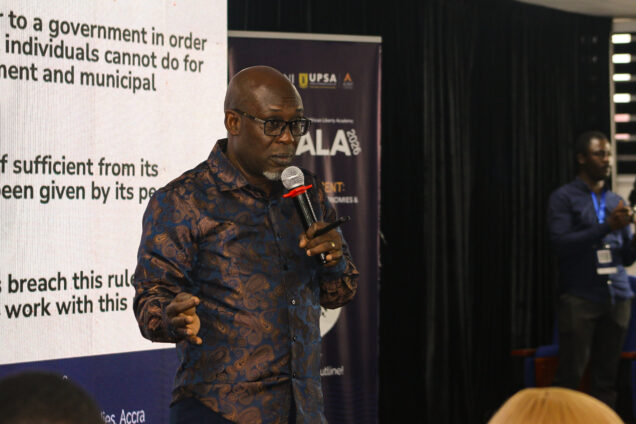
Lawyer and Vice President of IMANI Africa, Kofi Bentil, has called for stronger limits on government power, arguing that public authorities derive their authority from citizens and must not exceed the powers entrusted to them.
He said the purpose of government was to perform functions that individuals could not effectively undertake on their own, but warned that the concentration of unchecked power could lead to abuse and oppression.
Mr Bentil was speaking on Tuesday, August 25, at the Students and Young Professionals African Liberty Academy (SYPALA) 2026, organised by the IMANI Centre for Policy and Education in partnership with the University of Professional Studies, Accra (UPSA).
He said the principles of limited government, rule of law, property rights and fundamental freedoms were essential to understanding how societies should be governed.
Explaining the concept of limited government, Mr Bentil said citizens collectively establish governments and give them authority to perform specific functions on their behalf.
“We the citizens, the people in a nation, set up a government for themselves. In order for that government to do for them what they cannot do for themselves,” he said.
He said that arrangement required clear limits on the powers given to government.
“And when we say limited government, what we mean is, government should be limited only to those things,” he said.
Mr Bentil cautioned that history had repeatedly shown the dangers of giving individuals or institutions unchecked authority.
“Human beings, 100% of them, including you, including me, and you, across history, since we leave the caves, all the rich cities, have shown that anytime anybody is given unchecked power, they are abused,” he said.
He said the problem was particularly serious because the authority given to public officials for legitimate purposes could also be used to infringe on citizens' rights if it was not properly checked.
“By virtue of empowering that person, you also give him power to abuse you. If you don't check him,” he said.
Mr Bentil said citizens should therefore remain conscious of the fact that political authority ultimately belonged to them.
“You have to appreciate that power is owned by the people. The people donate part of that power to that government. Only to perform limited duties to the individuals other than themselves,” he said.
He warned that governments should not become independent of the citizens whose authority they exercised.
“No government has the right to be self-sufficient from its people. Or to exceed the authority it has been given by its people. If allowed, that leads to oppression,” he said.
Mr Bentil also urged citizens to judge governments by their actions rather than their official descriptions or names.
“What you need to understand is to see things for what they are, not what they are called,” he said.
He used North Korea as an example, pointing to the country's official name as evidence that the description of a political system does not necessarily correspond with how it operates in practice.
“What a government is called. What a nation is called. What a political system is called. Has little to do with what it actually is,” he said.
Mr Bentil said citizens must therefore pay attention to how political institutions actually function and whether they respect the limits placed on governmental authority.
He also advised participants at the academy not to reject institutions simply because they were imperfect, arguing that existing systems that were capable of delivering essential outcomes should be strengthened while efforts were made to improve them.
“When you have something that is very good, or is good enough, hold on to it. Don't say because it's not perfect, you are not going to hold on to it and give it a go after 10 years. You may not get 10 years. Most things in the world are not perfect,” he said.
Latest Stories
-
Second edition of Prince Amoako Jr giveback project scheduled for December
14 seconds -
Muntaka commissions polyclinic at Ayigya Zongo to address healthcare challenges
8 minutes -
World Habitat Day: Adequate housing for all – a right we must build
9 minutes -
Ghana Institute of Architects urges government to adopt coordinated agenda for affordable housing
10 minutes -
Yutong bus extensively damaged by fire at Gbogdaa
10 minutes -
Spanish PM Sánchez calls early election after housing protests
16 minutes -
GH¢3,000 monthly allowances for Paramount Chiefs and Queen Mothers fully paid – Ayariga
16 minutes -
Government disbursed over GH¢5bn to MMDAs in 2025- Ayariga
16 minutes -
Teachers’ strike: Abosamso queenmother, assemblyman take over classroom
20 minutes -
GPL 2026/27: Tanko, Agyemang shortlisted for September Coach of the Month award
25 minutes -
Mahama directs creation of Local Government TV – Ayariga
26 minutes -
GPL 2026/27: Amankona, Gyamfi Junior and four others nominated for September Player of the Month award
31 minutes -
Government to remodel 24-hour markets, rename project District Model Markets – Ayariga
34 minutes -
June 29 floods exposed weaknesses in Ghana’s environmental sanitation system – Ayariga
40 minutes -
Local Gov’t Minister announces plans to regenerate Agbogbloshie enclave
45 minutes