

Audio By Carbonatix
Ghana’s political stage has never lacked drama or intrigue, but it becomes downright riveting when siblings choose to set up camp on opposing sides—or, at times, unite under one banner to amass influence. The Ahwoi, Marfo, Woyome, and Jinapor families illustrate how political fortunes can be a family affair. With a blend of adept manoeuvring, generational loyalty, and the occasional public spat, these “happy and lucky” brothers have turned blood ties into a strategic advantage, ensuring that someone in the clan always has a seat at the table—no matter which party reigns supreme.
Few sibling groups command as much respect (and at times, wariness) as the Ahwoi brothers. They are, in many ways, the original blueprint for political fraternities in the Fourth Republic. Rising to prominence during the era of Jerry John Rawlings, they played substantial roles in the PNDC and subsequently the National Democratic Congress (NDC).
From governance advisory to grassroots politicking, they brought an enviable mix of strategic thinking and institutional memory to the table. Their staying power, despite multiple shifts in political winds, proves that while parties may come and go, smart networking and policy acumen can grant near-immortality in Ghanaian politics. Each brother carved out his own niche—some in academia, some in bureaucratic corridors—yet collectively bolstered the family brand. It is a master class in how to turn sibling synergy into enduring political capital.
If the Ahwois exemplify siblings uniting under a single umbrella, the Marfos prove that straddling political divides can be just as lucrative—perhaps even more so. Adjei Marfo is often associated with the Provisional National Defence Council (PNDC) and, by extension, the NDC after Ghana’s transition to multiparty democracy. Though he may not have hogged the spotlight, his PNDC-era connections and quiet counsel kept him relevant long after the country adopted constitutional rule.
Meanwhile, Yaw Osafo-Maafo rose to national prominence on the other side of the aisle. A distinguished engineer from Kwame Nkrumah University of Science and Technology (KNUST), he utilized his technocratic prowess to excel under President Kufuor, serving as Minister of Finance from 2001 to 2005, and later as Senior Minister under President Nana Akufo-Addo from 2017 to 2021.
His legacy as a champion of fiscal reforms and a results-oriented leader secured him a front-row seat in the New Patriotic Party (NPP). Despite being at ideological loggerheads, the two brothers share a thread of mutual benefit, ensuring that when one party stumbles, the other might rise—and the Marfo name remains firmly embedded in Ghanaian political life.
No conversation about influential families in Ghana would be complete without mentioning the Woyomes. Their story weaves through high-profile financial and legal sagas, proving that controversy can sometimes amplify a family’s enduring influence. Media coverage, courtroom drama, and financial entanglements have kept the Woyome name on front pages, but they have shown resourceful resilience by never fully vanishing under legal scrutiny.
Through alliances, well-timed philanthropic gestures, and a knack for behind-the-scenes negotiation, they continue to preserve and even enhance their standing. They provide a compelling lesson in the art of political survival, illustrating that with the right connections and strategic manoeuvring, it is possible to stay afloat long after many would have predicted total downfall.
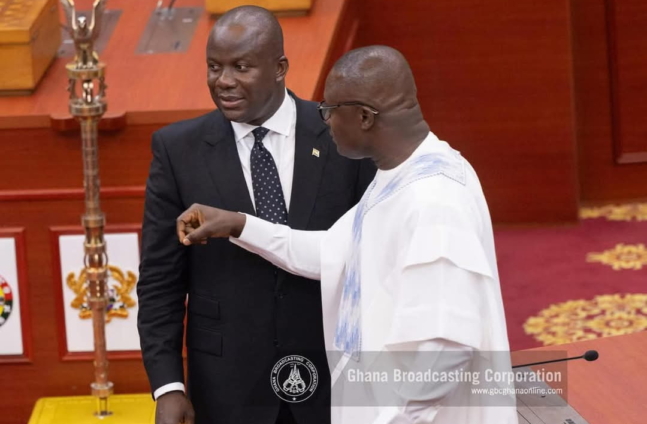
The Jinapor brothers offer a more amiable example of siblings on opposite political benches, embodying a kind of cross-party détente rarely seen in heated Ghanaian politics. One is firmly anchored in the NDC, the other in the NPP, yet they openly celebrate each other’s successes.
This genial dynamic keeps the family name untarnished by partisan warfare and secures their long-term relevance. If the NDC loses ground, the NPP takes charge, ensuring that at least one Jinapor remains in a position of influence—and the family collectively reaps the benefits.
What unites the Ahwois, Marfos, Woyomes, and Jinapors is a deeper recognition that politics in Ghana is not merely about party lines, but about relationships, legacy, and strategic positioning.
Whether siblings unite under one party or hedge their bets across party aisles, the aim remains the same: safeguard and advance the family’s collective interests. By maintaining a presence in multiple camps, they minimize the risk of being politically sidelined. Their diverse skill sets—ranging from finance and legal expertise to grassroots mobilization—make them indispensable to current and future power players alike. Consistent reinvention and adaptation to shifting landscapes have turned longevity into an art form for these families.
Ghana’s political sphere is as complex as it is captivating, and few narratives illustrate its intricacies better than these siblings who navigate that space together or apart. Whether standing shoulder to shoulder or operating from rival party headquarters, these “happy and lucky” brothers show that blood ties can transcend even the fiercest ideological battles. In a system where alliances can make or break careers, having a brother on the other side might just be the shrewdest insurance policy of all.
Latest Stories
-
He entered at eight. He is now 16: Ghana’s children growing up in prayer camps
42 minutes -
‘Development must not always begin from Accra’ — Anwelle Foundation launched in Jirapa
44 minutes -
PKO trio eye victories at Odwira Festival
3 hours -
346 Ghana Navy recruits pass out after 26 weeks of intensive training
3 hours -
Newsfile to discuss EOCO-MP arrest, drug trafficking, speech arrests and $235m water debt
4 hours -
JoyNews gets results as listeners raise GH¢40,000 to help 17-year-old student with cerebral palsy attend SHS
4 hours -
Vice President calls for stronger local pharmaceutical production to reduce medicine imports
5 hours -
The brewing tension at KNUST; Beware the Ides of October….
5 hours -
Health Ministry moves to integrate traditional medicine into mainstream healthcare
5 hours -
550 pupils in Kintampo South get educational lifeline as ‘Seeds of Hope’ reaches farming communities
6 hours -
Opoku Mensah urges Christian Council, House of Chiefs to speak up on democratic freedoms
6 hours -
Teacher unions’ strike: Minority demands immediate payment of teacher arrears, 20% deprived area allowance
6 hours -
The Accra-Kumasi Expressway: Building it right
6 hours -
Beyond gold exports: Building value and economic resilience from Ghana’s gold
6 hours -
2027 AFCONQ: Ghana under pressure as Gambia beat Somalia 2-1
7 hours