

Audio By Carbonatix
Minister for Transport Joseph Bukari Nikpe has outlined a series of interventions and reforms undertaken in the rail, maritime, aviation, and road transport sectors to improve connectivity, safety, and support Ghana’s economic transformation.
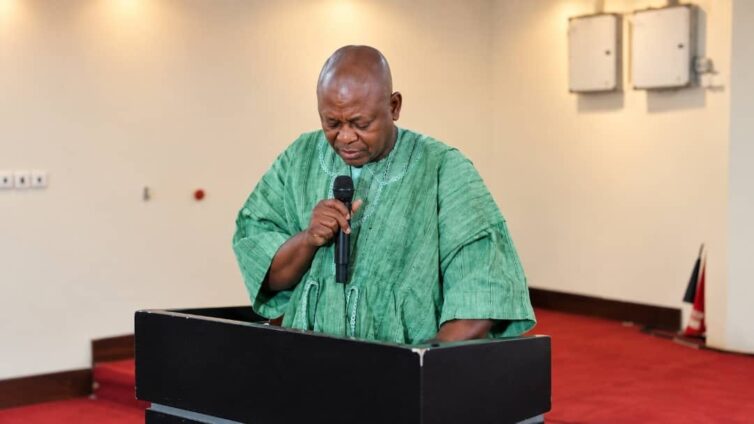
Speaking at the opening of the 2026 Transport Sector Review Conference in Ho on Wednesday, Mr Nikpe said the completion of the 97-kilometre Tema-Mpakadan standard-gauge railway line had enabled passenger services between Tema and Afienya, integrated with Ayalolo bus services to provide first- and last-mile connectivity.
He said the Ghana Railway Development Authority was taking steps to commence freight operations on the line, with two diesel locomotives and 20 wagons procured for the purpose.
He said final preparations, including the development of a port facility at the lakefront to facilitate the transfer of cargo from rail to the Volta Lake, were expected to be completed to enable seamless freight operations.
On the Western Line, Mr Nikpe said work on the Takoradi Port-Huni Valley section, which stalled in 2024, resumed in August 2025 and was expected to facilitate the haulage of mineral ore to the Takoradi Port upon completion.
In the maritime and inland waterways sector, the minister said the ministry had implemented strategic initiatives to address capacity constraints, modernise port infrastructure, and position Ghana as a leading oil and gas services hub in West Africa.
He said the first phase of the Takoradi Multi-Purpose Terminal had been completed, providing modern waterfront facilities for handling containerised and conventional cargo, while an Oil and Gas Service Terminal had also been completed to provide shore logistics support for offshore oil and gas exploration activities.
Mr Nikpe said a new liquid bulk terminal had also been completed, with capacity to accommodate vessels carrying up to 60,000 tonnes of petroleum cargo, including diesel, LPG, bitumen, and other heavy fuels.
At Tema Port, he said the retooling of MPS Terminal 3 with 11 ship-to-shore cranes, two mobile harbour cranes and 29 other cranes had significantly increased the port’s capacity to receive and service larger container vessels.
He said work was ongoing on the Keta Port Project, which was expected to become Ghana’s third seaport and serve as a catalyst for a maritime industrial enclave in the Volta Region, with opportunities in aquaculture, marinas, and oil and gas services.
Mr Nikpe said Phase One of the Boankra Integrated Logistics Terminal, aimed at facilitating transit trade and helping to decongest the Port of Tema, was about 82 per cent complete.
He added that the Ministry had also constructed 12 fish landing sites, or mini-ports, as part of efforts to modernise the artisanal fishing industry and provide safer landing facilities and more hygienic environments for fish handling.
On aviation, Mr Nikpe said Ghana had strengthened safety and security standards through collaboration between the Ghana Civil Aviation Authority and local and international partners, placing the country among the top-performing countries in Sub-Saharan Africa in aviation security performance and oversight capability.
He said the upgrades of Tamale Airport and the expansion of Kumasi Airport into an international airport had been completed, improving the movement of people and goods while creating opportunities for tourism and economic growth.
He said the entry of new international airlines, including IBOM Air, ITA Airways, British Airways operating from Gatwick to Accra and Kenya Airways, had increased passenger choices and strengthened Ghana’s international connectivity.
Mr Nikpe said Kenya Airways had also expanded its operations with a twice-weekly Nairobi-Accra-Senegal-Accra-Nairobi service.
He said the Ministry had negotiated and signed Bilateral Air Services Agreements with Luxembourg, Qatar, Seychelles and Saudi Arabia, while negotiations had been concluded with several other countries to further liberalise Ghana’s airspace.
The Minister said the passage of the Ghana Civil Aviation Act, 2024 (Act 1120), had further strengthened the country’s compliance with the Chicago Convention and the Standards and Recommended Practices of the International Civil Aviation Organisation.
He said the introduction of the Advance Passenger Information/Passenger Name Record (API/PNR) system was also a major step towards improving safety and security at Ghana’s airports.
Mr Nikpe added that a 10-member task force had been constituted to guide the establishment of a new national air carrier, with the expectation that it would soon complete its work towards operationalisation.
In the road transport sector, the minister said the government had undertaken policy and regulatory reforms aimed at improving service delivery, road safety and sustainability.
He said the National Road Safety Authority Regulations, 2022 (L.I. 2468), provided the legal framework for the effective implementation of the National Road Safety Authority Act, 2019 (Act 993).
He said the Road Traffic (Amendment) Act, 2025, and the Road Traffic Regulations, 2026 (L.I. 2519), approved by Parliament on May 28, 2026, provided a regulatory framework for the operation of motorcycles and tricycles across the country.
Mr Nikpe said the digitisation and automation of Driver and Vehicle Licensing Authority services, including vehicle registration and driver licensing, had transformed the institution and improved customer service.
He said the Ministry had also procured 100 new intercity buses for Metro Mass Transit Limited to augment its operations and support the government's objective of providing affordable, reliable, and efficient mass public transport.
Despite the progress, Mr Nikpe said the transport sector continued to face significant challenges, particularly road safety.
He said railway development also faced challenges, including financing constraints that resulted in the suspension of work on the Western Line in December 2024 before partial resumption in August 2025.
Mr Nikpe further expressed concern about illegal mining activities damaging sections of railway track formations, which required costly re-engineering instead of routine maintenance.
He said vessel turnaround time at the Port of Tema had deteriorated from 72.66 hours in 2023 to 130 hours in 2025 as cargo volumes increased, warning that efficiency gains must keep pace with growth.
He also identified land encroachment and obsolete communication, navigation, and surveillance equipment as challenges requiring urgent attention.
Mr Nikpe said the realignment of the transport sector provided an opportunity for the government to plan and deliver infrastructure as one interconnected network, with ports linked efficiently to roads and railways, production centres connected to markets, and inland waterways complementing road transport.
He said such integration was essential to the success of the 24-Hour Economy Policy, because an economy could not operate around the clock if workers, raw materials, and finished goods could not move safely, predictably, and affordably.
“Our task is therefore not simply to build more transport infrastructure. It is to finance and deliver the right infrastructure and services, in the right places, to the right standards, and in a manner that is resilient, sustainable, and responsive to our economic needs,” he said.
Mr Nikpe said if the country succeeded in achieving that objective, transport would not merely support Ghana’s economic transformation but would become one of its principal drivers.
Latest Stories
-
Ghana Medical Trust Fund, Hungary explore partnership to strengthen specialised healthcare
42 seconds -
Manhyia South MP Baffour Awuah pleads not guilty to EOCO charges, granted GH¢10m bail
4 minutes -
NPP conference: We need leaders to complement our efforts in Parliament – Annoh-Dompreh
6 minutes -
Sammy Crabbe steps down from NPP Chairmanship race, backs John Boadu
7 minutes -
NPP postpones constitutional amendments, including proposal on party leadership to next national conference
11 minutes -
NDC ‘running into opposition like Usain Bolt’ – Sammy Awuku
22 minutes -
Local pharma production can create jobs, strengthen Africa’s health security – Mahama
24 minutes -
Mahama calls for removal of barriers to boost Africa’s pharmaceutical industry
29 minutes -
NPP needs ‘war-like’ leaders to take fight to government – Annoh-Dompreh
32 minutes -
Mahama unveils HINGE digital platform to streamline health investment and regulation in Africa
39 minutes -
We won’t return to the classroom without concrete solutions – NAGRAT
45 minutes -
Mahama urges Africa to invest in local pharmaceutical manufacturing
51 minutes -
Akufo-Addo giving Bawumia space to assert himself as NPP leader – Gabby Otchere-Darko
56 minutes -
NPP delegates, not social media, will decide election winners – Miracles Aboagye
1 hour -
I have no interest in this election; I believe Bawumia will win 2028 election – NAPO
1 hour