

Audio By Carbonatix
President John Dramani Mahama has moved to quell public debate surrounding the government’s free primary healthcare programme, firmly clarifying that tricycles distributed to Community-based Health Planning and Services (CHIPS) compounds are not intended to serve as ambulances.
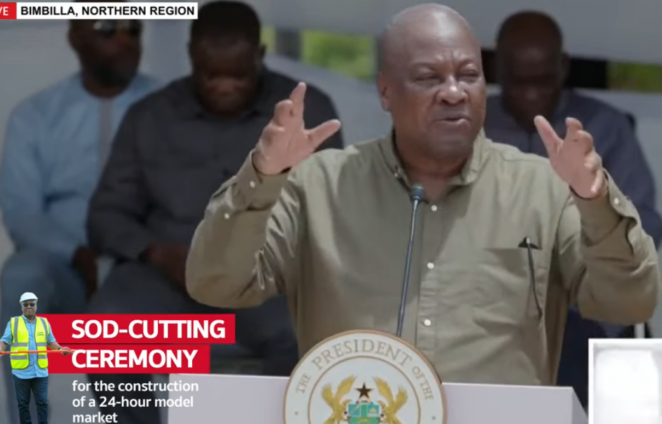
Speaking during the sod-cutting ceremony for a proposed 24-hour economy market in Bimbilla as part of his Northern Region tour, Mr Mahama addressed growing public misconceptions, particularly on social media, about the purpose of the vehicles being deployed under the initiative.
Referring to a recent launch event, he stated: “Two days ago, in Dodowa, I inaugurated the beginning of the free primary health care programme. And we handed over equipment and some vehicles to the CHIPS compounds.”
The initiative, which forms a key pillar of his broader healthcare vision, targets grassroots delivery through over 6,000 CHIPS compounds nationwide.
According to Mr Mahama, the equipment package includes both motorcycles and tricycles, tailored to meet the logistical realities of different regions.
“We demonstrated what each CHIPS compound was going to get. There are more than 6,000 CHIPS compounds in Ghana. And we showed what they were going to get in terms of equipment and all that.”
However, the inclusion of tricycles has sparked criticism, with some commentators suggesting they were being presented as a substitute for ambulances. Mr Mahama rejected such claims.
“Let me be clear. I mean, if you don't understand something, ask. Don't jump to conclusions. Those tricycles are not ambulances.”
He elaborated that the vehicles are designed specifically to support frontline health workers and volunteers in conducting outreach services in remote communities.
“Those tricycles are meant for the health workers and the health volunteers to go from village to village for screening. That is what they are meant for.”
Mr Mahama further explained that the tricycles are equipped with compartments capable of preserving vaccines at appropriate temperatures, enhancing their utility in immunisation drives.
“At the back of the tricycle, they have a compartment where they can keep vaccines, to keep the vaccines cool.”
Distinguishing between operational needs in northern and southern Ghana, he noted differences in mobility preferences and skillsets among healthcare personnel.
“In the north, a lot of our sisters who are health workers can ride motorcycles… In the south, many of the health workers cannot ride a motorcycle. But you need to give them a means of transport to be able to go and do the work you've given them.”
As such, motorcycles will be prioritised for CHIPS compounds in northern regions, while tricycles will be deployed in southern areas where they are more practical.
“So in the southern parts where the health workers cannot ride motorcycles, they'll be given tricycles to go from village to village to do their work.”
He painted a clear picture of how the system is intended to function in the north:
“In the north, where they know how to ride motorcycles, their CHIPS compound will have a motorcycle. Our sister who is the nurse, she'll sit on it, she'll put equipment behind her, ride to the village and go and give them the attention they want.”
Returning to the central point of contention, Mr Mahama reiterated his position with emphasis:
“So let me emphasise again, those tricycles are not ambulances.”
He criticised what he described as attempts to misrepresent the initiative: “I've seen a lot of people try to denigrate them and say that we're going to bring these as ambulances. They are not ambulances.”
Instead, he stressed their critical role in preventative healthcare delivery.
“They are vehicles for the health workers who are engaged in the Primary Healthcare Programme to go to the village, deliver vaccinations, and then also to do health screening, test people's high blood pressure to see if it's high, test their sugar level to see if they are developing diabetes.”
Mr Mahama expressed hope that his clarification would put an end to the controversy.
“And so I hope this will end all that argument and things on social media. Those tricycles, once again, are not ambulances. They are vehicles for the free primary healthcare volunteers to go around and do their work,” he said.
Latest Stories
-
Ghana eyes stronger trade ties as Australia hosts multicultural trade and investment forum
3 minutes -
Margaret-Marie Krakue
6 minutes -
Ayariga announces plans for live broadcast of MMDAs’ meetings on local radio stations
9 minutes -
Mrs Anna Tackie
11 minutes -
Ghana links Afghan heroin and Brazilian cocaine to global drug markets – Global Organised Crime Index
18 minutes -
NHIA launches nationwide inter-school quiz to deepen students’ knowledge of NHIS
25 minutes -
Political protection could be masking Ghana’s cocaine trade – Global Organised Crime Index
29 minutes -
AFCON 2027Q: ‘We have to dissolve the GFA’ – Effia MP after Black Stars lose to Gambia
32 minutes -
NPP announces voting schedule and ID requirements for October 3 national elections
34 minutes -
Lupus can mimic HIV symptoms and damage kidneys if untreated – KNUST expert
36 minutes -
Focus on Sickle Cell Foundation seeks to introduce sickle cell education through comics in Ghanaian schools
42 minutes -
NPP rewrites the campaign playbok as opposition reality shapes National Executive contest
44 minutes -
Road safety education will fail without enforcement – NRSA boss
45 minutes -
Daily Insight for CEOs: Finishing Q3 strong and entering Q4 with purpose
46 minutes -
National Ambulance Service begins ‘Operation Restore Fleet’ to restore grounded ambulances
46 minutes