

Audio By Carbonatix
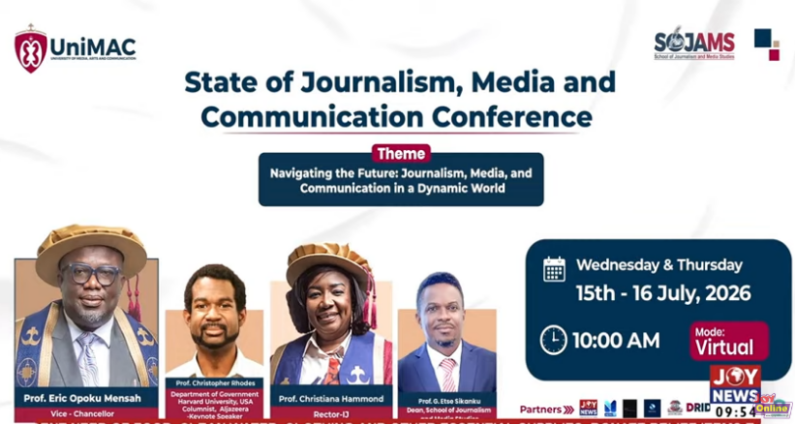
The University of Media, Arts, and Communication (UniMAC) has opened its maiden State of Journalism, Media, and Communication Conference (SJMCC 2026), marking the institution's first major international academic conference since the merger of the Ghana Institute of Journalism (GIJ), the National Film and Television Institute (NAFTI), and the Ghana Institute of Languages (GIL).
The two-day virtual conference, which began on Wednesday, July 15, is being held on the theme "Navigating the Future of Journalism, Media, and Communication in a Dynamic World."
The conference brings together academics, researchers, media practitioners, and communication experts from across the world to deliberate on the rapidly evolving media landscape and the future of journalism in the digital age.
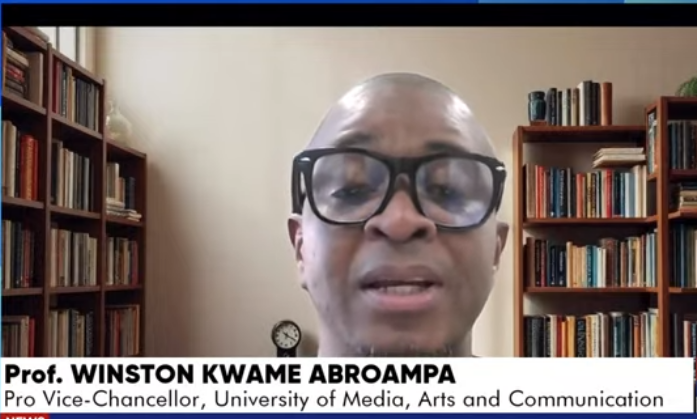
Delivering the welcome address on behalf of the Vice-Chancellor of UniMAC, Prof Eric Opoku, the Pro Vice-Chancellor, Prof Winston Kwame Abroampa, described the conference as the beginning of what he believes will become one of the world's leading academic gatherings on journalism and communication.
"I therefore solemnly believe that years from now, we shall look back on this gathering as one that began a new chapter in UniMAC's scholarly journey... One that grows into enduring research collaborations, influential publications, informed public policy, and stronger partnerships across Ghana, Africa, and the wider international community."
He added that he was confident the conference would establish itself as a globally recognised platform for scholarly engagement.
"In years to come, SJMCC will stand among the world's important conferences on journalism and communication. It is a platform for reflection, dialogue, collaboration, and most importantly, solutions."
Prof Abroampa said the conference would examine a broad range of issues shaping contemporary journalism and communication, including artificial intelligence, technology and democracy, fact-checking, media ownership, journalism education, investigative reporting, science and environmental journalism, strategic communication, gender in the media, development communication, and wider issues relating to media and society.
According to him, although these topics may appear distinct, they are deeply interconnected and ultimately point to one critical concern.
"Ultimately, ladies and gentlemen, they converge on one central question. How do we build media systems that genuinely serve the public interest? This conference offers an excellent opportunity and platform to explore these questions."
He stressed that safeguarding the integrity of the information ecosystem requires collective action from journalists, universities, governments, and technology companies.
The Pro Vice-Chancellor also encouraged participants to use the conference as an opportunity to build lasting research collaborations rather than simply present academic papers.
"Knowledge achieves its greatest value when it improves society. And I'm confident these discussions will generate ideas capable of influencing policy, strengthening professional practice, and enriching scholarship."
Prof Abroampa commended the Dean of the School of Media Arts and Communication, the School of Journalism and Media Studies, the conference planning committee, faculty, staff, students, and volunteers for successfully organising the inaugural event.
He also expressed appreciation to keynote speaker Prof Christopher Rhodes, plenary presenters, moderators, reviewers, and participants for contributing to what he described as a landmark conference in UniMAC's academic journey.
The two-day programme features keynote presentations, plenary sessions, roundtable discussions, and research panel sessions focused on addressing emerging challenges and opportunities within journalism, media, and communication.
Latest Stories
-
GES to submit more data to CAGD to process outstanding teacher promotion arrears – Education ministry
7 minutes -
I wish to experience childbirth; I’m jealous of women – Okyeame Kwame
18 minutes -
Manhyia South constituents demand apology from EOCO over attempt to ‘unlawfully’ arrest MP
22 minutes -
Twelve women have been killed in one part of South Africa since July. Here’s what we know so far
25 minutes -
OMJ Foundation commits to supporting transport, safety and livelihoods of commercial riders in Akuapem South
27 minutes -
The Reciprocity crisis: Why Ghana welcomes British Professionals while the UK relegates ours
28 minutes -
GNAT rejects gov’t fresh assurances, demands implementation of August 31 agreement
38 minutes -
Gabriel Tanko Kwamigah-Atokple appointed Patron of NDC UK and Ireland Aldershot Branch
43 minutes -
Bawumia engages Ghana Medical Association on health workforce and licensing concerns
46 minutes -
SEC shuts down Nyak-City Hostels over unlicensed investment scheme
48 minutes -
The Ladder Project engages 60 UPSA student leaders on leadership and Ghana’s next chapter
49 minutes -
National Investment Quiz: St. Augustine’s, Prempeh College advance to semi-finals
54 minutes -
Leadership is about responsibility, not titles – Sammi Awuku tells UPSA students
56 minutes -
National Investment Quiz: Corpus Christi, Wesley Girls, advance to semi-finals
1 hour -
Phone dealer murder: 3 suspects remanded as court adjourns Teshie case
1 hour