

Audio By Carbonatix
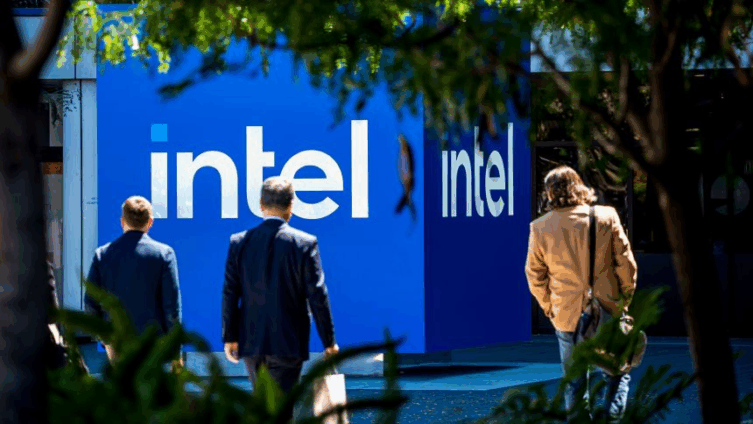
The White House confirmed on Tuesday that the Trump administration is working on a deal that could see the US government taking a 10% stake in chip giant Intel.
"The president wants to put America's needs first, both from a national security and economic perspective," White House press secretary Karoline Leavitt told reporters.
The potential deal could involve swapping government grants for Intel shares, according to US Commerce Secretary Howard Lutnick.
The highly unusual move could help Intel as it struggles to compete with rivals like Nvidia, Samsung and TSMC, particularly in the booming artificial intelligence (AI) chip market. Intel has been contacted by the BBC for comment.
The US wants a stake Intel in exchange for grants approved during the Biden administration, Lutnick said on CNBC on Tuesday.
"We should get an equity stake for our money," he added. "We'll get equity in return for that... instead of just giving grants away."
The potential deal, which was first reported last week, aims to help Intel build a flagship manufacturing hub in the US state of Ohio. At the time, a White House spokesman told the BBC that the reports "should be regarded as speculation" unless officially announced.
Last week, Intel did not comment directly about reports but said it was "deeply committed to supporting President Trump's efforts" to strengthen manufacturing and technology in the US.
On Monday, Japanese investment giant Softbank said it would buy a $2bn (£1.5bn) stake in Intel, in a move that some analysts said is a sign of confidence in the firm's turnaround.
After that announcement,the firm's shares rose by almost 7% in New York on Tuesday.
Intel is one of the few US companies capable of producing high-end semiconductors at scale but the company has fallen behind global rivals.
The government potentially taking a stake in Intel reflects the firm's "unique position" as America's main producer of high-end chips domestically, said Dan Sheehan from Telos Wealth Advisors.
But political involvement could slow down decision making and shift priorities, adding challenges to an already tough turnaround for Intel, said Mr Sheehan.
Some other experts have expressed concerns over the potential deal and whether companies may be pressured to follow political agendas.
The developments came as the US chip industry is under intense scrutiny by the White House.
Last week, Nvidia and AMD agreed to pay the US government 15% of their Chinese revenues as part of an unprecedented deal to secure export licences to China.
Latest Stories
-
Old students of Peki SHS break ground to give 70-year-old school infrastructure a facelift
14 minutes -
Ablakwa facing ‘personal vendetta’ over refusal to grant Nana B service passport – Majority
15 minutes -
Every year, the lawyers come out, and so does the nonsense! – Ace Ankomah writes
27 minutes -
Digital transformation without an ownership culture can digitise poor service
30 minutes -
Fishing communities demand revocation of offshore gold exploration licences over livelihood concerns
33 minutes -
How Ghanaian tycoon Manoj Lakhiani built a water and plastics empire from a $25,000 loan
35 minutes -
GoldBod recovers GH¢38.7m of GH¢55.8m outstanding receivables; remainder subject to legal action – Sammy Gyamfi
42 minutes -
GEXIM Bank donates GH¢200,000 worth of medical equipment to Korle-Bu Child Health Department
45 minutes -
Majority rejects Minority’s claims over GH¢49.7m South Africa evacuation
46 minutes -
GEXIM urges banks to support refurbishment of Korle-Bu Teaching Hospital’s Child Health Department
50 minutes -
Don’t appoint your cheerleader as referee
54 minutes -
Ghana needs stronger international cooperation to fight cybercrime – CSA
56 minutes -
CSA warns of growing cyber threats as Ghana’s digital dependence increases
1 hour -
USTED dean warns GAUA strike could disrupt Ghana’s restored academic calendar
1 hour -
Bechem meat processing factory 50% complete, set for March 2027 completion – Kwakye Ofosu
1 hour