


Audio By Carbonatix
The Vatican is to open its archives on the wartime papacy of Pius XII, kept secret for decades amid accusations that he turned a blind eye to the Holocaust.
Critics say Pius XII, sometimes labelled "Hitler's Pope", knew Nazi Germany was murdering Jews but failed to act. He reigned from 1939 to 1958.
But the Vatican says Pius XII worked behind the scenes to save Jews.
Dozens of scholars are preparing to pore over the many documents.
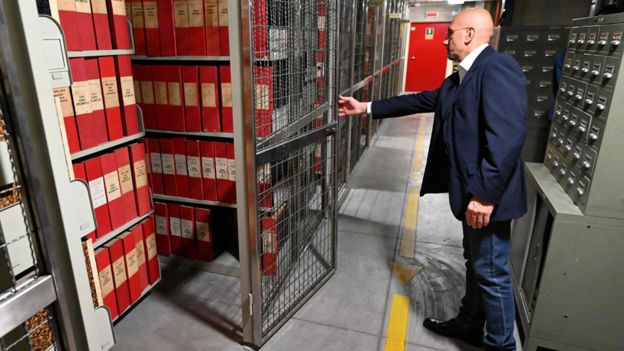 Journalists were shown a section of the Pius XII archive last week
Pope Francis took the decision a year ago to open up the archives on one of the Roman Catholic Church's most controversial figures.
"The Church is not afraid of history," the Pope told Vatican researchers.
Pope Francis said the Pius XII papacy was marked by "moments of grave difficulties, tormented decisions of human and Christian prudence, that to some could appear as reticence".
Bishop Sergio Pagano, prefect of the Vatican's Apostolic Archives, said the World War Two documents ran into millions of pages, divided into 121 sections according to topic.
All the space in the consulting area has been booked for the rest of the year, said Bishop Pagano, quoted by Reuters news agency. The scholars include some from the Holocaust Memorial Museum in Washington DC and award-winning German historian Hubert Wolf, a specialist on the Pius XII pontificate.
The BBC's Mark Lowen in Rome reports that the controversy over this papacy is thought to have halted his elevation to sainthood.
"There is no doubt that the pope was aware of the murder of Jews," said Hubert Wolf, quoted by AFP news agency.
Journalists were shown a section of the Pius XII archive last week
Pope Francis took the decision a year ago to open up the archives on one of the Roman Catholic Church's most controversial figures.
"The Church is not afraid of history," the Pope told Vatican researchers.
Pope Francis said the Pius XII papacy was marked by "moments of grave difficulties, tormented decisions of human and Christian prudence, that to some could appear as reticence".
Bishop Sergio Pagano, prefect of the Vatican's Apostolic Archives, said the World War Two documents ran into millions of pages, divided into 121 sections according to topic.
All the space in the consulting area has been booked for the rest of the year, said Bishop Pagano, quoted by Reuters news agency. The scholars include some from the Holocaust Memorial Museum in Washington DC and award-winning German historian Hubert Wolf, a specialist on the Pius XII pontificate.
The BBC's Mark Lowen in Rome reports that the controversy over this papacy is thought to have halted his elevation to sainthood.
"There is no doubt that the pope was aware of the murder of Jews," said Hubert Wolf, quoted by AFP news agency.
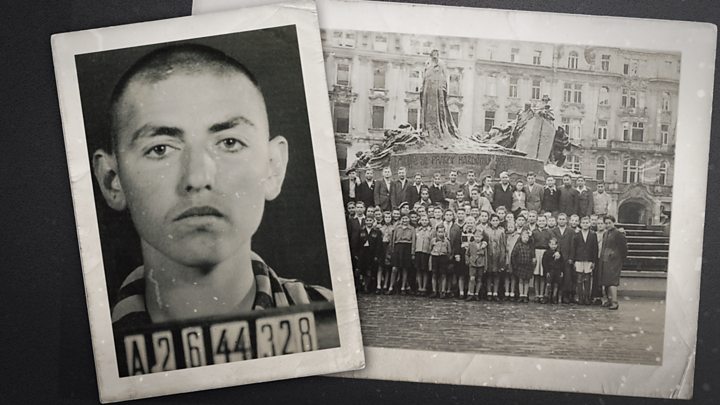 Holocaust survivors: The families who weren’t meant to live
In the 1920s the then Cardinal Eugenio Pacelli had witnessed the rise of Nazism as Holy See ambassador in Germany, before returning to the Vatican and becoming pope.
There are Jesuit documents sent to the pope which informed him about Nazi concentration camps, but historians have not yet seen any of his replies.
Holocaust survivors: The families who weren’t meant to live
In the 1920s the then Cardinal Eugenio Pacelli had witnessed the rise of Nazism as Holy See ambassador in Germany, before returning to the Vatican and becoming pope.
There are Jesuit documents sent to the pope which informed him about Nazi concentration camps, but historians have not yet seen any of his replies.
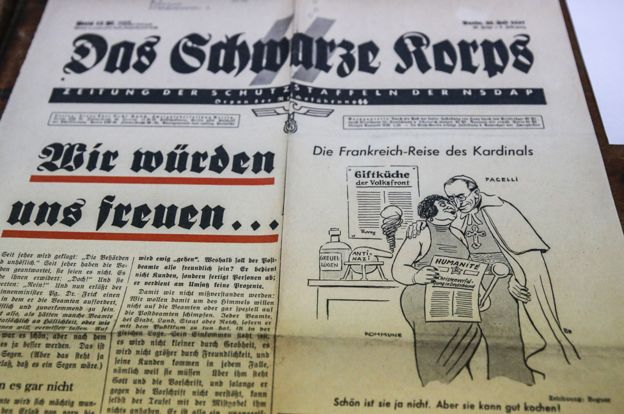 A Nazi SS cartoon in 1937 lampoons Cardinal Pacelli - shown embracing a communist woman
Mr Wolf says he is also keen to see any letters the pope received from his ambassadors during the war.
In addition, historians still have many questions about the notorious "ratline" - an escape route facilitated by some Catholic clergy who helped Nazi war criminals flee to South America after the war.
A Nazi SS cartoon in 1937 lampoons Cardinal Pacelli - shown embracing a communist woman
Mr Wolf says he is also keen to see any letters the pope received from his ambassadors during the war.
In addition, historians still have many questions about the notorious "ratline" - an escape route facilitated by some Catholic clergy who helped Nazi war criminals flee to South America after the war.
Journalists were shown a section of the Pius XII archive last week
Pope Francis took the decision a year ago to open up the archives on one of the Roman Catholic Church's most controversial figures.
"The Church is not afraid of history," the Pope told Vatican researchers.
Pope Francis said the Pius XII papacy was marked by "moments of grave difficulties, tormented decisions of human and Christian prudence, that to some could appear as reticence".
Bishop Sergio Pagano, prefect of the Vatican's Apostolic Archives, said the World War Two documents ran into millions of pages, divided into 121 sections according to topic.
All the space in the consulting area has been booked for the rest of the year, said Bishop Pagano, quoted by Reuters news agency. The scholars include some from the Holocaust Memorial Museum in Washington DC and award-winning German historian Hubert Wolf, a specialist on the Pius XII pontificate.
The BBC's Mark Lowen in Rome reports that the controversy over this papacy is thought to have halted his elevation to sainthood.
"There is no doubt that the pope was aware of the murder of Jews," said Hubert Wolf, quoted by AFP news agency.
Holocaust survivors: The families who weren’t meant to live
In the 1920s the then Cardinal Eugenio Pacelli had witnessed the rise of Nazism as Holy See ambassador in Germany, before returning to the Vatican and becoming pope.
There are Jesuit documents sent to the pope which informed him about Nazi concentration camps, but historians have not yet seen any of his replies.
A Nazi SS cartoon in 1937 lampoons Cardinal Pacelli - shown embracing a communist woman
Mr Wolf says he is also keen to see any letters the pope received from his ambassadors during the war.
In addition, historians still have many questions about the notorious "ratline" - an escape route facilitated by some Catholic clergy who helped Nazi war criminals flee to South America after the war.DISCLAIMER: The Views, Comments, Opinions, Contributions and Statements made by Readers and Contributors on this platform do not necessarily represent the views or policy of Multimedia Group Limited.
DISCLAIMER: The Views, Comments, Opinions, Contributions and Statements made by Readers and Contributors on this platform do not necessarily represent the views or policy of Multimedia Group Limited.
Latest Stories
-
Nigeria says domestic gas supply surpasses 2 billion cubic feet per day, eyes further growth
1 hour -
Suspected Islamists kill Nigerian villagers collecting firewood
1 hour -
Kodua dismisses rift fears, says he and John Boadu are focused on NPP victory
2 hours -
Why Canada is preparing for a (long shot) US invasion
2 hours -
Dangote’s planned Kenya refinery faces legal challenge by consumer-rights group
2 hours -
Hawa Koomson stands by pepper spray plan, vows to bring rival on board
3 hours -
‘There is no competition’ – Justin Kodua confident of NPP General Secretary re-election
3 hours -
J100 Accra Doubles Champions : Kolesolva/ Ndukwa, Agarwal/Patel seal title victories
3 hours -
Sydney Wright crowned J100 Accra Champion
3 hours -
J100 Accra Boys’ Singles: Verma denies Beckles back-to-back titles to claim crown
3 hours -
Two friends fined GH¢12,000 for stealing
3 hours -
Son jailed for threatening to stab mother
4 hours -
Drive constitutional reform – GJA urges journalists
4 hours -
NPP Delagates Congress: Confusion delays voting at Ashanti Region TESCON centre
5 hours -
Fire ravages shops, houses near Koforidua Central Police Station
5 hours