

Audio By Carbonatix
When a pregnant woman in Baduli–Sakpe in the Lankani Electoral Area of the Nanumba South District begins to feel contractions, her family’s first thought is not about hospital fees — it’s about the road.
The 10-kilometre stretch linking Baduli–Sakpe and its neighbouring communities to the main Wulensi–Kpandai highway has become a nightmare route that often determines whether a patient lives or dies.

During this year’s rainy season alone, at least 10 tricycles have been involved in accidents along the route, leaving several residents with severe injuries and lifelong scars. Since 2000, the short but treacherous road has been linked to the deaths of more than 10 pregnant women who could not reach hospitals in time at Wulensi, Bimbilla, Yendi, or Tamale.
Once a modest feeder road, the route has now deteriorated into a corridor of pain, dust, and broken dreams. Deep gullies, loose gravel, and eroded surfaces make travel dangerous. Motorbike crashes, pregnancy complications, and lost livelihoods have become part of daily life — yet the road remains neglected despite years of promises.
“We have lost women, pregnancies, and livelihoods on this road. Sometimes, when you’re rushing a sick person to Bimbilla or Wulensi hospital, you pray they survive the journey,”
— Tabor Jacob, Assemblyman for Lankani Electoral Area.
Communal Effort Amid Official Neglect
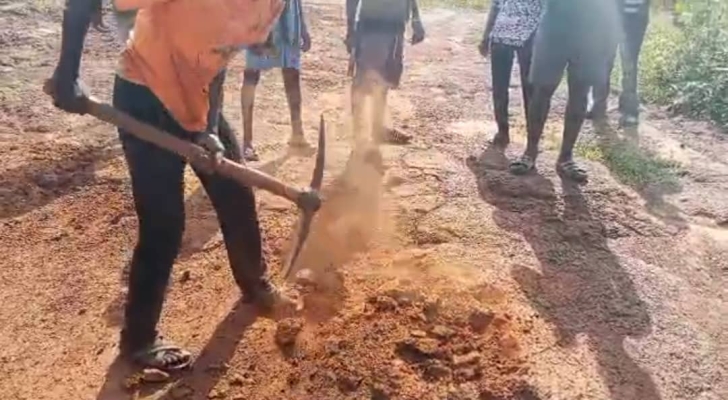
With little to no official support, residents have resorted to communal labour. Armed with pickaxes, shovels, hoes, and wheelbarrows, they dig gravel and fill potholes themselves — a desperate attempt to make the road at least passable.
But their efforts provide only temporary relief. The gravel they dig often leaves deep pits, that worsen erosion and turn muddy during the rains, making the road nearly impassable again.
“We’ve been doing this for years. We fill the holes, and the rains wash everything away again. But what choice do we have?”
— Assemblyman added.
A Road Turned Campaign Tool
For decades, the Baduli road has been a recurring feature in political campaigns within the Wulensi Constituency. Every election season, it symbolizes hope — and later, betrayal.
With a significant voting population, Baduli and its surrounding communities often play a decisive role in determining who becomes a Member of Parliament. Yet, election after election, promises to fix the roads fade as quickly as campaign posters.
“Every MP that comes says the same thing — ‘We’ll fix the Baduli road.’ After elections, they forget us until the next campaign,”
— Wajah Magaln, resident.
Taxpayers’ Investments Left to Rot
Adding to residents’ frustration is the sight of road construction machinery under the government’s District Roads Improvement Programme (DRIP) — a taxpayer-funded initiative to maintain rural roads — rusting away in the open in many assembly yards across the regions.
An opinion leader, Unikpel Blacky Simon Liyir, questioned why such expensive equipment remains unused while communities like Baduli–Sakpe continue to suffer.
“The government brought these machines for a reason, but they are wasting away in the assembly yard. Are Baduli and the Konkombas here not Ghanaians? Do we not deserve our share of development?”
— Mr. Simon, asked.
He called on the Nanumba South District Assembly, the Member of Parliament, and the Ministry of Roads and Highways to ensure equitable distribution of resources, warning that the continuous neglect of Konkomba communities only deepens mistrust and widens the development gap.
Women Bearing the Heaviest Burden
Women — particularly expectant mothers — bear the brunt of the road’s deplorable state. Travelling to health facilities in Wulensi or Bimbilla for antenatal care or emergencies on tricycles and motorbikes has led to several miscarriages and birth complications, residents say.
“I lost my pregnancy because of this road,” one young mother recounted. “The shaking and pain on the tricycle to navigate through the stones were too much. Before we got to the hospital, I had lost the baby.”
The poor road also affects education, trade, and agriculture. Farmers struggle to transport their produce, leading to post-harvest losses, while traders spend more on tricycle or motorbike repairs, eating into their already meagre profits.
“When it rains, no one can go to market or even school. The road becomes like a river,” another resident said, pointing to an eroded section.
A Broader Development Challenge
The situation in Baduli–Sakpe mirrors the broader rural infrastructure crisis across Ghana. Data from the Ghana Statistical Service (GSS) indicates that over 60 per cent of the country’s feeder roads are in poor condition — a reality that continues to hinder access to education, healthcare, and markets in rural and peri-urban communities.
Despite millions of cedis invested annually in road maintenance and equipment, progress remains painfully slow. Analysts blame weak monitoring systems, inadequate funding, and poor accountability.
“Feeder roads are lifelines for rural communities. Neglecting them is not just a transport issue — it’s a public health and development crisis,”
— a development expert noted.
A Call for Accountability and Action
Residents of Baduli and neighbouring communities are calling on the government, through the Nanumba South District Assembly and the Ministry of Roads and Highways, to urgently rehabilitate the road and deploy the idle DRIP machinery in their area.
They insist that feeder roads — the arteries of rural life — must not be reduced to campaign rhetoric but treated as essential public infrastructure that sustains lives and livelihoods.
Government’s Response
In an interview with Graphic Online, the District Chief Executive (DCE) for Nanumba South, Mr. Abdul Rashid Musah, acknowledged the poor condition of the road and assured residents that rehabilitation work would begin once the rains subside.
He urged residents to remain calm and continue to support the Assembly’s development agenda.
The Road Ahead
Until deliberate steps are taken to deploy government road equipment effectively, prioritise feeder roads and strengthen local accountability, communities like Baduli–Sakpe will continue to pay the price — with their lives, livelihoods and futures.
Latest Stories
-
Asantehene plants trees to commence Jimi Watercourse Rehabilitation destroyed by galamsey
4 minutes -
15 arrested, 6 trucks impounded over sandwinning activities on Kumasi-Accra Expressway
4 minutes -
OFFICIAL: Vinicius will miss El Clásico, suspended four games
7 minutes -
Prayer vigil held after four arson attack murders
14 minutes -
GRA fully recovers $154k legacy debt owed by foreign entities between 2022 and 2024
16 minutes -
Kwesi Pratt Jr warns bus preachers are adding to passengers’ stress with accident prophecies
17 minutes -
MTN Ghana to spend $1.1bn in 3 years, build 500 new sites as MoMo hits 44% Growth
19 minutes -
I have no regrets joining Assemblies of God – Mahama
19 minutes -
Starlink restrictions in Ukraine war linked to political situation, Zelensky aide says
22 minutes -
Furniture boost for Techiman North schools as MP donates to 20 institutions
22 minutes -
Assemblies of God to loan 10,000-seater dome for Ghana@70 celebrations
23 minutes -
Government to audit 2,016 community network sites – Communications Minister
23 minutes -
Heritage Series notes: BoG promises more inclusive cedi with improved sizes, tactile features
40 minutes -
‘We want answers’ – Family seeks probe into 14-year-old’s death 12 days after starting SHS
51 minutes -
No preacher has the right to impose beliefs on bus passengers – Kwesi Pratt Jr backs preaching ban
55 minutes