

Audio By Carbonatix
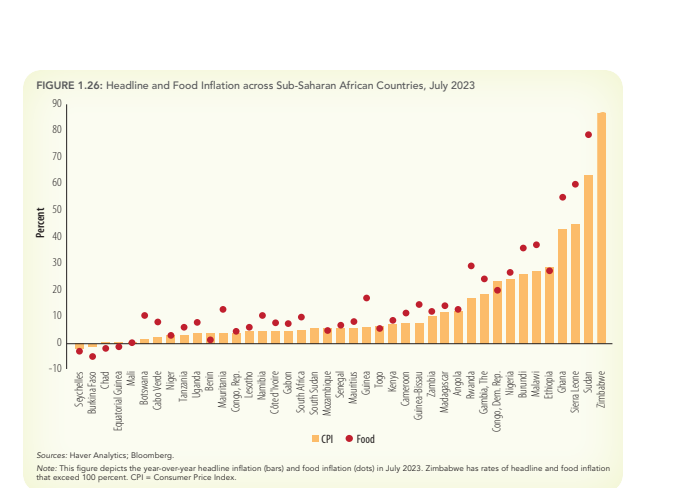
Ghana’s inflation of 40.1% is the 4th highest in Sub-Saharan Africa in 2023, the World Bank October 2023 Africa Pulse Report has revealed.
Zimbabwe is 1st with more than 80% inflation and is followed by Sudan (60%) and Sierra Leone (42%).
According to the report, food and energy prices are still contributing to driving headline inflation in most countries in the region.
By July 2023, it said, nearly half of the countries in the region with monthly available information on food prices (20 of 41 countries) had double-digit year-on-year rates of food inflation, with the fastest increases experienced in Burundi, Ghana, Malawi, Sierra Leone, Sudan, and Zimbabwe.
The report furthered that there has been progress in the fight against inflation in several countries in the region with some of them having already reduced inflation to near or within the central bank target band for example, Kenya, South Africa, and Uganda.
“In other countries, inflation still remains above target and has been for a prolonged period of time and/or shows no sign of having peaked Ghana, Nigeria, and Sierra Leone”, it added.
Despite the disinflation trend exhibited by some countries in the region, the report stressed that the rates of consumer price growth are still high, above target, and above pre-pandemic levels for others.
In contrast, the rate of inflation in four countries in the region is expected to accelerate by more than 10 percentage points in 2023 from last year, namely, the Democratic Republic of Congo, Ghana, Sudan, and Zimbabwe.
Inflation for August 2023 falls to 40.1%
The year-on-year inflation for the month of August 2023 fell to 40.1% from the 43.1% recorded in July 2023, the lowest in 12 months.
According to data from the Ghana Statistical Service, Food inflation witnessed a decrease to 51.9% in August 2023, from 55.0% the previous month.
Non-food inflation also dropped by 2.9% to 30.9% in August 2023.
For the first time in the year, inflation for imported products recorded a rate lower than locally produced items. Whilst inflation for locally produced items was 42.4%, inflation for imported items was 36.2%.
Latest Stories
-
GRA submits preliminary report on drug shipment case to Mahama – Commissioner-General
8 minutes -
Sammy Gyamfi using ‘procedural roadblocks’ to dodge defamation case? – Afenyo-Markin’s lawyers
9 minutes -
The illusion of a good deal: Why some everyday money-saving habits may be costing you more
24 minutes -
Family seeks autopsy, police investigation into death of student 12 days after Abomosu SHS enrolment
32 minutes -
Trade Minister urges employers to leverage industrial opportunities to create jobs
39 minutes -
Asantehene plants trees to commence Jimi Watercourse Rehabilitation destroyed by galamsey
1 hour -
15 arrested, 6 trucks impounded over sandwinning activities on Kumasi-Accra Expressway
1 hour -
OFFICIAL: Vinicius will miss El Clásico, suspended four games
1 hour -
Prayer vigil held after four arson attack murders
1 hour -
GRA fully recovers $154k legacy debt owed by foreign entities between 2022 and 2024
1 hour -
Kwesi Pratt Jr warns bus preachers are adding to passengers’ stress with accident prophecies
1 hour -
MTN Ghana to spend $1.1bn in 3 years, build 500 new sites as MoMo hits 44% Growth
1 hour -
I have no regrets joining Assemblies of God – Mahama
1 hour -
Starlink restrictions in Ukraine war linked to political situation, Zelensky aide says
1 hour -
Furniture boost for Techiman North schools as MP donates to 20 institutions
1 hour