

Audio By Carbonatix
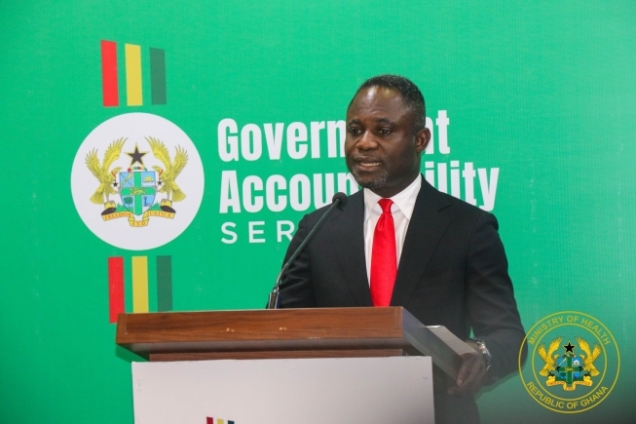
The contractual integrity of Zipline Ghana’s drone delivery service has been challenged by Minister of Health Kwabena Mintah Akandoh, who revealed that the multi-million-dollar scheme is predominantly being used to transport non-emergency items, including condoms and school textbooks, rather than lifesaving supplies to hard-to-reach areas.
Speaking at the Government Accountability Series on Monday, December 1, 2025, the minister presented data showing that the service has largely strayed from its core mandate, raising serious concerns about the value for money the government is receiving, especially amid reports of a colossal GH¢174 million debt owed to Zipline.
The original contract for Zipline was focused on two critical areas: serving hard-to-reach areas and providing emergency medical services.
However, the minister’s review exposed a drastic diversion from this core mission.
“The services were to concentrate on hard-to-reach areas and emergency services, but upon review of the activities, the hard-to-reach areas constitute only 12% of their activities, and emergency services constitute only 4% of their activities,” he said.
This means a staggering 84% of Zipline's operations fall outside the scope of its intended hard-to-reach or emergency services.
Mr Akandoh detailed a list of common items being flown by the expensive drone service, arguing that many could be transported more cheaply and efficiently via traditional logistics channels.
“It will interest you to know some of the items they fly. Items like condoms, blood-donor cards, mosquito nets, food and nutrition items, adhesive tapes, syringes and needles, education materials like textbooks and uniforms, among other things.”
The revelation that non-emergency items like school uniforms, textbooks, and common contraceptives are being delivered by drones intended for vital blood and vaccines has fueled public criticism of government spending on the contract.
The minister's comments come at a time of severe operational and financial strain for the service:
- Debt Crisis: Zipline is reportedly owed an outstanding GH¢174 million by the government, a debt crisis that has already led to the closure of three of its operational centres.
- Engagement for Value: Mr. Akandoh confirmed that the government is actively engaging the provider over the ballooning range of services and the outstanding financial obligations, emphasizing the need for cost efficiency.
“We think that there must be value for money, therefore we are engaging them,” he said.
The controversy has drawn fierce political opposition, most notably from Majority Leader Mahama Ayariga, who has previously called for the full termination of the contract, describing the drone delivery scheme as a "mismanagement of public funds" that has consistently failed to provide demonstrable value for the considerable investment.
Latest Stories
-
Power restoration fault suspected in Kumasi Central Market fire
4 hours -
The 7-foot giant of Ngleshie Amanfro: Seven-foot Ghanaian Ephraim Saawa dreams of joining the national basketball team
4 hours -
Government promises support for Kumasi Central Market fire victims
4 hours -
Vibes The Movie: Big Ghun’s Ghanaian film earns five nominations at 2026 REFFA
5 hours -
MamaCare CEO warns unresolved conflicts among health workers could undermine maternal and neonatal care
5 hours -
Health professionals urged to translate medical knowledge into practice to save mothers
5 hours -
Conflicts among care providers linked to maternal, neonatal deaths – Expert
7 hours -
GIS marks 10th TIME conference, champions improved teaching practices
7 hours -
BRICS Or Balance? What Ghana’s bid really means
8 hours -
GPRTU wants full TRAFFITECH-GH implementation to start in 2027
8 hours -
Mahama announces plans to import electric wheelchairs for PWDs
8 hours -
KGL U17 Colts 2026: Western beat Prempeh Elite Academy to set up final final with Greater Accra Region
8 hours -
Late Solanke strike salvages 10-man Spurs draw at Man United
8 hours -
Gender Ministry to monitor welfare of Nana Akua Addo’s children amid domestic violence case
8 hours -
Benedict Okyere Yeboah: Ghana’s football problem goes beyond sacking a coach
9 hours