

Audio By Carbonatix
"In the global multilateral systems, only 0.5% of the funding is allocated for the health sector. Additionally, less than half of the required needs for water, Sanitation, and Hygiene (WASH) financing are met."
This revelation comes from the Executive Director of the Pan African Climate Justice Alliance (PACJA), who stressed the urgent need for increased financial assistance.
Dr. Mithika Mwenda advocates for augmented funding to bridge these gaps, particularly in the areas of mitigation, adaptation, loss and damage, response measures, and addressing the needs of youth and gender, especially within Africa.
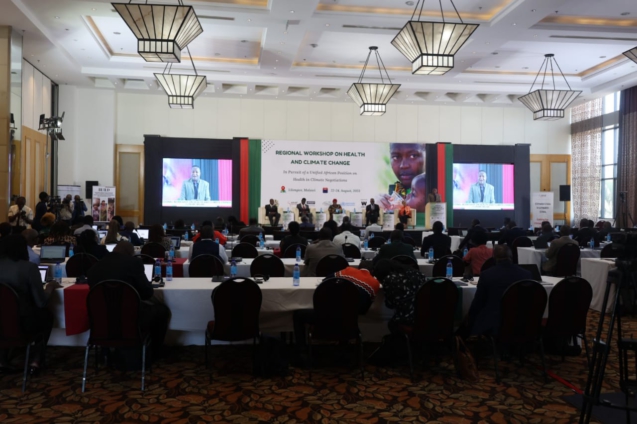
Dr. Mwenda conveyed this message during a regional workshop held in Malawi, where the objective was to establish a unified stance on climate change and its impact on health across Africa.
This event brought together a notable assembly of both state and non-state actors, along with experts and leaders from the health and climate change sectors. The three-day workshop aimed to foster agreement, share insights, and amplify Africa's collective standpoint on health within the context of climate change. The ultimate goal is to nurture sustainable and comprehensive policies that prioritize both health and the environment.
Dr. Githinji Gitahi, CEO of AMREF Health Africa, emphasized the need to fundamentally integrate health into the climate justice dialogue, highlighting that this integration can lead to more comprehensive strategies that protect communities' well-being while simultaneously addressing the global climate crisis.
"By doing so, we can foster more comprehensive strategies that safeguard the well-being of communities while addressing the global climate crisis," he said.
Ephraim Mwepya Shitima, Chairperson of the African Group of Negotiators (AGN), lent his expertise to underscore the importance of cohesive strategies as countries navigate the complex interconnections between climate change and health. He stressed that charting a course that bolsters resilience and sustainable development is essential.
“It is imperative to chart a course that enhances resilience and sustainable development," he said.
Throughout the workshop, participants from diverse sectors engaged in substantive discussions to cultivate a mutual understanding of Africa's unified stance on health and climate change. This collective perspective aims to influence policy decisions, drive advocacy efforts, and guide collaborative actions leading up to COP28.
The World Health Organization (WHO) also emphasizes the significance of integrating health considerations into climate discussions. This approach serves as a unifying force, leveraging health arguments and evidence to effectively reshape the climate narrative.
Latest Stories
-
Anti-LGBTQ Bill: NDC’s arrogance is worrying – Hassan Tampuli
4 minutes -
Let’s give OSP time to mature, not to scrap it – Hassan Tampuli
7 minutes -
Nigeria convicts 386 Islamist militants in mass trials
13 minutes -
Djibouti president wins election with 97.8% of vote, state media says
17 minutes -
We don’t have mandate to deduct tax from rent allowance of security services personnel – Interior Ministry clarifies
31 minutes -
Ablakwa receives Presidential Special Envoy on Reparations to advance global agenda
49 minutes -
Christina Koch becomes first woman to travel around the moon on Artemis II
60 minutes -
Epstein survivors’ calls to meet King Charles and Queen harder to ignore as US visit approaches
1 hour -
UN Secretary-General names Ghana’s Anita Kiki Gbeho as South Sudan envoy
1 hour -
Mali withdraws recognition of Sahrawi Republic, backs Morocco’s autonomy plan
1 hour -
Gov’t distributes over 8,500 laptops to One Million Coders project
1 hour -
Julius Debrah, ‘man to beat’ as NDC’s James Agbey dismisses Musah Dankwah’s polls
1 hour -
GPRTU in Savannah Region to protest alleged eviction in Damongo
2 hours -
Re: Reinsurance does not replace process — A response to the SIGA–SIC defence
2 hours -
Gender Ministry supports Harriet Amuzu in ongoing abuse case
2 hours