

Audio By Carbonatix
The 24-Hour Economy Secretariat says sustainable job creation will be driven by increased production, modernised agriculture, manufacturing, and a coordinated national development plan.
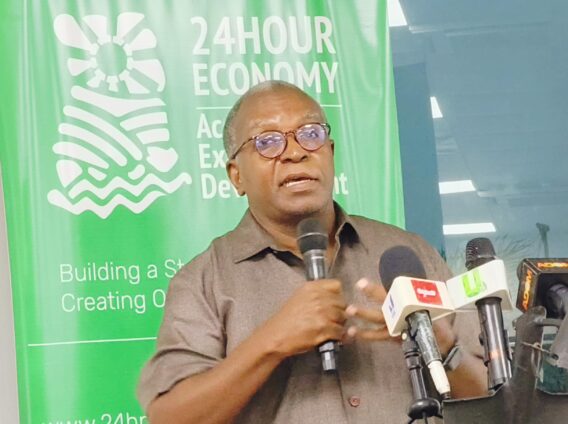
Kyeretwie Opoku, Coordinator of the Secretariat, said the strategy was aimed at addressing the employment needs of millions of Ghanaians, particularly the youth.
Speaking at a 24-Hour Economy Media Engagement in Accra, he said the secretariat would work with the media to improve public understanding of the programme and its objectives.
“Working with you is something we desperately want to do going forward. And tonight is the beginning,” he said.
Mr Opoku said the secretariat was established to help transform the organisation of the economy, create wealth, retain it locally, and support reinvestment for future generations.
He said sustainable employment would result from overall economic growth, particularly in agriculture and manufacturing, rather than government programmes alone.
“Our task, as we understand it, is to plant production first, because the jobs will come from production. We can't all be banking seven years all the time. We must make things that are bought and sold,” he said.
Mr Opoku said the government would seek to reorganise and modernise agriculture to make it less labour-intensive and more attractive to the youth, while improving the processing and distribution of agricultural products.
He said manufacturing would also be critical to job creation, particularly through the processing of agricultural raw materials into finished and semi-finished products.
He cited Ghana’s post-independence industrialisation under the late President Kwame Nkrumah as an example of how coordinated planning and industrial policy could support economic transformation.
Mr Opoku said the development of factories, agricultural estates, ports, power infrastructure and other facilities during that period formed part of a coordinated national development plan.
He said the 24-Hour Economy programme sought to revive national coherence and mobilisation around a development plan centred on agriculture, manufacturing, infrastructure, and investment.
“Our task today, in the 21st century, as a 24-hour programme, is to revive a plan, to revive national coherence, national mobilisation around a plan that delivers very specific social support,” he said.
Latest Stories
-
EOCO’s handling of arrests could cost NDC power – Kpebu
6 minutes -
Health sovereignty a priority for 1.4b Africans – President Mahama declares
20 minutes -
NACOC begins pre-screening checks at Accra International Airport
23 minutes -
‘I was stepping up into an alliance’ – Sammy Crabbe clarifies John Boadu backing
25 minutes -
Turn CSIR research into commercially viable products for national dev’t – Dr Agyeman-Rawlings
47 minutes -
Baffour Awuah thanks Bawumia, NPP supporters after GH¢10m bail
49 minutes -
Ghana gaining notoriety for drugs – Bawumia demands bipartisan probe
1 hour -
Government urges SMEs to embrace digitalisation for growth and job creation
1 hour -
Ghana’s university libraries urged to lead change in digital age
1 hour -
NPP National Delegates Conference: Nhyiaeso MP calls for unity and peace
1 hour -
Cargill Ghana renovates, equips ICT laboratory for Ahmadiyya Basic School
1 hour -
GH¢6,500 cocoa promise has turned out to be a scam – Bawumia
1 hour -
Firefighters battle blaze behind Amasaman China Mall
1 hour -
We’ll pursue accountability despite intimidation – Afenyo-Markin
2 hours -
‘Ghana Jollof’: Restoring the flavor
2 hours