

Audio By Carbonatix
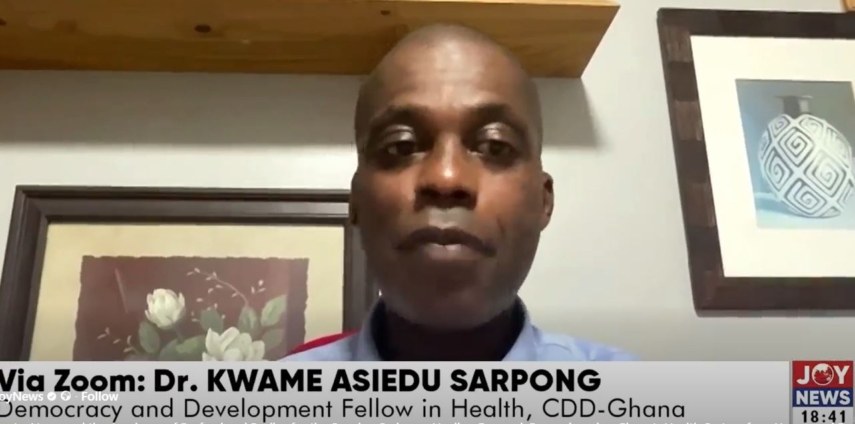
A staggering 63% of Ghanaian citizens live in constant anxiety regarding their ability to afford healthcare, according to new data presented by Dr. Kwame Asiedu Sarpong, a Research Fellow at the Centre for Democratic Development (CDD-Ghana).
Speaking at the 'JoyNews and Amalgam of Professional Bodies Speaker Series' held on Tuesday, December 16, 2025, Dr. Sarpong delivered a sobering "diagnosis" of the nation’s medical landscape.
Under the theme “Healing Forward: Re-engineering Ghana’s Health System For A Young and Restless Nation,” he warned that Ghana’s demographic reality is colliding with an archaic health model that is failing to protect its most vulnerable.
The Affordability Crisis: A Nation on Edge
The cornerstone of Dr. Sarpong’s address was the Afrobarometer Round 10 findings, which reveal a deep-seated financial insecurity within the populace.
Beyond the 63% who worry "somewhat or a lot" about medical costs, the data highlights a persistent barrier to actual care:
- Access Gap: Only 47% of Ghanaians report that they have never gone without needed medical care in the past 12 months.
- Difficulty of Service: 51% of citizens describe obtaining medical care as “difficult” or “very difficult.”
- The NHIS Paradox: While a massive 88% of respondents use the National Health Insurance Scheme (NHIS), satisfaction is abysmally low, with only 48% expressing contentment with the service.
- Integrity Concerns: In a troubling sign of systemic decay, 19% of respondents admitted to paying a bribe at least once to receive medical attention.
“Confidence in medical protection is weak,” Dr. Sarpong noted. “With just 49% satisfied with how medical aid supports them when ill, we are looking at a system that is financially stressed and vulnerable to informal practices.”
A Demographic Mismatch: "Fighting 1980s Battles"
Dr. Sarpong argued that the current health system is structurally incapable of supporting Ghana’s "young and restless" population.
With 57% of the population under age 25 and 35% under age 15, nearly 900,000 youth enter the labor force annually. Yet, the healthcare infrastructure remains frozen in a bygone era.
“Our health system still behaves as though we are fighting the battles of the 1980s,” Dr. Sarpong asserted. “Diagnosis: A youthful nation trapped in an ageing health model.”
He pointed out that while the demographic pyramid is broad and young, the medical strategy has failed to pivot from the communicable diseases of the past to the chronic crises of the present.
The Silent Killers: The Shift to NCDs
The most alarming structural threat identified was the rapid divergence in Ghana's disease landscape. Since 1993, the country has transitioned from being dominated by malaria and diarrhoeal diseases to a "complex burden" where Non-Communicable Diseases (NCDs) now account for nearly half of all deaths.
- The Modern Threats: Hypertension, diabetes, stroke, trauma, mental health disorders, and cancers are now the primary killers.
- Systemic Failure: Dr. Sarpong noted that data from the World Health Organisation (WHO) and the Global Burden of Disease show these conditions have accelerated at a pace the current system was never designed to absorb.
The 2026 Budget: A Call for Radical Reform
As the government prepares to implement the 2026 Budget, which focuses on "resetting growth," Dr. Sarpong posed a critical question to policymakers: “Can Ghana grow if its young population remains underserved by its health system?”
He concluded by citing a former South African health minister: “Without health, no nation can stand.”
For Ghana to "Heal Forward", Dr. Sarpong insisted that affordability, trust, and real access must be the pillars of the 2026 agenda, matching the urgency of a demographic reality that can no longer wait.
Latest Stories
-
I have supported highway authority financially to fix roads in my constituency – A Plus
36 minutes -
US, Iran fail to reach peace agreement after marathon talks in Pakistan
59 minutes -
ECG kicks off Phase Two of transformer upgrades at Lashibi; brief outages expected
2 hours -
Port crises loom as 11,000 drivers threaten four-day strike
2 hours -
A source of excellence across generations – Vice President Opoku-Agyemang lauds Mfantsipim
3 hours -
(Photos) Mfantsipim School launches historic 150th anniversary
4 hours -
Knights and Ladies of Marshall group backs Catholic Bishops’ stance on anti-LGBTQ+
5 hours -
Bright Simons writes: All the Filla in the Ibrahim Mahama/E&P – Gold Fields Saga
5 hours -
Monetise Idiocy In Ghana
5 hours -
The Ghanaian prophet and the mysterious death of his scottish wife Charmain Speirs
6 hours -
Nearly 400 sentenced in Nigeria for links to militant Islamists
6 hours -
Ghana’s recovery supported by gold strength despite global oil price pressures – Standard Bank Research
6 hours -
Methodist Church hails Mfantsipim@150; calls for “fresh consecration” to excellence
7 hours -
‘Excellence is our inheritance’ – Nana Sam Brew-Butler hails Mfantsipim’s 150-year reign in leadership
7 hours -
Kwaku Azar writes: A-G vs OSP
7 hours