

Audio By Carbonatix
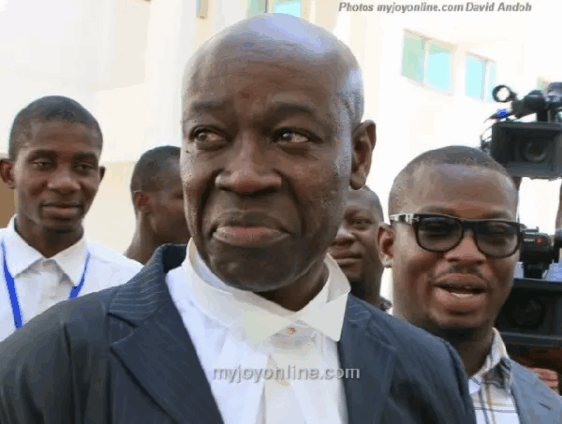
Private legal practitioner Thaddeus Sory is questioning the value of Parliament’s vetting process for Chief Justice nominees.
In a yet-to-be-aired interview with KSM, he said the process has become disrespectful and flawed.
He argued that the conduct of Parliament has affected not only the now-approved Chief Justice nominee, Justice Baffoe-Bonnie, but also another top judge.
“Apart from the disrespect to the nominee, it even went further to affect another justice, the most senior justice of the day, Justice Gabriel Pwamang, who was the chairman of the committee that recommended that the Chief Justice [Justice Gertrude Torkonoo] be removed.”
He suggested Justice Pwamang contributed to the current situation. “To some extent, I would blame Justice Pwamang because, I think I’ve said here or somewhere, that his own report is the problem.”
Mr Sory revealed that the Minority Leader, Alexander Afenyo-Markin, was one of the reasons his client petitioned against the former Chief Justice.
“The Minority Leader was one of the reasons why my client petitioned for the removal of the then Chief Justice. There was a huge count which mentioned his name and mentioned the acts that formed the basis of our petition.”
He pointed to what he described as an unprecedented courtroom advantage.
“We said he had set a precedent, in fact, a record in the court by being the only party, or being the only person who, within two hours, was able to get a full panel of the Supreme Court, presided over by the former Chief Justice Gertrude Araba Torkornoo, to give him orders that by the scope of the application before the court, no court in the world of the common law jurisdiction will give him.”
He also said personal ties influenced judicial interactions. He recalled what he was told during the proceedings.
“In the course of all of those proceedings, and after people who knew the two of them spoke to me, and said, ‘Don’t you understand that is his sister’.”
KSM asked, “Sister, in terms of what?” Mr Sory responded: “That they come from the same place. Two, when her father died, the Minority Leader hosted her visitors, and people who were there called me.”
Mr Sory said he was prepared to raise an objection against the Chief Justice herself. “If I had attended the next proceedings, the next person against whom I was going to raise that objection was the Chief Justice.”
He said he confronted the situation directly. “I said, you know, all of these arguments we are having back and forth, and you are literally descending into the arena of conflict is because somebody that you are close to is the plaintiff in this particular matter. Who was the plaintiff? It is Alexander Afenyo-Markin.”
Mr Sory also cited claims of financial interests. “Also, there is now information coming out that services are being rendered in the judicial service which are linked to Afenyo-Markin.
He’s rendering those services and getting commercial profits from them, and huge ones.”
Mr Sory insisted the Minority Leader’s loud opposition has little to do with national interest.
“And so at this point in time, when Afenyo-Markin is making it look like there’s a national public interest aspect of all of this nomination process, and there’s some dispute and all of that, it has nothing to do with a minority position.”
He said it was all personal. “He sold it out to his colleagues to believe that, well, we all have to take a collective position against this, but it is a personal interest.
"And so the facts that we have show that he has an interest in her being there. And so he’s crying louder than every other person, because he has an interest in the woman being there.”
Mr Sory said Parliament must rethink the entire vetting culture. “I think they should… They should look at this whole idea of prior approval. The Constitution didn’t say vetting. It said prior approval of Parliament.”
The lawyer proposed a simpler, less theatrical process. “There ought to be another way; they look at your CV, and they’ve done your background checks. If you are calling for any vetting, then there are specific areas they want you to clarify. Otherwise, Parliament should do an acclamation and you go.”
He added that poor performance can always be addressed. “And then if you come and you can’t deliver, your appointer is there, they will sack you.”
Mr Sory criticised the current system as a needless spectacle. “But they keep all of us glued to television, and we are sitting down there and watching a process that 95% of it is a joke.”
Latest Stories
-
GES asks applicants to check status of 2026 promotion applications on October 15
12 minutes -
Kobe Boujee joins Olympics.com team for Dakar 2026 Youth Olympic Games
20 minutes -
Slaty egret’s shifting nesting sites offer clues to changing ecosystems
26 minutes -
First phase of arrears for promoted teachers to be paid on Friday – Haruna Iddrisu announces
29 minutes -
Caveman Watches partners with Mfantsipim School for 150th anniversary
51 minutes -
We’ll pursue GH¢15m defamation suit against Sammy Gyamfi to its logical conclusion – Afenyo-Markin’s lawyers
51 minutes -
Martin Kpebu urges Afenyo-Markin not to return to court over Sammy Gyamfi lawsuit
1 hour -
GRA submits preliminary report on drug shipment case to Mahama – Commissioner-General
1 hour -
Sammy Gyamfi using ‘procedural roadblocks’ to dodge defamation case? – Afenyo-Markin’s lawyers
1 hour -
The illusion of a good deal: Why some everyday money-saving habits may be costing you more
2 hours -
Family seeks autopsy, police investigation into death of student 12 days after Abomosu SHS enrolment
2 hours -
Trade Minister urges employers to leverage industrial opportunities to create jobs
2 hours -
Asantehene plants trees to commence Jimi Watercourse Rehabilitation destroyed by galamsey
2 hours -
15 arrested, 6 trucks impounded over sandwinning activities on Kumasi-Accra Expressway
2 hours -
OFFICIAL: Vinicius will miss El Clásico, suspended four games
2 hours