

Audio By Carbonatix
The US has formally left the 2015 Paris climate agreement. Future US participation in the international pact will depend on the outcome of the presidential election.
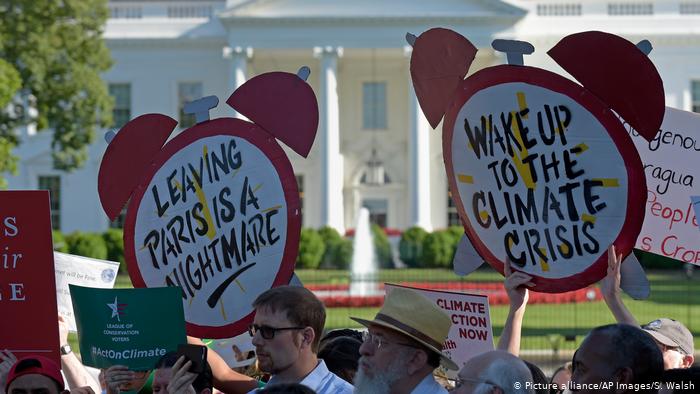
The United States formally left the Paris climate accord on Wednesday, becoming the first country in the world to withdraw from the international climate pact aimed at reigning in greenhouse emissions.
President Donald Trump's administration had notified the United Nations last year of the US withdrawal from the accord. The mandatory one-year waiting period required for it to exit ended on Wednesday.
The fate of the US participation in the Paris agreement now rests on the outcome of the presidential election.
Trump to keep US out, Biden wants back in
Trump, a staunch opponent of the international accord, had first announced his intention to withdraw the US from the landmark agreement in 2017, but the UN rules prevented countries from leaving in the first three years.
If Trump were to be reelected, the US — the world's largest economy and the second-biggest polluter after China — would stay out of the accord.
During his presidency, Trump has questioned climate science on multiple occasions, championed the fossil fuel industry, and weakened environmental protections.
His Democratic rival Joe Biden, in contrast, has vowed to immediately rejoin the Paris agreement if he wins the presidential election.
Biden has called climate change and global warming "an existential threat to humanity" and that the US has a "moral obligation to deal with it."
Biden has also proposed a $1.7 trillion plan to bring US carbon emission to net-zero by 2050.
'Make or break'
Regardless of how the election turns out, the United States will still be "outside the conversation" when the UK and the UN host a climate summit on December 12, on the fifth anniversary of the Paris accord.
Climate scientists have warned the unless drastic action is taken, global temperatures may rise more than 2 degrees Celsius above pre-industrial levels, triggering a series of catastrophic climate tipping points by the end of the century.
This could be averted if global emissions reached net-zero by mid-century, according to the UN's Intergovernmental Panel on Climate Change.
Dutch Climate Scientist Niklas Hohne backed Biden's plan in a tweet on Tuesday.
"This election could be a make or break point for international climate policy," he said. "Biden's climate plan alone could reduce temperature increase in the order of 0.1°C. Every tenth of a degree counts."
Latest Stories
-
WERise Network announces 2026 annual programme to celebrate growth and scale women-owned businesses
3 minutes -
Nothing will happen to me – Baffour Awuah invokes Psalm 91 amid EOCO row
13 minutes -
Jomoro MP introduces One Million Coders programme to equip youth with digital skills
13 minutes -
WAFU B U-17 Girls Cup: Black Maidens thump Niger in fourth game
14 minutes -
2026 Best Farmer and Best Poultry Farmer winners to receive sponsored Italy trips
21 minutes -
NACOC arrests rose from 73 to 217 under NDC – Majority
23 minutes -
Prudential Life Insurance Ghana leads Ghana in MDRT Global Top 100
24 minutes -
Baffour Awuah accuses EOCO boss Raymond Archer of abusing state power
25 minutes -
Jefferson Sackey clarifies Cameron Duodu is not described as ‘late’ in memoir
25 minutes -
Majority calls for stronger collaboration among security agencies to fight drug trafficking in Ghana
34 minutes -
CDM calls for bipartisan parliamentary probe into Ghana’s port and border-control systems
36 minutes -
Miracles Aboagye challenges Ghana Maritime Authority to clarify status of VTMIS surveillance system
38 minutes -
More drug trafficking arrests, prosecutions expected – Majority leader
42 minutes -
IFC MD visits Kwame Nkrumah Memorial Park, highlights heritage tourism and jobs in Ghana
1 hour -
Akim Swedru MP tells Mahama to ‘sit up’ over EOCO’s attempted arrest of Manhyia South MP
1 hour