

Audio By Carbonatix
Scientists at the CSIR-Building and Road Research Institute (CSIR-BRRI), Kumasi and the KNUST School of Public Health and the University of Washington, Seatle, are calling for upward readjustment of Ghana EPA permissible noise level for heavy industrial areas.
The recommendation comes at the back of research which found the ambient noise permissible limit at 70 dBA to be unrealistic.
A-weighted decibels, or “dBA,” are often used when describing sound level recommendations for healthy listening. While the dB scale is based only on sound intensity, the dBA scale is based on intensity and on how the human ear responds.
The cross sectional study, conducted in the Ashanti and Ahafo regions, was aimed at establishing the occupational noise exposure levels of carpenters and operators of concrete mixers, bulldozers, excavators, among others.
The noise measuring tool known as dosimeter was mounted on a worker’s clothing at the shoulder level to monitor the noise exposure level for each specific task executed.
They found the bulldozer produced the highest average daily noise exposure level and small steel rollers produced the least. All the nine worker groups monitored with the noise dosimeter were exposed to mean noise levels exceeding the Ghana EPA permissible limits by between 10.1dBA and 23.6dBA.
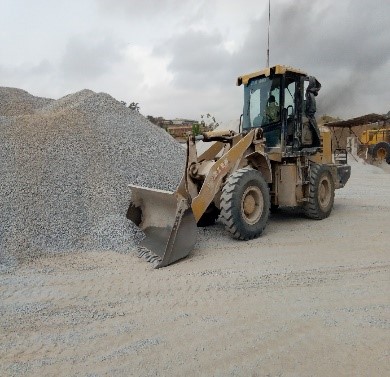
The operators of bulldozer, asphalt-producing plant, concrete mixer, pneumatic tyre roller, carpenters, pay-loader, excavator, steel roller and small steel roller were exposed to average daily personal noise exposure levels of 93.6dBA, 92.4dBA, 87.9dBA, 87.3dBA, 86.4dBA, 86.2dBA, 85.6dBA, 81.5dBA and 80.1dBA respectively.
The peak noise pressure levels from all the equipment exceeded the limits of Ghana EPA (by 50.7dBA–72.6dBA), ISO/NIOSH (by 35.7dBA–57.6 dBA) and OSHA (by 30.7dBA– 52.6dBA). The highest was recorded from the bulldozer, followed in that order by the carpenters, excavator, pneumatic tyre roller, asphalt-producing plant, pay-loader, concrete mixer, small steel roller and steel roller.
“It’s obvious from the study that the Ghana EPA permissible limits for heavy industrial areas, where road construction falls set at 70dBA during night and day is unrealistic,” said the lead researcher at the CSIR-BRRI and Occupational Hygienist, Isaac Kofi Yankson.
The scientists which included researchers from the Komfo Ankoye Teaching Hospital, University of Washington, Seattle and Ghana Health Service, however say, the recommended noise level does not pre-dispose unprotected workers to noise-induced hearing loss over an 8-hour working period.
Mr. Yankson advises owners of construction companies to provide welfare facilities such as pre-employment and in-service medical monitoring.
Latest Stories
-
Today’s front pages: Tuesday, October 13, 2026
5 minutes -
Wealth Over Water: How Galamsey Is Threatening Ghana’s Water Security
41 minutes -
LA 2028: Black Queens pumped up for second leg of Mauritius tie
49 minutes -
LA 2028: Black Queens hold final training session ahead of second leg against Mauritius
1 hour -
Standards are not Seasonal: What the EC appointments teach both sides
2 hours -
King Mohammed VI urges private sector to create youth jobs and spread benefits of growth
2 hours -
KGL U17 Colts 2026: Greater Accra win title after penalties win over Western Region
2 hours -
UK Investment Roadshow opens in London to advance UK-Ghana growth partnership
2 hours -
Assemblies of God requires pastors to resign before entering partisan politics – Rev. Wengam
2 hours -
Ghana targets 20% annual reduction in maternal deaths – Health Minister
2 hours -
Cyber attacks in Africa grow faster than global rate, report finds
2 hours -
Ghana signs UAE deal to create 5,000 overseas jobs
2 hours -
One Million Coders Programme targets 100,000 digital jobs in two years – Sam George
2 hours -
John Jinapor, Italian Ambassador explore opportunities for energy sector investment
2 hours -
NHIA seeks legal reforms to support Free Primary Healthcare
2 hours