

Audio By Carbonatix
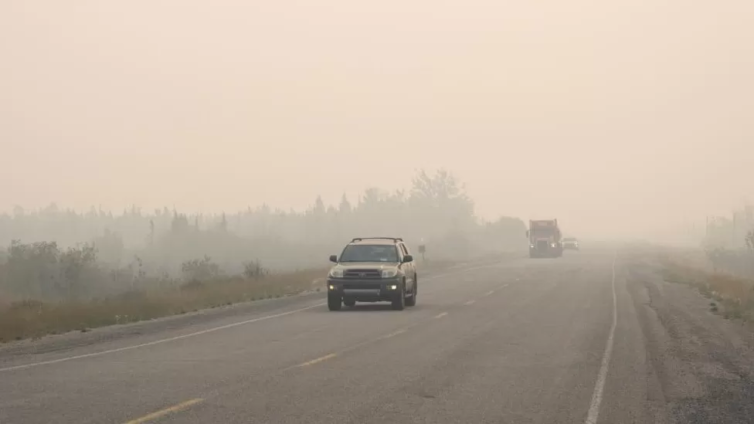
Wildfire is bearing down on the capital city of Canada's Northwest Territories, with thousands of people under evacuation orders.
The conflagration - which has already razed one remote community - could reach the city of Yellowknife by the weekend, say officials.
Another fire is threatening the community of Hay River.
One evacuee told the CBC her car began melting as they drove through embers while fleeing the town on Sunday.
The Northwest Territories declared a state of emergency late on Tuesday as it battles more than 200 wildfires.
Hay River Mayor Kandis Jameson estimated that about 500 people were still in the community of some 3,500 people as of Tuesday despite an evacuation notice issued for the town over the weekend.
The fire moved 30km in a few hours because of strong winds earlier this week, closing the only two highways out of the town.
The road out of Hay River is "treacherous", the mayor said, and food and petrol supplies are getting low in the town.
Phone and internet services have also been down in the remote region.
Canada's military has been co-ordinating airlift operations out of several communities in Northwest Territories' South Slave Region that have been threatened by wildfires in recent days.
It is the largest airlift evacuation effort in the territory's history.
Most evacuees have been brought south to the neighbouring province of Alberta, with no indication as to when they will be able to return home.
Yellowknife, a city of 20,000 south of the Arctic Circle, declared a state of emergency on Monday.
Officials hope Yellowknife could be spared the wildfires if it rains as forecast in the next few days. The blaze was about 17km (10 miles) north-west of the city as of Wednesday afternoon.
Fort Smith, K'atl'odeeche First Nation, Hay River, Enterprise and Jean Marie River are all under evacuation orders.
Enterprise, home to 120 people, is "90% gone" after a wildfire swept through this week, the community's mayor told the CBC on Tuesday.
Canada is having its worst wildfire season on record, with nearly 1,100 active fires burning across the country as of Wednesday.
Experts have pointed to a warmer and drier spring than normal as the reason.
Scientists say climate change increases the risk of the hot, dry weather that is likely to fuel wildfires.
Latest Stories
-
Aggrieved Gold Coast Fund Management Company customers to petition Mahama over locked-up funds
10 seconds -
NSMQ 2026: PRESEC, Legon dethrones defending champions Mfantsipim in thrilling battle to book semi-final spot
14 minutes -
Ghana’s cashew industry faces processing gap as Côte d’Ivoire moves to capture more value
25 minutes -
“Our greatest wealth is not in our soil but our people” — Upper West Minister
30 minutes -
Luex Healthcare launches children’s health education book series with Luey the Lion
43 minutes -
NAGRAT urges gov’t to communicate early if September deadline cannot be met
1 hour -
We trust government to meet September deadline on teachers’ promotions – NAGRAT
1 hour -
“We dare not fail” – Gov’t promises to honour teachers’ promotion pay deal
2 hours -
The GH¢19.8 billion mirage: Inside Ghana’s state enterprise turnaround
2 hours -
Luv FM High School Debate: KNUST SHS and Osei Adutwum SHS set up thrilling final after dramatic semi-finals
2 hours -
KNUST AI Coordinator urges structured adoption of AI in teacher education
2 hours -
Nepal rescuers blast hillside in search of hydropower workers as families wait anxiously
2 hours -
Teachers who pass promotional exam to get January 2026 start date after gov’t resolves promotion dispute – Dr Apaak assures
2 hours -
NSMQ 2026: St. John’s School rally from slow start to book semi-final spot
2 hours -
Promotion pay row: Gov’t gives teachers September 2026 to complete salary adjustments
3 hours