

Audio By Carbonatix
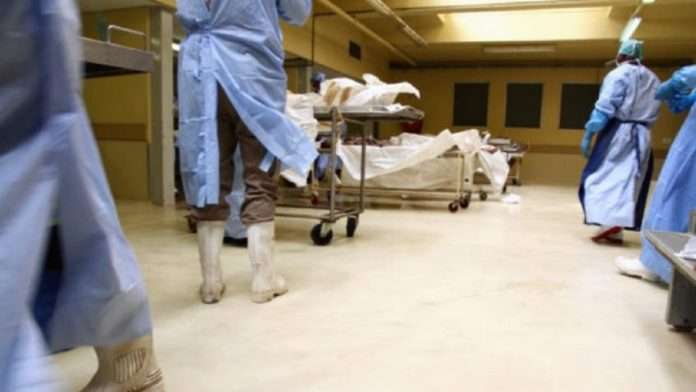
No mortuary facility, public or private, has obtained the requisite licence to operate in the country as required under the Health Institutions and Facilities Act, 2011 (Part 2), the Mortuaries and Funeral Facilities Agency has said.
The agency said it had identified at least 232 mortuaries operating in the country and more of such facilities were likely to spring up.
“None of these 232 mortuaries is licensed to operate per the law,” the Chief Executive Officer of the agency, Dr Yaw Twerefour, told the Daily Graphic, adding that “licences will tell you how to operate.”
The agency, Dr Twerefour said, had consequently developed standards in line with the law in the quest to enforce the act, stressing that the move was to properly regulate the system and streamline the work of mortuary operators.
He said the standards would be handed over to the stakeholders to apprise themselves of it after which they would be given time to prepare for inspection and the enforcement of the law by licensing the facilities.
“By the end of the next quarter, we would have engaged everybody for them to know what they are expected to do,” Dr Twerefour said.
After that, he said, they would be given three months to put their houses in order in terms of licensing.
“After all of this, when we come to your premises and you still don’t comply or you don’t fall within what we have, then you don’t have any business on the field,” he said.
Act
The agency, established under Part Two of Act 829, is responsible for licensing, controlling and regulating facilities connected with the storage, transportation and disposal of human remains through functions, including receiving, considering and approving applications of licences for both facilities and practitioners.
Practitioners to be licensed comprise pathologists, autopsy assistants, embalmers, funeral home directors, mortuary attendants, undertakers, cremators, hearse service providers and drivers; cemetery managers, graveside workers, professional pallbearers, mausoleum directors and funeral escorts.
The facilities to be licensed include cold storage facilities for human remains, mortuaries, funeral homes, crematoria, columbaria, mausoleums, cemeteries and hearses.
Dr Twerefour said the facilities had standards they were supposed to meet, adding, “For instance, if I come to your morgue, I need to know the composition of management, the registration — who are the owners, their financial capacity, your vision, your mission, infection prevention control, security, backup water and backup generator."
He said a backup tank should be able to keep the facility in operation for one week, meaning it should have a huge tank as water was one of the main requirements for operating mortuaries.
“So if I come and you don’t have a storage tank of a certain capacity, you are out; you can’t work.
Even if you have a borehole, you must have a storage tank since that could fail and may not be able to pump water,” he explained.
Crime
Dr Twerefour said, because there were no standards, someone could kill another person, bundle the body up and deposit it at any mortuary and abscond.
Such situations, he said, resulted in some bodies being left in mortuaries for a long time and afterwards they were declared as unclaimed bodies and often given a mass burial.
He said because there were no standards, some facilities just accepted anybody without trying to find out the details of where it came from, among other conditions.
“Now, who is checking them, Nobody.
So now it’s a free-for-all field and people are just doing what they like.
Some morgues want to do the right thing but because others are not doing the right thing, they have also relaxed,” he noted.
An advantage of licensing the morgue, he said, was that it would also weed out unlicensed hearses, as those would also be checked if they met the requirements of the law.
Through that and other measures, he said, there would be a chain reaction when activities within the sector were streamlined.
“But the ultimate goal is to go digital such that when I sit in my office I can know how many bodies entered the cemetery in the Western Region on a daily basis.
This is because once you enter you have to key in the information, real-time information,” he said.
Dr Twerefour disclosed that the infrastructure to that effect was being developed.
“By the end of the year, we would have started licensing all the facilities - hearses, morgues, crematoriums, mausoleums.
“This is a new dawn, things are changing; it is either you join us or you fall out.
I am for collaboration; I am not here to kill or destroy anybody’s business.
I am here to support and set the standards; either you meet the standards or you drop out,” he emphasised.
Latest Stories
-
Kodua dismisses rift fears, says he and John Boadu are focused on NPP victory
38 minutes -
‘There is no competition’ – Justin Kodua confident of NPP General Secretary re-election
2 hours -
J100 Accra Doubles Champions : Kolesolva/ Ndukwa, Agarwal/Patel seal title victories
2 hours -
Sydney Wright crowned J100 Accra Champion
2 hours -
J100 Accra Boys’ Singles: Verma denies Beckles back-to-back titles to claim crown
2 hours -
Two friends fined GH¢12,000 for stealing
2 hours -
Son jailed for threatening to stab mother
3 hours -
Drive constitutional reform – GJA urges journalists
3 hours -
NPP Delagates Congress: Confusion delays voting at Ashanti Region TESCON centre
4 hours -
Fire ravages shops, houses near Koforidua Central Police Station
4 hours -
NPP Delegates conference: The wisdom of the masses will prevail – Napo
5 hours -
Flydubai co-pilot attacked captain with axe, UAE official says
5 hours -
NPP Bosome Freho Constituency Chairman reportedly arrested over ballot paper incident
5 hours -
Medical plane with 6 on board missing off Massachusetts coast
5 hours -
Bolt driver jailed 25 years for robbing beautician
5 hours