

Audio By Carbonatix
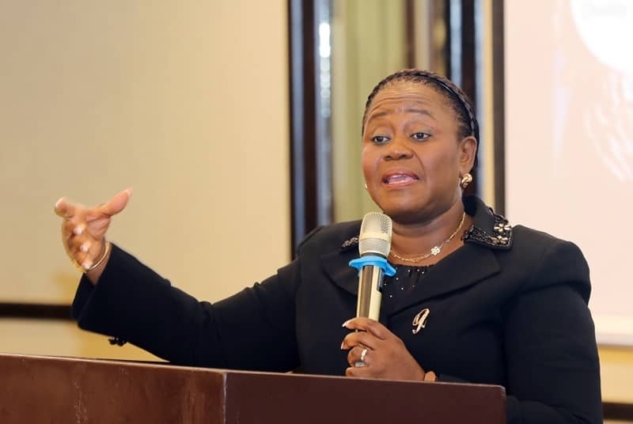
Chief Justice Gertrude Sackey Torkornoo says the more robust human rights protection within a community, the more attractive it is as an investment destination.
She said the more assertive in efficiency, integrity, and transparency that a justice delivery system was, the more attractive it was as an investment destination for citizens, foreigners, and every vehicle of business creation.
Chief Justice was speaking at the opening of the 18th International Association of Women Judges (IAWJ) Africa Regional Conference on the theme: “Combating Negative Cultural Practices- The Role of Women Judges.”
She stated that judges, therefore, were in a prime place to apply the law in a manner that sends a signal of abhorrence of every form of exploitation, including the promotion of human rights and protection of women from harmful cultural and traditional practices.
“By virtue of the unique position we hold in our society, judges exert influence that will always be a force for good,” she added.
The Chief Justice said the nature of the judicial career provided knowledge of the socio-cultural topography of the national environment and the communities in which they work, which was useful raw material for contributing thought to other policymakers on how to combat and eradicate harmful cultural practices.
She noted that in addition to their various judiciaries, their voice as a powerful caucus should be strong in the advocacy for the introduction and implementation of policies that promote the rights of women and the vulnerable in society.
“Our numbers and voice must count for something in shaping the social direction and institutions,” Chief Justice Torkornoo said.
She stated that it was noteworthy that steadily the representation of women on the Ghanaian bench kept increasing.
Ghana has seen a significant increase in the number of judges/magistrates in the Judiciary over the past four years and in 2019, the Judiciary recorded a total of 138 females.
The Chief Justice said by the 2022/23 year, this number had appreciated to 218, signifying an increase of approximately 58 per cent within the four years.
She stated that while there were still more male judges/magistrates than women, this rate of increase was encouraging for gender parity in the coming years.
She noted that the contribution to the fight against domestic and gender-based violence of Ghana’s Judiciary led to the establishment of Child-Friendly Gender-Based Violence Courts across the country as a special division of the District Court.
Chief Justice Torkornoo said studies on economic status show that women from families with economic power and women exposed to higher education, were less likely to be subjected to most of these negative cultural practices that persisted on the continent of Africa.
She said many of the named and unnamed cultural practices that affected the health and quality of life of women thrived strongest in poverty and illiteracy.
She urged women judges to contribute effectively to the need to combat negative cultural practices by keeping in view the intricate linkages between all parts of human life.
She indicated that women judges could also combat harmful cultural practices by mentoring women and girls.
She said the Chief Justice’s Mentoring Programme was designed as an educational programme of the Judicial Service for students in Second Cycle Institutions to familiarize themselves with the work of the Judiciary in Ghana.
It serves as a platform for participating students to interact with members of the Bench and the Bar to demystify the legal profession and encourage students to consider future careers in the legal profession.
With the support of the UNFPA, the Programme was expanded in 2016 to include young kayayei who had dropped out of school but still had the ambition of furthering their education.
She said since she assumed office in June last year, “we have further deepened the Mentoring Programme and established Justice Clubs in Senior High Schools, the first two of which I inaugurated a couple of weeks ago.”
The goal is to create a dedicated corps of students in Senior High Schools, who have been mentored and equipped with knowledge about their rights and responsibilities to pass on that knowledge to their colleagues.
It is also to raise the consciousness of young adults in second-cycle institutions regarding the concept of rights, entitlements, and obligations which make for a strong regime in the rule of law.
Latest Stories
-
Ghana Psychological Association calls for greater involvement of people with lived experience in mental health care
6 minutes -
Ablakwa says Ghana could evacuate more citizens from South Africa if the situation worsens
34 minutes -
Violence against girls must be tackled through individual responsibility – Gender advocate
38 minutes -
Ghana’s BRICS bid must be guided by national interest – International Affairs Analyst
51 minutes -
Journalists look back on a decade of breast cancer reporting in Ghana
1 hour -
President Mahama ends Resetting Ghana tour of Ahafo Region
3 hours -
African negotiators seek delivery of climate commitments at COP31
3 hours -
BoG develops AI rules for financial sector
3 hours -
‘Big Push’: Government assures contractors of prompt payments
3 hours -
Court fines miner for breaking into gold buying shop
4 hours -
Tarkwa court jails labourer for three years over GH¢123,000 theft
5 hours -
GAEC must retain nuclear scientists for Ghana’s nuclear ambitions – Minister
5 hours -
Man reportedly mistaken for game and shot by hunter dead in forest
5 hours -
19-year-old mason jailed 15 years for defiling seven-year-old pupil
5 hours -
Ghana’s banking sector assets rise 20.47% to GH¢500.2bn – BoG Governor
5 hours