

Audio By Carbonatix
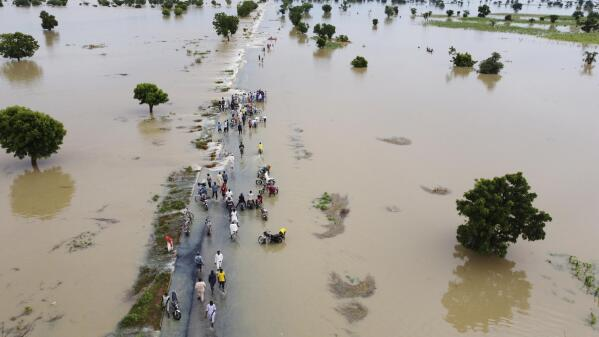
People in Nigeria's flood-hit northeastern Borno state are struggling to get medical care as overwhelmed aid agencies warn of an outbreak of waterborne disease following the worst floods to hit the region in three decades.
More than 30 people have been killed by the floods, which authorities say affected about one million people, most of whom are housed in camps without food and clean water.
The deluge threatens not only the health and safety of the displaced but puts a strain on aid agencies and government resources, exacerbating an already critical humanitarian crisis.
The floods in Borno, the birthplace of Boko Haram militants in the Lake Chad basin, started when a dam burst its walls following heavy rainfall that has also caused floods in Cameroon, Chad, Mali and Niger, all part of Africa's Sahel region that usually receives little rain.

In the last two weeks of August, more than 1.5 million people were displaced across 12 countries in West and Central Africa due to floods, and about 465 have been killed, according to the United Nations humanitarian affairs office.
Over the weekend, an additional 50,000 people were displaced in northeastern Nigeria as the floods intensified, the Norwegian Refugee Council (NRC) said on Monday.
"The situation in the Sahel and Lake Chad region is increasingly dire, as the compounding effects of conflict, displacement and climate change take a severe toll on vulnerable populations," said Hassane Hamadou, NRC's Central and West Africa regional director.
The floods in West Africa come at a time of flooding in Europe after days of torrential rain that caused rivers to burst their banks in several parts of the region.
In a camp in Maiduguri, Borno's state capital, Bintu Amadu was among hundreds of frustrated people waiting for hours to see a doctor because her son had diarrhoea.
"We have not received any aid, and our attempts to see a doctor have been unsuccessful. We have been waiting for medical attention since yesterday, but to no avail," she said.

Ramatu Yajubu was happy she had obtained an appointment card after waiting for days, but quickly added: "I am uncertain about receiving attention due to the overwhelming number of people seeking care."
Mathias Goemaere, a field coordinator for Medecins Sans Frontieres, said that even before the floods, residents in Borno were struggling with malnutrition, following years of an Islamist insurgency that has driven people from their farms.
"They are exposed to their environment, so what do we see? A lot of waterborne diseases, diarrhoea, diarrhoeal diseases ... Malaria is around with a lot of mosquitoes," Goemaere told Reuters.
"So a lot of people, because of malnutrition, are immuno-suppressed, which makes them more susceptible to diseases."
Nigeria's government has separately warned of rising water levels in the country's largest rivers, the Benue and Niger, which could cause floods in the oil-producing Niger Delta region in the south.
Latest Stories
-
My focus is victory in 2028, those with Agenda 2032 can wait — John Boadu
17 minutes -
AK24 Entertainment wins Event Promoter of the Year at Ghana Entertainment Awards USA 2026
20 minutes -
KNUST, UNCDF host EU Ambassador to advance EU Pact for skills development initiative agenda
20 minutes -
Teachers’ strike: School in Wa turns ghost town; pupils forced onto ‘virtual holiday’
22 minutes -
Gov’t should not see bipartisan probe into 3.9-tonne cocaine haul as attack – Akuapem North MP
34 minutes -
The foundation of every boy’s upbringing is important – Kobby Kyei
36 minutes -
Middle East conflict pushed Ghana fuel prices higher in first half of 2026 – COMAC
43 minutes -
President Mahama puts mining firms on notice over 2030 raw mineral ore export ban
45 minutes -
Ghana’s fuel consumption rises 12.24% to 4.06 billion litres in first half of 2026
45 minutes -
Global oil shock tests Ghana’s shift towards domestic fuel production
49 minutes -
Roads Ministry threatens legal action against utility companies over excavation of completed roads
49 minutes -
Mammography available in only 5 regions, making breast cancer screening difficult – Radiologist
60 minutes -
Pastor Daniel Amoateng pays for release of 23 Nsawam prison inmates
1 hour -
Government to equip health facilities with mammography, radiotherapy machines – Deputy Health Minister
1 hour -
Floodwaters recede in Hohoe as residents begin returning home – NADMO
1 hour