

Audio By Carbonatix
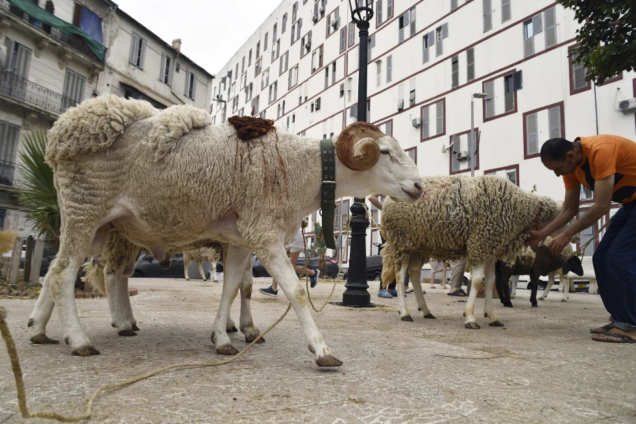
Algeria’s president has announced plans to import a staggering 1 million sheep ahead of this year’s Eid al-Adha, the holiday during which Muslims worldwide purchase livestock for sacrifice.
President Abdelmadjid Tebboune on Sunday instructed his ministers to launch plans for the massive livestock import effort to stabilize costs and meet soaring demand.
The plan is the latest in a series of measures designed to ease public frustration over rising costs and the military-backed government’s uncompromising grip on power.
It builds on previous efforts to flood markets with food staples throughout Islam’s holy month of Ramadan. Yet its scale has few parallels.
North Africa is enduring its seventh consecutive year of extreme heat and below-average rainfall.
The record drought has shrunk harvests and driven up the price of animal feed needed to raise livestock, including in the northern Algerian highlands where breeders raise sheep revered by the population for their quality.
Algeria’s government has traditionally played a dominant role in the economy and in the past imported livestock in small quantities to ensure affordable options for low-income citizens.
Last year, it facilitated the sale of 100,000 sheep in state-run stores, sourcing them from Argentina, Australia, Brazil and Spain.
Eid al-Adha, which takes place this year in early June, is an annual “feast of sacrifice” in which Muslims slaughter sheep to honor a passage of the Quran in which the prophet Ibrahim prepared to sacrifice his son as an act of obedience to God, who intervened and replaced the child with a sheep.
It’s a celebrated tradition in Muslim-majority Algeria, yet also a pricey proposition. During last year’s Eid, sheep prices skyrocketed to 200,000 Algerian dinars ($1,496) in some markets — ten times the country’s minimum wage. Many Algerians have in recent years been forced to forgo the cherished tradition.
This year’s initiative aims to prevent price spikes and shortages that could put the ritual sacrifice out of reach for most Algerian families.
The Ministries of Agriculture and Trade will immediately seek international sources to meet Tebboune’s target, hoping to counteract the soaring inflation that has pushed basic goods and services — including meat — beyond the reach of many.
“Thank God, this year’s Ramadan is a blessing. The markets are well-stocked, housewives can shop without stress, without pressure. Products are available, and prices are accessible,” said Yasmine Zireg, a mother of three, on Monday.
History has shown that food prices can incite widespread political anger in North Africa and Algeria isn’t the only country taking steps ahead of Eid Al-Adha.
Its import plan comes just ten days after neighbouring Morocco’s King Mohammed VI offered his subjects a reprieve from the costly ritual.
The King said in a Feb. 27 letter read on state-run television, warned that the slaughter could burden low-income Moroccans and, as the highest religious authority under Moroccan law, said they could forgo it.
The move — which was widely covered in Algerian media — could harm livestock producers and put disparities between those who can afford sheep and those who can’t on stark display.
Tebboune’s intervention is also designed to make the Eid more feasible for those who otherwise couldn’t afford sheep.
It’s one of several government spending policies Algeria has put in place to calm social unrest while continuing to crack down on opposition parties, journalists and people critical of the military-backed government.
Latest Stories
-
Ghana eyes stronger trade ties as Australia hosts multicultural trade and investment forum
3 minutes -
Margaret-Marie Krakue
6 minutes -
Ayariga announces plans for live broadcast of MMDAs’ meetings on local radio stations
9 minutes -
Mrs Anna Tackie
11 minutes -
Ghana links Afghan heroin and Brazilian cocaine to global drug markets – Global Organised Crime Index
18 minutes -
NHIA launches nationwide inter-school quiz to deepen students’ knowledge of NHIS
25 minutes -
Political protection could be masking Ghana’s cocaine trade – Global Organised Crime Index
30 minutes -
AFCON 2027Q: ‘We have to dissolve the GFA’ – Effia MP after Black Stars lose to Gambia
32 minutes -
NPP announces voting schedule and ID requirements for October 3 national elections
34 minutes -
Lupus can mimic HIV symptoms and damage kidneys if untreated – KNUST expert
37 minutes -
Focus on Sickle Cell Foundation seeks to introduce sickle cell education through comics in Ghanaian schools
42 minutes -
NPP rewrites the campaign playbok as opposition reality shapes National Executive contest
44 minutes -
Road safety education will fail without enforcement – NRSA boss
45 minutes -
Daily Insight for CEOs: Finishing Q3 strong and entering Q4 with purpose
46 minutes -
National Ambulance Service begins ‘Operation Restore Fleet’ to restore grounded ambulances
47 minutes