

Audio By Carbonatix
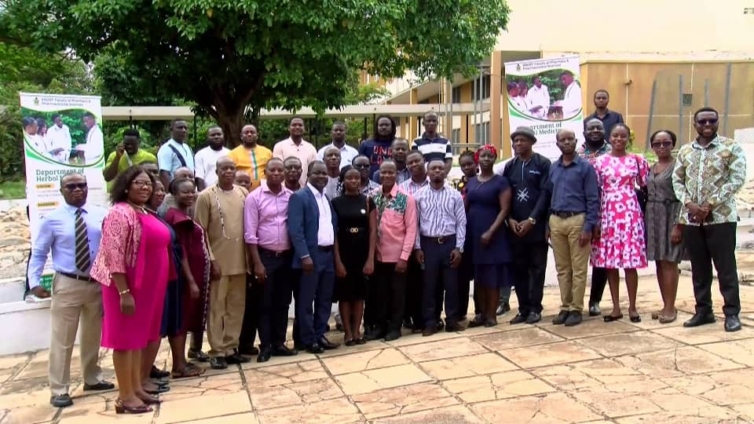
The Department of Herbal Medicine of the Kwame Nkrumah University of Science and Technology (KNUST) is offering training to herbal medicine producers to improve standards and efficacy to compete in the global market.
The World Health Organisation projects the global market for herbal products will be worth five trillion dollars by 2050.
It is estimated that 951 tonnes of crude herbal medicines were sold on Ghana's herbal market in 2010, with a total value of around 7.8 million dollars.
President of the Herbal Medicine Practitioners Association, Dr. Solomon Appiah Kubi, says the group is working with the University for ISO certification to gain acceptability in international markets.
“If you buy a product from China and other foreign countries, you find international standards certification on it, this shows they have standards that make the products highly acceptable. The university will give us a roadmap that will help us attain these standards,” he said.
For years, a section of the public has doubted the efficacy of some herbal medicines because they are not advertised for specific diseases.
The training at KNUST will equip the practitioners with extraction techniques which will ensure products are disease-specific and efficacious.
Dr. Solomon Appiah Kubi says the engagements will expose the side effects of herbal medicines for a better appreciation by researchers in chemical medicine practice.
"Herbal medicines have minimal side effects compared to chemical-based medication. Can we have a study where we can really establish these side effects so that the product can be appreciated by those in chemical based medication," he emphasised.
Head of Herbal Medicine Department at KNUST, Prof. Isaac Kingsley Amponsah, says there is a need for researchers to partner with industry in ensuring herbal medicine is safer for the public.
"With where our practitioners want to go, I think that we owe them a duty that, having brought Science and Technology into herbal medicine practice, we have to help them improve their formulation for the efficacy to go up with low toxicity or very safe profiles," he said.
Meanwhile, the Dean of the Faculty of Pharmacy and Pharmaceutical Sciences, Prof. Samuel Asare Nkansah, says in ensuring the sustainability of herbal medicine production, research will be conducted into the medicinal purposes of other plants.
"Whatever is responsible for activity in a medicinal plant is what we call secondary metabolites, it is not only one plant that has this that can be useful for the treatment of other conditions. What we will have in the collaboration is research and development," he said.
Prof. Nkansah added that "through the research, we can help the manufacturers to know that there can be other plants that can do similar work like the others they have known all this while."
Latest Stories
-
Ghanaian tech professionals develop SMS-based AI tool for non-smartphones
24 minutes -
MTN@30: Three customers drive away brand-new Land Cruiser Prado in Kumasi
44 minutes -
If BOST made GH¢684m profit, why use NPA Bill 2026 to weaken it? – IERPP questions Gov’t
46 minutes -
NPP alleges executive, administrative confusion over Arabic, Chinese language policy
47 minutes -
Minority accuses AMA of targeting Konkomba Yam Market in planned demolition over 24-hour market
54 minutes -
Ghana struggles to raise local funds for delayed cocoa season as investors demand higher returns
1 hour -
GSA delays laboratory equipment replacement despite available funds
2 hours -
IERPP calls for withdrawal of proposed NPA Bill, raises concerns over BOST mandate
2 hours -
We’re not demolishing Konkomba Yam Market – Accra Mayor dismisses Minority’s claims
2 hours -
Nitiwul, Accra Mayor clash over Konkomba Yam Market demolition for 24-Hour-Economy market
2 hours -
BoG urges digital asset businesses to build compliance into operations at Digital Assets Summit Africa
2 hours -
NGIS Money Market Fund’s net assets rise 33.3% to GH¢11.78m
2 hours -
Vaglas join Vughin to mark Dɛng Festival of Sonyor in Savannah Region
2 hours -
Ghanaian model Eligere Di Merrebel attends 2026 Venice Film Festival
2 hours -
“You can’t take our GH¢82m and run away to Nigeria” – Roads Minister fires Enchi–Elubo road contractor
2 hours