

Audio By Carbonatix
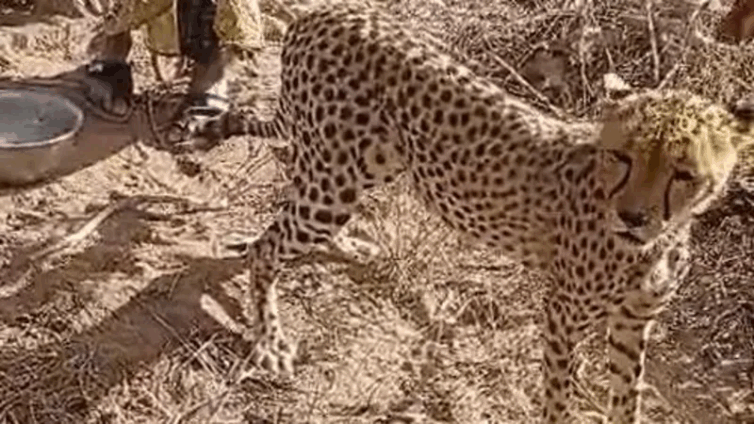
A Kenyan family has told the BBC how a cheetah cub they adopted after finding it lying next to its dead mother became almost like one of their children.
However, their neighbours in the northern Wajir county were not pleased to see a wild animal being raised so close to them.
"Many people immediately told us to get rid of the cub so it wouldn't harm the livestock. We didn't do that because it seemed unreasonable," Bisharo Abdirahman Omar said.
The reaction was unsurprising as the Somali-speaking nomadic community earn their living by raising livestock, which are often threatened by predators such as cheetahs, leopards, lions, and hyenas.
"We knew it wouldn't benefit us in any way, like livestock would," said Rashid Abdi Hussein, a 45-year-old father of 10.
"But I decided that since people are killing these animals, maybe we should raise them instead and be different."
The family cared for the cub for two years and three months, during which it became an inseparable part of the family.
"The animal was troublesome at first, but in the end, it became tame and became one of the children," he said.
The family fed the cub milk through a syringe at first, then meat when it was old enough.
"We have made a big sacrifice - since the day I rescued it, I have slaughtered 15 sheep to feed the cheetah," Mr Hussein told the BBC.
The family have been praised by the Kenya Wildlife Service (KWS) for their generosity in looking after an animal which is often killed or trafficked.
Sharmaarke Mohamed, head of the Northeastern Conservancy Association (NECA), says cheetahs and wildlife across north-eastern Kenya are facing a growing crisis that has gone largely unnoticed.
"Cheetahs are currently facing a very grave threat, along with many other wild animals," he said.
"This young cheetah that was recently found was most likely orphaned, its mother was either killed or poisoned," he said.
According to the Cheetah Conservation Fund, the smuggling of baby cheetahs is widespread in the region, with active trafficking routes running through northern Kenya, eastern Ethiopia, and Somalia.
The organization estimates that between 200 and 300 cheetah cubs are smuggled out of the Horn of Africa each year, many of which are transported to Yemen and then distributed across the Gulf States to be illegally sold as pets.
Ms Omar said the family were approached by people who wanted to buy the young cheetah but they refused to sell it.
"While we were taking care of it, there were people who offered us money. Some even said they would pay 20,000 Kenyan shillings ($155; £115)," she told the BBC.
"Others suggested we trade it for goats, but we refused because it had become part of the family."
While KWS praised the family for looking after the cheetah, it pointed out that keeping wild animals as pets is against the law.
"We deeply appreciate the Good Samaritan's compassion and remind all Kenyans that true coexistence means protecting wildlife," the agency said.
The young cheetah is now being taken care of at the Nairobi Safari Walk.
Latest Stories
-
Ed Sheeran admits ‘mistakes’ at first show since Macklemore controversy
1 hour -
Harry and Meghan’s media treatment echoes what happened to Diana, Earl Spencer tells BBC
3 hours -
Nvidia boss rejects AI extinction fears as ‘doomsday narratives’
3 hours -
Workers came across human remains – and unearthed a mass grave of 572 people
4 hours -
Each Jehovah’s Witness member now decides whether to accept or donate main blood components
4 hours -
Trump says US will form ‘AI Force’ and appoint an artificial intelligence tsar
4 hours -
Google’s Gemini AI hacked three companies in security test
4 hours -
Converse pulls ‘deeply upsetting’ advert after backlash
4 hours -
Warren Buffett steps down after six decades at Berkshire – ‘Father Time always wins’
4 hours -
Billionaire Man United owner says he has lost confidence in the UK
5 hours -
I have experienced racism a thousand times – Lamine Yamal
5 hours -
Ipswich Town investigates racist abuse of Fatawu
5 hours -
Man City battle past Sunderland in eight-goal thriller
5 hours -
Neville calls Man Utd ‘pathetic’ – but Carrick maintains belief
5 hours -
Cunha rescues point for Man United at Fulham
5 hours