


Audio By Carbonatix
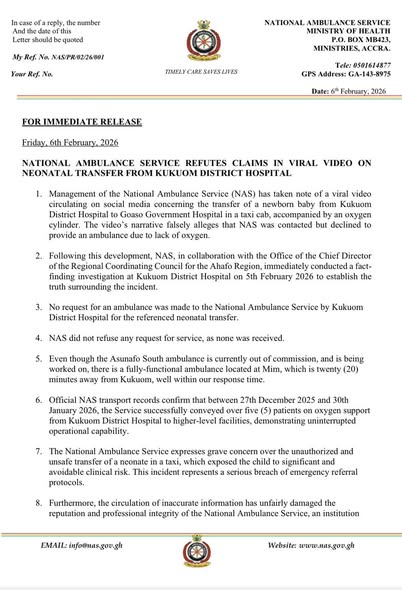
The National Ambulance Service (NAS) has issued a rebuttal to allegations of negligence following the viral circulation of a video involving a newborn baby.
The footage, which sparked widespread public outrage, alleged that the NAS declined a request to transfer a neonate from the Kukuom District Hospital to the Goaso Government Hospital due to a purported lack of oxygen.
However, in a detailed statement released on Friday, 6th February 2026, the NAS clarified that a forensic audit of dispatch logs and on-site investigations conducted at the Kukuom District Hospital on 5th February 2026 proved no such call was ever placed.
The Service maintains that the narrative suggesting they refused to assist is factually incorrect, as they were never activated for the emergency.
“No request for an ambulance was made to the National Ambulance Service by the Kukuom Government Hospital for the referenced neonatal transfer,” the statement confirmed.
Addressing the specific claim that a lack of oxygen prevented the transfer, the NAS stated that because no request was received, the issue of oxygen availability never arose during the period in question.
The Service emphasised that it did not refuse any request, as the Kukuom facility failed to follow the standard operating procedures required to trigger a neonatal emergency dispatch.
The Service expressed grave concern that the infant was eventually moved in a taxi, a mode of transport entirely unsuited for a critical medical referral.
The NAS described this unauthorised and unsafe transfer as a serious risk to the health and safety of the newborn, noting that such actions bypass the life-saving equipment and trained paramedics available in state ambulances.
The incident has highlighted a critical lapse in inter-facility coordination within the region.
To prevent a recurrence, the National Ambulance Service has called on all health facilities to strictly adhere to established emergency protocols.
Key procedural requirements for neonatal transfers include:
- Official Dispatch Request: Facilities must contact the NAS control room to log a formal request for transfer.
- Pre-arrival Coordination: Ensuring the receiving hospital (Goaso Government Hospital) is prepared for the incoming neonate.
- Qualified Supervision: Ensuring patients are moved in an environment equipped with oxygen and neonatal support systems.
The NAS reiterated that it remains committed to providing 24-hour emergency medical services across the country.
By condemning the use of taxis for medical emergencies, the Service is pushing for a revision in how district hospitals manage critical referrals to ensure patient safety is never compromised for the sake of convenience.
Latest Stories
-
Asantehene plants trees to commence Jimi Watercourse Rehabilitation destroyed by galamsey
22 minutes -
15 arrested, 6 trucks impounded over sandwinning activities on Kumasi-Accra Expressway
23 minutes -
OFFICIAL: Vinicius will miss El Clásico, suspended four games
26 minutes -
Prayer vigil held after four arson attack murders
33 minutes -
GRA fully recovers $154k legacy debt owed by foreign entities between 2022 and 2024
35 minutes -
Kwesi Pratt Jr warns bus preachers are adding to passengers’ stress with accident prophecies
36 minutes -
MTN Ghana to spend $1.1bn in 3 years, build 500 new sites as MoMo hits 44% Growth
37 minutes -
I have no regrets joining Assemblies of God – Mahama
38 minutes -
Starlink restrictions in Ukraine war linked to political situation, Zelensky aide says
41 minutes -
Furniture boost for Techiman North schools as MP donates to 20 institutions
41 minutes -
Assemblies of God to loan 10,000-seater dome for Ghana@70 celebrations
41 minutes -
Government to audit 2,016 community network sites – Communications Minister
42 minutes -
Heritage Series notes: BoG promises more inclusive cedi with improved sizes, tactile features
59 minutes -
‘We want answers’ – Family seeks probe into 14-year-old’s death 12 days after starting SHS
1 hour -
No preacher has the right to impose beliefs on bus passengers – Kwesi Pratt Jr backs preaching ban
1 hour