

Audio By Carbonatix
The Council for Scientific and Industrial Research (CSIR) has introduced an early detection technology known as ‘Spore Smart Collector’ to help farmers identify crop diseases before they spread.
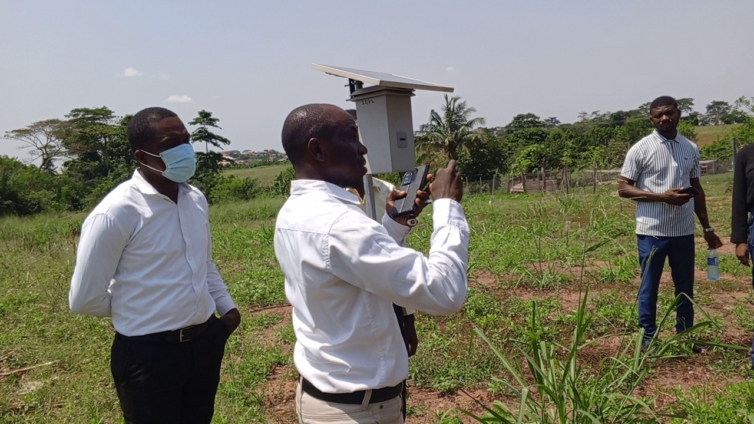
A demonstration meeting brought together farmers, Agricultural Extension Officers, Directors from the Ministry of Food and Agriculture (MOFA), and research scientists to discuss the benefits and possible rollout of the technology.
Country Lead and a Senior Research Scientist, Dr Kwesi Atta Aidoo Snr, explained that the SporeSmart Collector “captures fungal spores within the environment. So in the lab, we can detect the kind of disease that can happen in the field.”
He said the device collects fungal spores from the air on farms, and samples are sent to the laboratory for analysis. This allows experts to detect potential diseases early and advise farmers on preventive action before crops are affected.
Dr Aidoo also addressed concerns about the security of the device when installed on farms.
“Security-wise, we haven’t recorded anything yet in Ghana. For the commercial farmer, it will be in the field, which is being fenced, and there will be a security person or somebody in the field. For security-wise in terms of theft and all that, I don’t think there’s a problem because it’s already in Brazil on the field and they haven’t recorded any theft as yet and we hope that here in Ghana too we'll not record anything like that,” he added.
Luke Murrell of MMV Sense in the UK, who participated in the demonstration, highlighted key challenges that must be addressed before the technology can be expanded nationwide.
“One would be training. Because if we’re going to go from one small installation to many, many thousands of farms, there’s a big training activity that needs to be done, particularly with extension officers,” he said.
He also pointed to financing and building a sustainable service model as important steps for scaling up the project.
“One’s going to be financing the programme, financing the creation of a service. So I think it’s about finding the right partners, finding the right funding models, and a way to pay for this type of service,” he explained
Discussions have been held with the Ministry of Food and Agriculture on possible support, including private-public partnership models. For now, the focus remains on piloting the Spore Smart technology in selected farming communities before expanding it across the country.
Latest Stories
-
Police officer, 6 others injured in New Winneba shooting over land dispute
6 minutes -
SIGA Report: TDC more than triples net profit to ¢195.6m in 2025
11 minutes -
KiDi’s WDWGFH album listening draws strong turnout
18 minutes -
Adu-Boahen Trial: Court gives Atta Akyea final chance to end cross-examination
20 minutes -
Adu-Boahene trial adjourned to September 2 as defence gets extra day to cross-examine witness
22 minutes -
Rising fuel prices will inevitably push up transport fares – COPEC
24 minutes -
GoldBod now appears to be operating a forex bureau – NPP
25 minutes -
Rapid urban expansion outpacing Ghana’s electricity infrastructure – Electrical engineer warns
43 minutes -
Common Fund must not be used to finance Accra waste management, residents must pay – Ayariga
46 minutes -
Palm oil should not be used to induce vomiting
46 minutes -
Nearly 3 out of 4 women give birth without a trained professional in Sene East
52 minutes -
PRURide 2026: Elite race set for September 6
55 minutes -
Forms Capital empowers young Ghanaian innovators to reimagine the future of finance at Hack54 2026
57 minutes -
Recovering ECG’s losses could strengthen power sector without tariff increases – Ing. Quaye-Larbi
58 minutes -
Local Government Minister declares war on indiscipline over sanitation rates
59 minutes