

Audio By Carbonatix
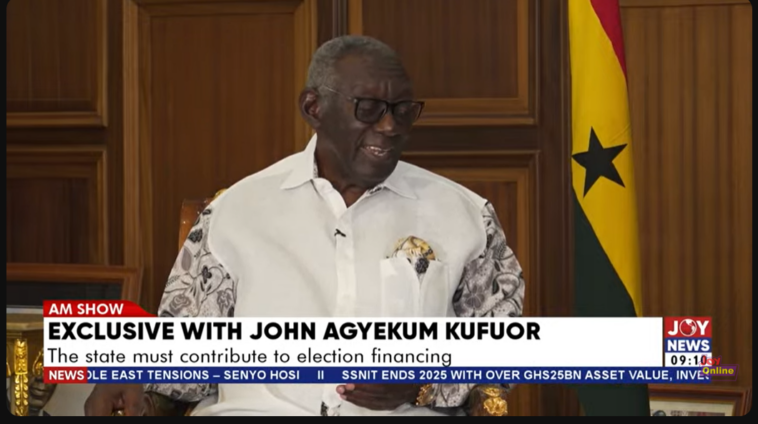
Former President John Agyekum Kufuor has called for a major overhaul of public sector remuneration in Ghana, arguing that low wages for government officials contribute significantly to corruption.
Speaking in an interview on the AM Show, Mr Kufuor said the current salary structure for civil servants and political office holders is unrealistic and creates conditions where corruption can become a coping mechanism rather than an isolated act of misconduct.
According to him, improving governance requires paying public servants competitively while enforcing strict penalties for those who still engage in corrupt practices.
The former president cited the example of Lee Kuan Yew, who famously argued that ministers and senior public officials should be paid salaries comparable to top corporate executives to attract and retain the best talent in government.
“The people I used to fashion these policies are as good as the people in the corporate world getting fat salaries — so they must be paid like the people in the corporate world,” Mr Kufuor quoted Lee Kuan Yew as saying.
He suggested that by that standard, Ghana’s top political offices are significantly underpaid compared to the level of responsibility and expertise required.
Mr Kufuor, however, stressed that better salaries must be matched with strict accountability measures.
“When you choose to be in the public sector, to be well-paid, and you allow yourself to be tempted into red tape and corruption — and they catch you — some of the worst punishments would be visited on you,” he said.
Debate about public sector pay has persisted in Ghana for years, particularly following the introduction of the Single Spine Salary Structure in 2010.
The policy was designed to address wage disparities across the public sector, but critics say it has not fully resolved concerns about fairness and competitiveness in government pay.
Mr Kufuor, who served two terms as president from 2001 to 2009 under the New Patriotic Party, said a comprehensive rethink of how Ghana compensates its public servants is necessary if the country wants to reduce corruption and improve efficiency in public administration.
Latest Stories
-
Collapsed glacier likely caused deadly Nepal-Tibet floods, scientists say
40 minutes -
The Cyrus Lesson: Why Ghana must look beyond religion in choosing its next leader
46 minutes -
I have no problem with public tribunals; they’re constitutional – Anthony Forson
56 minutes -
GRA boss supports mothers’ hostel, donates pickup to Upper Denkyira East Police
1 hour -
NSMQ 2026: St. John’s School beat Benkum SHS, Nandom SHS to secure quarter-finals spot
1 hour -
Minifootball Association of Ghana unveils women’s national team ahead of inaugural AFCON
1 hour -
Appointments Committee recommends approval of three Supreme Court nominees
1 hour -
NSMQ 2026: St. Hubert Minor Sem. reclaims lost seed, sends Mawuli School packing to book quarter-final spot
1 hour -
Beyond “what do you bring to the table?”: Rethinking what partners bring to relationships
1 hour -
NSMQ 2026: Mfantsiman Girls’ back in the quarter-finals after 10 years, snatches spot from St. James
1 hour -
Education Ministry to amend law to restore faith-based representation on GES Council
1 hour -
Teacher unions demand automatic salary placement for newly promoted teachers
1 hour -
Asawase fire: NADMO stops victims from rebuilding burnt homes
1 hour -
SYPALA 2026: ‘Anti-corruption without enforcement is meaningless’ — Senanu
2 hours -
ICT, afternoon court sittings can help clear case backlog – Supreme Court nominee
2 hours