

Audio By Carbonatix
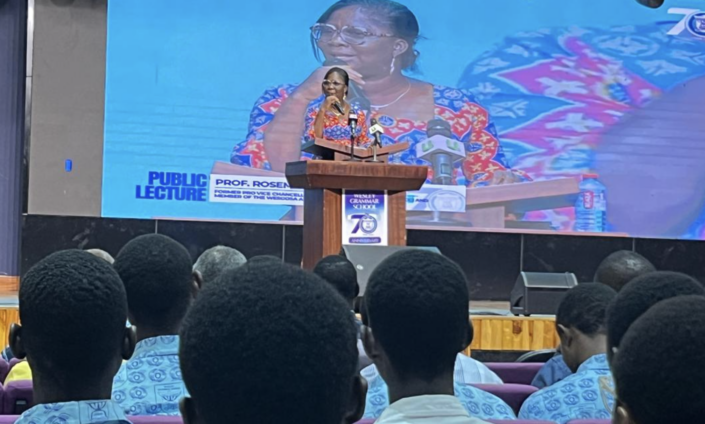
Professor Rosemond Boohene, former Pro Vice-Chancellor of the University of Cape Coast, says Ghana’s curriculum must equip learners with the skills to innovate and solve societal problems.
She said the alignment of the country’s educational system should mould and develop students into agents of transformation in their communities.
Prof Boohene made the call on Wednesday during a lecture as part of activities to mark the 70th Anniversary of Wesley Grammar Senior High School in Accra.
The lecture, organised by the School and the Alumni Association, was on the topic: “Educated to Innovate: Artificial Intelligence, Entrepreneurship, and the Future of Work.”
She said it was imperative not only to educate learners to acquire knowledge but, more importantly, to imagine and think outside the box to address challenges.
Prof Boohene said the advent of Artificial Intelligence (AI) was not meant to take away people’s jobs but to enhance and complement human capital to spur national development.
That, she stressed, was necessary because value was created through real-time negotiation and adaptation mechanisms.
Prof Boohene said the modern education system was a product of the Industrial Revolution, adding that globalisation, technology, and AI had changed the face of education.
Modern education, she noted, should stimulate students to focus on what they could do with what they knew, moving from a knowledge economy to an innovation-driven economy.
She said an entrepreneurial mindset should be embedded in the curriculum from the early stages to help learners become resilient and business-minded.
“The ability to see a problem and the willingness to solve it, especially in the era of AI, are key to the holistic development of learners,” Prof. Boohene said.
“When we combine AI and entrepreneurship in teaching our students, it results in a portfolio life where students are not only defined by a single employer but by multiple opportunities”
Teaching students how to learn and create value for themselves, she stressed, was the way forward to remain competitive in the world of work.
“Learners should be fluent in AI and human values to become responsible future leaders. The future does not belong to passive consumers but to those who combine AI in their activities,” she said.
Professor William Baah-Boateng, Vice-Chancellor of Methodist University, Accra, acknowledged the importance of AI in improving efficiency at the workplace.
He said AI would not replace the human work factor because it was not a human being, cautioning users about the quality of information used to generate responses.
“The human knowledge feeds the technology and must be properly targeted and supplied to produce positive outcomes,” he said.
Latest Stories
-
MTN Ghana webinar urges SMEs to get financial discipline right
19 minutes -
Duvor Klu, Hua crowned champions as J30 Accra Week 1 concludes
32 minutes -
Gov’t to make rural telephony services cheaper by first quarter of 2027 – Sam George
55 minutes -
National Chief Imam remains Ghana’s strongest symbol of interfaith harmony – Mahama Ayariga
1 hour -
Gov’t to upgrade all rural telephony networks to 4G capability – Sam George
1 hour -
‘We’ve never seen a CJ in our judiciary system who is everywhere like MTN’ – Janet Nabla
1 hour -
Lawyers, prosecutors fume over abandoned 26-year-old Upper West High court project
2 hours -
At least two dead in blast at Bolivia military barracks
2 hours -
Tate brothers officially indicted with trafficking and sex crimes in Romania
2 hours -
US envoys arrive in Moscow ahead of Ukraine talks
2 hours -
Health Minister to brief media on Free Primary Healthcare programme on Monday
2 hours -
‘It was inappropriate to make that comparison’ – Dr Pumpuni Asante on CJ’s SOE comment
3 hours -
Photos: Final-day shopping continues at Joy FM Back-to-School Discount Fair
3 hours -
Darkey and Frimpong set up J30 Accra boys’ doubles final
3 hours -
When war takes more than territory: The human cost of conflict
3 hours