

Audio By Carbonatix
(Letter from the Republic of Uncommon Sense)
Dear citizens,
This little story is perhaps the simplest way to understand the great security recruitment conversation now shaking the Republic.
Once upon a time in the Republic of Uncommon Sense, a hospital announced that it had five beds available for patients.
Just five.
Within hours 105,000 sick people arrived.
They came with files.
They came with relatives.
They came with the serious facial expression Ghanaians reserve for government opportunities.
Forms were filled.
Names were recorded.
Registration fees were paid.
Hope filled the waiting room like the smell of Dettol.
But inside the hospital ward, the nurses were already arranging the beds.
One bed for the minister’s cousin.
One bed for the colonel’s nephew.
One bed for the party chairman’s son.
One bed for the district director’s daughter.
And the last bed for someone whose name appears on no hospital list but whose influence travels faster than ambulance sirens.
His name is Protocol.
When the hospital doors finally opened, the nurse stepped outside and cleared her throat.
“Unfortunately,” she said gently, “the hospital is full.”
The crowd stared.
“But… we were here first.”
The nurse nodded sympathetically.
“Yes. But the beds arrived before you.”
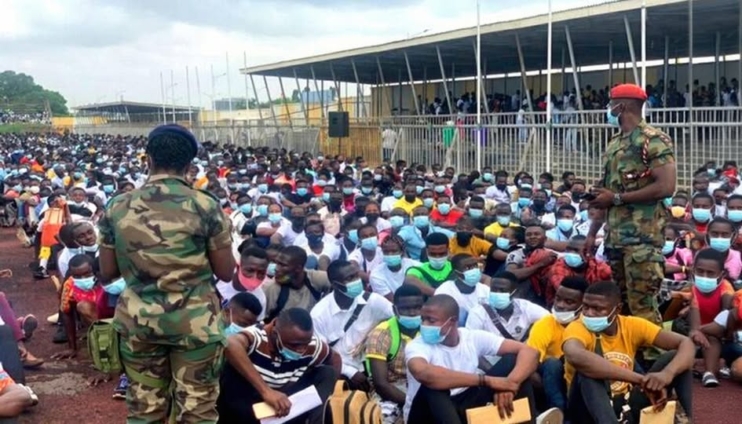
The Ministry of Interior opened recruitment for the security services — police, immigration, fire service, and prisons.
The response from the youth was impressive.
If enthusiasm were electricity, Ghana would now be exporting power to Europe.
The numbers are so beautiful they deserve to be recited slowly.
Available jobs: about 5,000.
Applicants who passed the early stage:
Over 105,000 hopeful young Ghanaians.
Twenty people chasing one uniform.
Twenty dreams competing for a single bunk bed in a barracks.
Twenty families praying that their son will finally wear khaki and start speaking confidently at family funerals.
You must understand the attraction.
A government uniform in Ghana is not just employment.
It is stability.
It is accommodation.
It is pension.
It is the ability to say at weddings, “I work with the state.”
So when recruitment opens, the youth do not walk.
They run.
From Tamale.
From Tarkwa.
From villages where opportunity often arrives late and leaves early.
Forms are filled carefully.
Passport pictures are uploaded.
And then comes the part that has made many citizens raise their eyebrows.
Applicants must pay a registration fee.
Pause for a moment.
In a country where thousands of young people are unemployed, the system asks them to pay money just to apply for a job.
Yet the organisers already know something important.
There are only 5,000 available positions.
Which means tens of thousands of applicants are paying money to enter a process where the overwhelming majority will not succeed.
Naturally the public square has reacted with Ghana’s favourite coping mechanism.
Humour.
One netizen wrote:
“Ghana is the only country where you pay entrance fees for a race whose winners are already warming up at the finish line.”
Another added:
“The recruitment portal is just the waiting room. The real interview happens on phone calls.”
A third offered wisdom that sounded suspiciously like a proverb:
“In Ghana the queue matters… but the connection behind the queue matters more.”
Others were less diplomatic.
“This recruitment thing,” one user posted, “is beginning to look like a national Ponzi scheme for hope.”
Of course officials insist the process is transparent and merit-based.
And perhaps it is.
But citizens are asking reasonable questions.
If only 5,000 jobs exist, why collect registration fees from over 100,000 applicants?
How much money did the registration generate?
And most importantly, how do we ensure that the Republic’s most disciplined institutions recruit based on ability rather than access?
Because when hope begins to look like a business model, the public will inevitably ask questions.
And in the Republic of Uncommon Sense, the elders have always warned about long queues.
When the queue is very long, the wise man does not only watch the people standing ahead of him.
He also quietly watches the small door through which the chief’s relatives enter.
Because sometimes the problem is not unemployment.
Sometimes the problem is believing that the queue determines who enters the room.
Latest Stories
-
Mahama urges African governments to treat healthcare as an investment, not budget cost
31 minutes -
Bawumia congratulates John Boadu and new NPP executives, pledges support ahead of 2028
33 minutes -
‘No talent should be left out’ – Bawumia pledges inclusive NPP campaign for 2028
39 minutes -
Prof. Mike Oquaye recounts how he blocked Special Prosecutor’s attempt to arrest Bawku Central MP
54 minutes -
Make health sovereignty a priority for Africa – Mahama
1 hour -
Dorimon Naa, Wa West DCE lead massive clean-up exercise; threaten sanctions against recalcitrant residents
1 hour -
Photos From Adom FM Y2K Jam
1 hour -
Praye Tiatia steals the show at Adom FM Y2K Jam [Watch]
2 hours -
Boakye Agyarko congratulates John Boadu, pledges support for NPP leadership
2 hours -
Antwi HiMight thrills fans with Antwi ne Antwi hits at Adom FM’s Y2K Jam [Video]
2 hours -
Amb. Edward Boateng congratulates Boadu, Kodua on election wins
2 hours -
John Boadu pledges to rebuild NPP from grassroots and restore ‘winning machinery’
2 hours -
Ashaiman Assembly deploys monitoring system to curb dumping in storm drain
3 hours -
John Boadu must rebuild, unite NPP for 2028 – Edward Boateng
3 hours -
Executive intimidation of opposition undermines separation of powers – Prof Oquaye
3 hours