

Audio By Carbonatix
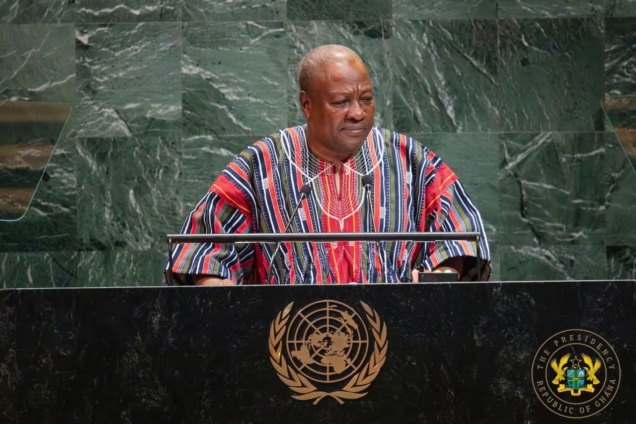
President John Mahama has raised alarm over what he calls the growing erasure of Black history in schools, public institutions, and media, urging the international community to safeguard the memory of Africa’s contributions and the struggles of enslaved Africans.
Delivering remarks at a United Nations event on slavery at the United Nations Headquarters on Tuesday, March 24, he stressed that historical slavery should not be reduced to statistics or sanitised narratives.
“When we speak of six million Africans trafficked to Brazil, two million to Jamaica, half a million to America, and 450,000 to Barbados, we must remember: these were human beings,” he said.
The President highlighted historical systems of oppression, including the Barbados Code of 1661, which allowed plantation owners to torture and kill enslaved Africans, and the Virginia doctrine of partus sequitur ventrum (1662), which legally ensured that children born to enslaved women were also enslaved, regardless of paternity.
President Mahama warned that modern-day erasure echoes these historical injustices.
He criticised educational materials in the United States that downplay slavery, such as a 2015 geography textbook referring to enslaved Africans as “workers,” and content from PragerU, which portrays slavery as a normal historical practice.
“Silence is a form of violence,” Mahama said. “When schools remove Black history courses, when books about slavery and segregation are banned, when museums and cultural institutions are prevented from showcasing Black history, we are repeating the same injustice—not in law, but in memory.”
President Mahama also underscored Africa’s critical contributions to building the New World.
“We laid roads, railways, buildings, and plantations; we cut sugar cane, picked cotton and cocoa, descended into mines, and wet-nursed children. Yet today, the silence about these contributions is deafening.”
The President called for a renewed commitment to teaching the truth about slavery and its legacies, describing it as a safeguard against forgetting.
“Erasing history does not change it,” he said. “It only ensures that the injustices of the past are repeated in memory and society.”
Latest Stories
-
10 rooms destroyed in Bebianiha house fire
1 minute -
Government repatriates 180 Ghanaians from Libya
5 minutes -
GNAT demands independent probe into death of teacher at Gindabour
7 minutes -
Mark Carney says he has considered possibility of US military action against Canada
7 minutes -
Gindabour: GNAT demands GES statement on death of teacher
7 minutes -
6th Western Gospel Awards unveils nominees ahead of November ceremony
9 minutes -
GMTF, GNPC open talks on stronger support for specialised healthcare
10 minutes -
Adu-Boahene case: Atta Akyea files no-case submission, cites evidential gaps, inconsistencies and failure to call material witnesses
28 minutes -
Manchester City ‘found guilty of majority of 115 charges’
36 minutes -
From abandoned ruins to model residence: How Techiman North DCE fulfilled 9-month promise
39 minutes -
Francis Spio Jungo appointed to FanteFest 2026 planning committee
42 minutes -
Roots and Routes uses health walks, air sensors and tree planting to tackle air pollution in Ghana
47 minutes -
Stanbic Bank moves to boost electric vehicle through ‘Be Powered’ campaign
53 minutes -
Tears in Damongo court as accused persons show alleged torture wounds while in police custody
54 minutes -
Telecel Business Runaway in Takoradi equips SMEs with practical tools for growth
59 minutes