

Audio By Carbonatix
President John Mahama has convened an emergency cabinet meeting to chart immediate policy responses to the sharp rise in fuel prices, as global oil markets react to escalating tensions in the Middle East.
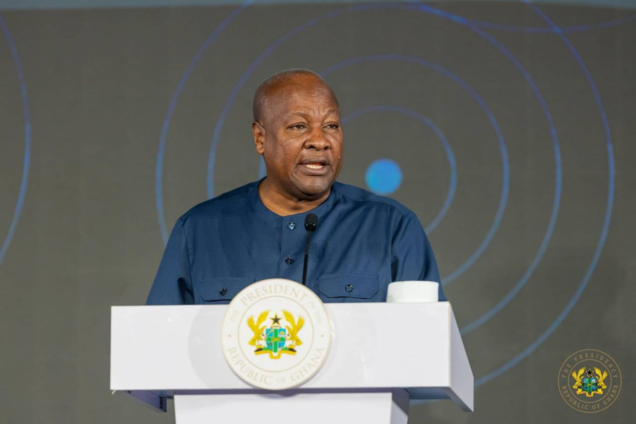
Addressing participants at the Kwahu Business Forum on Saturday, April 4, 2026, the President signalled that the government is moving swiftly to mitigate the impact of rising petroleum costs on households and businesses.
“I have called for this emergency cabinet meeting to decide on specific measures we can take to cushion petroleum prices while we hope the conflict comes to an end. There are adjustments we can make, particularly in the margins, to help maintain relatively stable prices as we pray for the war to cease,” he stated.
The meeting, he explained, will examine the structure of fuel pricing in Ghana, including taxes, levies and margins, with a view to identifying areas where relief can be provided without undermining fiscal stability.
The President’s intervention follows a significant jump in pump prices at the start of April, reflecting volatility in international crude oil markets. Data from the National Petroleum Authority shows that petrol prices climbed by about 15% to GH¢13.30 per litre, while diesel recorded an even steeper increase of roughly 19% to GH¢17.10 per litre for the April 1–15 pricing window.
The surge has raised concerns about knock-on effects on transport fares, food prices and the general cost of living.
Despite the pressures, President Mahama sought to reassure the public that the broader economy remains resilient.
“I can confidently tell you that the economy will not collapse because of the war in Iran,” he emphasised.
The President also acknowledged the role of key stakeholders, particularly transport operators, in helping to stabilise the situation in the short term.
He commended transport unions for resisting immediate fare hikes, describing their restraint as a critical buffer against further economic strain on commuters and businesses.
Any upward adjustment in transport fares typically triggers a chain reaction across the economy, affecting goods and services nationwide.
The outcome of the emergency meeting is expected to shape Ghana’s immediate response to global oil price shocks, as authorities navigate the delicate balance between consumer relief and economic stability.
Latest Stories
-
GPL 2026/27: Medeama go three clear as Hearts of Oak recover and Bechem stage stunning comeback
3 minutes -
Ntiamoah Foundation launches “BEYOND 20” anniversary campaign
23 minutes -
Credit Risk Management Directive: BoG to begin implementation for banks, others from July 1, 2027
40 minutes -
Ghana Brands Awards 2026: Leading brands, business trailblazers to shine on November 20
56 minutes -
T-bills auction: Demand improves as government exceeds target by about 76%; interest rates soften
1 hour -
Ziope undertakes initiative to build a technologically inclined community, commissions self-help ICT lab
1 hour -
ECG announces power outage in parts of Tema, Central Region due to network fault, maintenance
2 hours -
When the Gospel Becomes a Weapon: The church, blackmail and the abuse of faith
2 hours -
JoyNews’ Jacqueline Ansomah Yeboah selected for UK Media Excellence for Emerging Technology Fellowship
3 hours -
Mental Health Alliance urges government to operationalise Mental Health Fund
3 hours -
Ghana–Holy See agreement heads to Parliament after Cabinet approval
3 hours -
Luv FM Corporate Games 2026: Kumasi Central Prisons, Amanfiman Bank win big amid fun
3 hours -
WAFU B U17: Ghana top Group A after win over Togo
4 hours -
Ho Central Mosque reopens amid unresolved leadership dispute that led to closure
5 hours -
Minority caucus questions GH¢16.4m in Ablakwa’s SA evacuation spending, demands independent audit
5 hours