

Audio By Carbonatix
As gun violence and the use of explosive weapons surge across parts of Africa and beyond, leaders on the continent have stepped up urgent efforts to contain the growing menace and protect vulnerable communities.
The initiative, anchored on the 2022 Political Declaration on Explosive Weapons in Populated Areas (EWIPA), endorsed by more than 80 states worldwide, seeks to strengthen civilian protection by restricting the use of heavy explosive weapons in urban centres.
Speaking at an African Regional Workshop in Accra on Tuesday, April 14, Deputy Minister of the Interior, Ebenezer Okletey Terlabi, said African states must act decisively to prevent the spread of such threats, warning that even countries without direct exposure remain vulnerable.
He noted that while Ghana has not recorded incidents involving heavy explosive weapons, it is not insulated from emerging security risks and must therefore adopt proactive prevention strategies.
“Development gains achieved over decades can be reversed in a single conflict by just a blast. Across our continent, communities in conflict-affected regions face the devastating effects of explosive weapons.”
He further highlighted ongoing instability in parts of the Sahel, the Horn of Africa, and Central Africa, noting that these crises demonstrate the urgent need to prioritise civilian protection as both a humanitarian duty and a foundation for sustainable peace and development.
“The ongoing crises in the Sahel, the Horn of Africa, and Central Africa remind us that the protection of civilians demands our most urgent attention, not only as a matter of humanitarian obligation, but as a foundation for peace and development.”
Mr. Terlabi also referenced past incidents in Ghana to underline the domestic relevance of the issue, despite the country’s relative stability in comparison to conflict zones.
“Ghana has not experienced the scourge of explosive weapons. However, we have a firsthand understanding of the consequences of explosive incidents. This backs up the point that Ghana is not immune to these realities.”
He pointed specifically to the Konongo and Apiati explosions in 2025 and 2022, respectively, which resulted in loss of life, destruction of property, and lasting trauma for affected communities.
“The tragic Konongo and Apiati explosions in 2025 and 2022, respectively, where lives were lost, families shattered, livelihoods destroyed, and entire communities traumatised overnight, remain deeply in our national memory.”
He stressed that such events demonstrate the urgent need for sustained action and coordination to prevent similar tragedies.
“These incidents reinforce what we already understood: that the protection of civilians from explosive harm must be taken seriously.”
He added that explosive-related harm goes beyond statistics, representing real human suffering that demands coordinated policy responses and stronger governance frameworks.
“This is because explosive harm is a matter of real lives, real families, and real communities who demand concrete actions, coordinated governance, and unwavering resolve. These are lessons we have since committed ourselves to act upon.”
Mr Terlabi further called for enhanced collaboration between African states and international partners, stressing that no single institution can effectively address the challenge alone.
“The protection of civilians from explosive harm cannot be achieved by any single institution, ministry, or government alone. It requires a whole-of-government and whole-of-society approach, demanding coherent policies, strengthened regulations, well-trained security forces, effective monitoring, sustained public engagement, and a robust partnership between state and non-state actors.”
Adding a technical perspective, the Director at Article 36, Laura Boillot, said the impact of explosive weapons in urban areas is both predictable and preventable, based on well-established global evidence.
“When explosive weapons are used in towns and cities, the harm to civilians is not accidental; it is predictable, and it is preventable. This is why we see consistent and well-documented patterns across conflicts.”
She highlighted the recurring consequences, including mass civilian casualties and widespread destruction of critical infrastructure.
“High levels of civilian casualties, damage to homes, schools, and hospitals, and the disruption of essential services such as healthcare, water, and electricity.”
Ms Boillot stressed that the evidence base is already strong, shifting the debate from understanding the problem to acting decisively on it.
“The patterns of harm are well documented. It is no longer a question of whether we understand the problem, but how we act on that knowledge.”
She warned that the long-term effects extend far beyond immediate destruction, with cascading impacts on livelihoods and recovery.
“Damage to infrastructure can have cascading impacts on communities, affecting livelihoods, access to services, and recovery for months or years.”
According to her, these consequences are increasingly visible across African conflict-affected settings, where they compound broader development challenges.
“These effects are increasingly visible in contexts across Africa, where they intersect with broader development challenges.”
She added that the global community is supported by a growing body of evidence that clearly outlines both the causes and consequences of explosive violence.
“We’re not starting from a blank slate. There is now a substantial and growing body of evidence that helps us to understand both the causes and the consequences of this harm.”
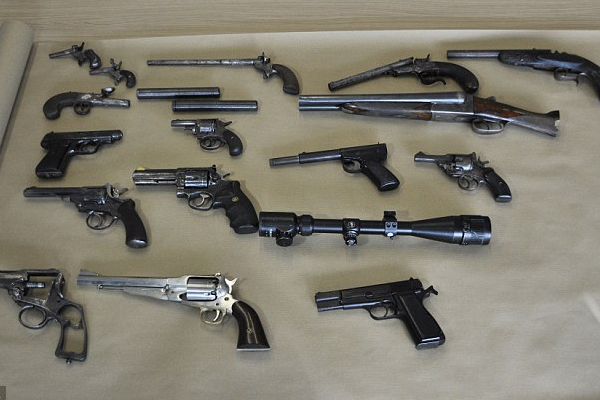
The Executive Secretary of the National Commission on Small Arms and Light Weapons, Adam Bona, also highlighted Ghana’s progress in tackling illicit arms through coordinated national action.
He recalled the Ghana amnesty programme declared by the Minister for the Interior in partnership with the National Commission on Small Arms and Light Weapons and the Ghana Police Service, describing it as a demonstration of the effectiveness of collective action.
“I am also proud to recall that at the national level, our collective efforts continue to bear fruit. The Ghana amnesty programme declared by the Honourable Minister for the Interior, in partnership with the National Commission on Small Arms and Light Weapons and the Ghana Police Service, demonstrated the power of coordinated national action.”
He noted that thousands of firearms were surrendered or regularised under the initiative, marking a significant step in strengthening public safety.
“Thousands of firearms were surrendered or formally regularised, a concrete and meaningful achievement in the broader project of building a safer, more secure Ghana that our citizens deserve.”
He added that the success of the programme underscores the importance of political will, institutional collaboration, and public trust in achieving lasting security gains.
“This success reminds us that political will, institutional collaboration, and public trust are not merely aspirational values; they are practical tools that can move mountains.”
Latest Stories
-
Education is critical to Ghana’s future and development – Haruna Iddrisu
12 minutes -
Who’s Emelia Affi Agbenyo, the 43-year-old newly sworn-in Deputy EC Chair?
46 minutes -
Haruna Iddrisu calls for limits on annual university accommodation fee increases
1 hour -
Today’s front pages: Tuesday, October 13, 2026
2 hours -
Wealth Over Water: How Galamsey Is Threatening Ghana’s Water Security
3 hours -
LA 2028: Black Queens pumped up for second leg of Mauritius tie
3 hours -
LA 2028: Black Queens hold final training session ahead of second leg against Mauritius
3 hours -
Standards are not Seasonal: What the EC appointments teach both sides
4 hours -
King Mohammed VI urges private sector to create youth jobs and spread benefits of growth
4 hours -
KGL U17 Colts 2026: Greater Accra win title after penalties win over Western Region
4 hours -
UK Investment Roadshow opens in London to advance UK-Ghana growth partnership
4 hours -
Assemblies of God requires pastors to resign before entering partisan politics – Rev. Wengam
4 hours -
Ghana targets 20% annual reduction in maternal deaths – Health Minister
4 hours -
Cyber attacks in Africa grow faster than global rate, report finds
4 hours -
Ghana signs UAE deal to create 5,000 overseas jobs
4 hours