

Audio By Carbonatix
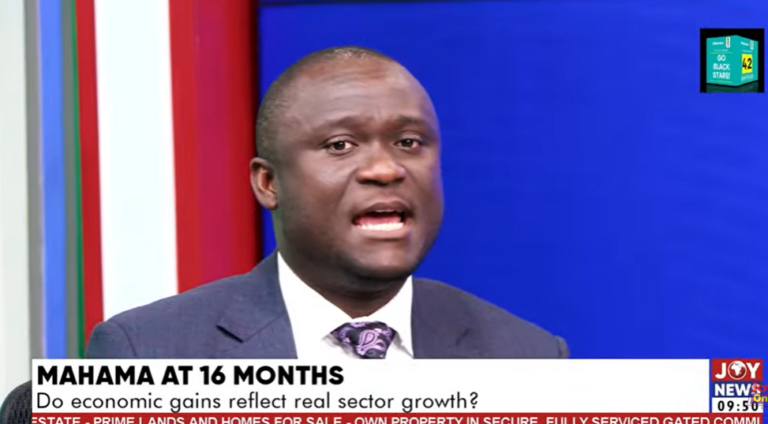
A technical adviser at the Ministry of Finance has defended the Mahama administration's economic record, arguing that the dramatic turnaround in Ghana's macroeconomic indicators is beginning to reach businesses and households, even if many Ghanaians are yet to feel it.
Frederick Amissah, speaking at The JoyBusiness Roundtable Discussion on the theme "Mahama at 16 Months: Do Economic Narratives Match Real-Sector Outcomes?", said the numbers tell a story that cannot be dismissed.
"If you look at the numbers, how they've been turned around — I mean from day to night," Amissah told the panel.
His remarks came as analysts and business groups continue to debate whether the government's macroeconomic achievements have translated into tangible relief for ordinary Ghanaians — on market shelves, at the fuel pump, and inside the boardroom.
Amissah anchored his case on lending costs.
He pointed to the Ghana Reference Rate — the benchmark used to price loans to banks' best customers — as evidence that the cost of borrowing has collapsed. The rate stood at 10 per cent for April 2026, down from 11.71 per cent in March, and a far cry from the roughly 30 per cent that businesses were paying not long ago.
"Ghana Reference Rate, which is the proxy for determining how banks are willing to lend to their best customers, was even around 30% — as we speak, it is 10%," he said. "Businesses are borrowing at a cheaper cost."
The sharp decline in the reference rate tracks a broader easing of monetary conditions. Average bank lending rates fell to 22.2 per cent compared with 30.5 per cent in the same period in 2024, according to the Bank of Ghana, and private sector credit growth recovered from a 7.1 per cent contraction in May 2025 to 5.4 per cent growth by October 2025.
Amissah also cited falling prices as evidence that macroeconomic stability is working its way into the real economy, pointing to a paper presented by the Ghana Union of Traders Association (GUTA) to Parliament in which over 4,000 commodity lines had seen actual price reductions — not just slower increases.
Ghana's headline inflation fell to 3.2 per cent in March 2026 — its lowest since the 2021 rebasing exercise and the 15th consecutive month of disinflation since January 2025.
That is a dramatic reversal from the crisis years under the previous administration, when inflation peaked above 50 percent and the cedi was in freefall.
But Amissah was careful to frame the situation honestly: gains at the macro level do not immediately mean gains at the market or the filling station. His central argument was that the path from macroeconomic stabilisation to microeconomic impact takes time — and that Ghana is currently in that transition.
"The first thing we did was to stabilise the economy," he said. "The path to the impact on the microeconomy is through the macroeconomy. That is what we are experiencing now."
Latest Stories
-
Allround Baby Pants launched in Ghana to ease diapering for mothers
43 minutes -
Aggrieved Gold Coast Fund Management Company customers to petition Mahama over locked-up funds
58 minutes -
NSMQ 2026: PRESEC, Legon dethrones defending champions Mfantsipim in thrilling battle to book semi-final spot
1 hour -
Ghana’s cashew industry faces processing gap as Côte d’Ivoire moves to capture more value
1 hour -
“Our greatest wealth is not in our soil but our people” — Upper West Minister
1 hour -
Luex Healthcare launches children’s health education book series with Luey the Lion
2 hours -
NAGRAT urges gov’t to communicate early if September deadline cannot be met
2 hours -
We trust government to meet September deadline on teachers’ promotions – NAGRAT
2 hours -
“We dare not fail” – Gov’t promises to honour teachers’ promotion pay deal
3 hours -
The GH¢19.8 billion mirage: Inside Ghana’s state enterprise turnaround
3 hours -
Luv FM High School Debate: KNUST SHS and Osei Adutwum SHS set up thrilling final after dramatic semi-finals
3 hours -
KNUST AI Coordinator urges structured adoption of AI in teacher education
3 hours -
Nepal rescuers blast hillside in search of hydropower workers as families wait anxiously
3 hours -
Teachers who pass promotional exam to get January 2026 start date after gov’t resolves promotion dispute – Dr Apaak assures
3 hours -
NSMQ 2026: St. John’s School rally from slow start to book semi-final spot
3 hours