

Audio By Carbonatix
The Chief Executive of the Ghana National Chamber of Commerce and Industry, Mark Badu Aboagye, has warned that Ghana’s improving macroeconomic indicators are yet to translate into tangible benefits for businesses and consumers, citing persistent structural constraints and the effects of tight monetary policy.
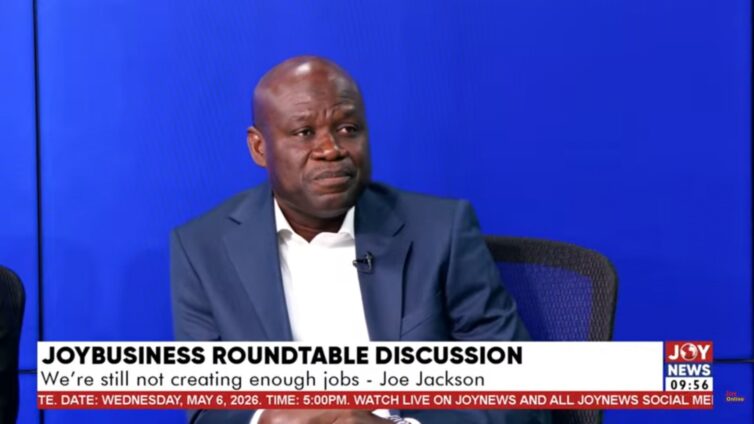
Speaking at a roundtable discussion hosted by Joy Business on “Mahama at 16 Months,” Mr Aboagye argued that while headline economic figures point to progress, the real economy continues to face significant challenges.
Mr Aboagye noted that the transmission of macroeconomic gains into everyday economic activity is neither immediate nor automatic.
He stressed that although government and policymakers appear to have made strides in stabilising key indicators, the benefits are yet to fully reach households and businesses.
“The transmission mechanism takes some time, moving from the macro to the micro,” he said. “Now you’ve done the macro, it is about time you do the micro.”
He acknowledged that recent figures are “critical” and “good,” but maintained that unresolved structural issues are slowing the pace at which these improvements are felt across the economy.
“These structural issues are still persisting, and that is the reason why we are not seeing this impact,” he explained.
A significant portion of the recent decline in inflation, according to Mr Aboagye, has been driven by monetary policy interventions led by the Bank of Ghana.
He explained that such measures typically involve reducing liquidity within the financial system to curb price increases.
In practical terms, this contractionary approach has reduced the amount of money in circulation, thereby weakening consumer purchasing power.
“The Bank of Ghana assumes there is a lot of money in the system and is mopping up liquidity,” he said. “That means the purchasing power of the ordinary person goes down.”
This dynamic, he noted, creates a paradox for businesses. While firms are willing and able to produce, weakened consumer demand limits their ability to sell goods and services at desired volumes.
“Businesses want to produce and people to buy,” he said. “But when people say there is no money in their pockets, demand falls. Naturally, that contraction affects the uptake of goods and services.”
Mr Aboagye emphasised that macroeconomic stabilisation often involves trade-offs, particularly when it comes to balancing inflation control with economic growth.
“Every macroeconomy comes with a cost,” he said, urging policymakers to weigh the broader implications of maintaining low inflation.
He questioned whether the current inflation level—around 3.2 per cent—is optimal for production and business expansion, suggesting that the focus on price stability may sometimes come at the expense of economic activity.
“That is why the Bank of Ghana has a target for inflation, not necessarily economic activity,” he observed.
Beyond monetary policy, Mr Aboagye highlighted the enduring challenge of high production costs, which continue to exert upward pressure on prices and undermine the benefits of falling inflation.
He argued that sustainable low inflation cannot be achieved without addressing the underlying cost structure faced by businesses, including expenses related to energy, transport, financing, and inputs.
“If you want to sustain inflation at a lower level, you need to look at the cost of production,” he said. “Anytime the cost of production is high, inflation will rise.”
Despite official data indicating declining inflation, he noted that many consumers and businesses do not feel the relief, largely because prices remain elevated in real terms.
“People are not feeling it,” he said. “They still say prices are high because the cost of production is still high.”
He called for a more balanced approach to economic management—one that not only focuses on stabilising key indicators but also addresses the underlying inefficiencies that hinder productivity and growth.
Latest Stories
-
“We dare not fail” – Gov’t promises to honour teachers’ promotion pay deal
52 seconds -
The GH¢19.8 billion mirage: Inside Ghana’s state enterprise turnaround
9 minutes -
Luv FM High School Debate: KNUST SHS and Osei Adutwum SHS set up thrilling final after dramatic semi-finals
16 minutes -
KNUST AI Coordinator urges structured adoption of AI in teacher education
30 minutes -
Nepal rescuers blast hillside in search of hydropower workers as families wait anxiously
46 minutes -
Teachers who pass promotional exam to get January 2026 start date after gov’t resolves promotion dispute – Dr Apaak assures
49 minutes -
NSMQ 2026: St. John’s School rally from slow start to book semi-final spot
49 minutes -
Promotion pay row: Gov’t gives teachers September to complete salary adjustments
1 hour -
Financial irregularities plummet by 62.9% as state tightens fiscal controls
1 hour -
DVLA to expand mobile services to underserved communities in Ghana’s Eastern Corridor of the Northern Region
1 hour -
GUTA urges GPHA to act swiftly to end Tema Port congestion to avert rising business costs
1 hour -
Port congestion could undermine 24-hour economy policy – GUTA
1 hour -
NSA opens three-day window to resolve national service biodata mismatches
1 hour -
Abu Jinapor highlights increased gold exports after Domestic Gold Purchase Programme
2 hours -
NPP UK branch calls for independent audit into gold purchasing operations and parliamentary probe
2 hours