

Audio By Carbonatix
The National House of Chiefs has renewed its appeal for increased financial support from the government, noting that inadequate funding is adversely affecting its ability to resolve chieftaincy disputes across the country.
According to the House, the lack of adequate resources has slowed down arbitration processes, causing several cases that could have been settled within days to drag on for months and, in some instances, years.
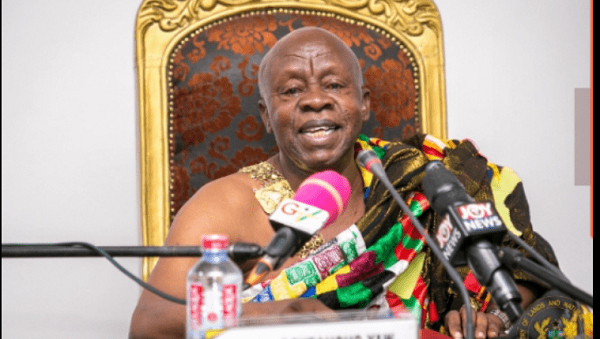
The President of the House, Ogyeahoho Yaw Gyebi II, made the appeal when the Parliamentary Select Committee on Chieftaincy and Religious Affairs paid a courtesy call on the House.
Speaking during the meeting, Ogyeahoho Yaw Gyebi II expressed concern over the growing number of unresolved chieftaincy disputes in various parts of the country, stressing that the situation continues to threaten peace, unity and development in affected communities.
He explained that although the House remains committed to promoting peace and settling disputes through traditional arbitration mechanisms, the lack of financial resources has become a major obstacle to its operations.
“Cases that can be resolved within three, four or five days sometimes take months or even years because of limited funds,” he stated.
The President, therefore, appealed to the Parliamentary Select Committee to support efforts aimed at improving funding for the House to enable it to effectively carry out its constitutional mandate.
He noted that adequate funding would help facilitate investigations, transport committee members to dispute areas, organise hearings and speed up adjudication processes to ensure timely justice in chieftaincy matters.
Chairman of the Parliamentary Select Committee on Chieftaincy and Religious Affairs, Dr. Fred Kyei Asamoah, acknowledged the concerns raised by the House and assured traditional authorities of the committee’s commitment to engaging the appropriate state institutions to address the challenges.
According to him, chiefs played vital governance roles long before the introduction of modern democratic systems, adding that the 1992 Constitution also recognises and assigns important responsibilities to traditional leaders.
He further noted that chieftaincy disputes have remained a major challenge in some parts of the country, often leading to tensions, violence and prolonged litigation, thereby affecting development and social harmony within communities.
He therefore appealed to all stakeholders to support efforts aimed at resolving such disputes peacefully.
The National House of Chiefs plays a key role in adjudicating and mediating chieftaincy disputes while also preserving Ghana’s cultural and traditional heritage.
Latest Stories
-
Africa Nations Volleyball Championship: Ghana set up quarterfinal clash with Cameroon after beating Chad
15 minutes -
Meet Dr Benjamin Appiah Osei — Ghana’s three-time tourism awards winner
44 minutes -
UEFA & CONCACAF demand Fifa pays $10m to all 211 members
45 minutes -
Inter fight back again to snatch draw at leaders Roma
49 minutes -
Suzuki proves worthy replacement for Martinez at Villa
54 minutes -
Brighton humbling ‘a big lesson’ for Arsenal – Arteta
58 minutes -
Arsenal handed first loss by brilliant Brighton
1 hour -
Video: Akwatia MP ‘clashes’ with Kofi Bentil over 3.9-tonne cocaine seizure
1 hour -
Ratcliffe ‘must go’ says Man Utd Muslim fan group
1 hour -
Ignite Social Enterprise targets global market for locally manufactured Ghanaian products
1 hour -
Eviction notice leaves retired, serving railway workers in Kumasi in limbo
2 hours -
Asiedu Nketia: Why I remain an unrepentant Nkrumahist
2 hours -
Kudus, Djiku return a boost to Black Stars – Agyemang-Badu
3 hours -
‘If the world, Africa honoured Nkrumah as the Millennium Man, why are we not doing same?’ – Asiedu Nketia
3 hours -
Yaw Preko backs renewed push to revive Colts football
3 hours