

Audio By Carbonatix
The bell rings at the Accra Sports Stadium, and Perina Lokure Nakang does what she has always done when life demands something of her: she runs.
It is Day Two of the African Senior Athletics Championships. Heat 2 of the women's 800 metres. She starts well. Strong. By the end of those 800 metres, she has not made the cut. The qualification places go elsewhere. She finishes, catches her breath, and stands tall.
She has been here before, not in Accra specifically, but in the space between what you hoped for and what happened. In 2010, her aunt grabbed her in the middle of the night and ran. War had broken out in South Sudan. They fled to Kakuma Refugee Camp in northern Kenya. Six years passed before she saw her mother again.
Sport found her late. Nakang is one of the most experienced of the five athletes representing the Athlete Refugee Team at these championships, a World Athletics initiative now a decade old. She arrived in Accra hoping to lower her personal best on the continental stage for the first time. It did not come on Day Two. But she is not done.
"Next time, people will organise for me another game, I'll do my best, I'll take medal or gold, I'll try next year to put my effort."
Each of the five carries a version of the same story told differently.
Solomon Okeny crossed into Kenya in 2010 with his mother and five siblings. He arrived at Kakuma Refugee Camp and initially turned to football. Athletics came by accident. Now he runs 400 and 800 metres.
"Being a refugee, it has been difficult before," he says. "As a refugee, we know we don't have that much chance or opportunity, but the experience we have in the camp was tough, but we are managing it. It depends on who you are, or what you want to do."
On the track in Accra, he runs with pride.
"When you step into the track, when you start participating, you participate with different people, different mindsets, and you find yourself competing with a champion, and those who have been there before. It really gave me hope, and seeing myself growing, and doing my best."
Abdifatah Aden Hassan fled Ethiopia in 2009. He was a child. War broke out. His talent was spotted through the IOC Refugee Athlete Scholarship programme. The 1500 metre specialist is still searching for his parents fourteen years after fleeing Ethiopia. The hope is to be an Olympian someday.
"Really, everything is going well. I'm very happy. My hope is to become a world classic championship and Olympian. And also I want to motivate other refugees all over the world and inspire them."
Dario Lokoro, in the 5000 metres, ran 16:13 at the Kenya trials and arrived in Accra with one clear instruction for himself: win.
"In the future, I need to train hard, to come and win," he says.
The other two athletes are Kun Waar Liem, who, at seven years old, was forced to flee South Sudan and has not seen his parents since.
Susan Nakiro. She is not competing in Accra. An injury ruled her out. But her story belongs in this telling.
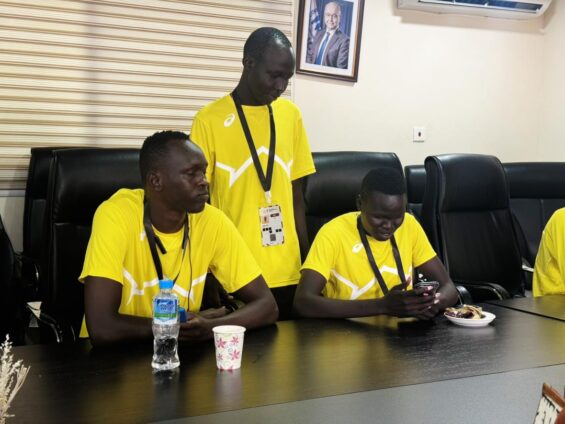
On Thursday, the team visited the UNHCR national office in Accra, a moment that anchored the week in something larger than track times and qualification rounds.
Tetteh Padi, who heads the office, met them.
"The refugee athletes are an embodiment of the resilience of refugees. The fact that they're like you and me, who have gone, but they have gone through unfortunate circumstances. But these athletes have proven that being a refugee should not be a barrier to realising your full potential."
Lieutenant General Jackson Tuwei, President of Athletics Kenya and Vice President of World Athletics, used the moment to push further. The programme, now a decade old, has produced athletes who have competed at every major championship. But its reach is still largely limited to East Africa.
"We want to urge other countries that host the refugees in their countries to also take up in this matter, so that it can then take care of all the refugees within the continent."
The five athletes of the Athlete Refugee Team did not come to Accra to be pitied or celebrated for their pain. They came to compete. They came to be seen as what they are, athletes who happen to have come through something most people will never face, and who chose to run toward something anyway.
Their ambitions in Accra have been humbling so far. Glory has been elusive. But none of them came here only for the result.
Latest Stories
-
CPP calls for protection and revival of state-owned enterprises to honour Nkrumah
2 minutes -
emPLE Life Insurance named Rising Brand of the Year at 6th CIIG Insurance Excellence Awards
3 minutes -
St Peter’s old boys to build 1,000-seater dining hall and modern kitchen for 70th anniversary
5 minutes -
St Peter’s old boys kick off 70th anniversary journey with ‘Run to 70’
21 minutes -
Agyemang-Badu urges GFA, Sports Ministry to disclose Carlos Queiroz’s contract terms
28 minutes -
Ghana and Panama sign MoU to deepen bilateral political consultations and cooperation
32 minutes -
Black Stars: Mohammed Fuseini receives late call-up for September-October games after head injury
38 minutes -
Traders reselling GH¢25k Kejetia phase one shops for up to GH¢120k — Local Government Ministry
48 minutes -
Korle Bu begins work on 400-bed Mother and Child Block with IVF, NICU and theatres
58 minutes -
Mahama discusses potential Open Society Foundations support for ECOWAS integration
1 hour -
IGP, Savannah Regional Minister visit Gbindabuor as 36 suspects assist police investigations
1 hour -
Carlos Queiroz sets 2027 AFCON qualification as Ghana’s immediate Black Stars target
2 hours -
When oil rises but the pump does not rise as much
2 hours -
Starting a business in Ghana as a young man is tough – HR practitioner
2 hours -
Nkrumah’s policies should inform Ghana’s development — UG African Studies Director
2 hours