

Audio By Carbonatix
For many Ghanaian diaspora investors, real estate remains one of the most trusted ways to build wealth, preserve capital, stay connected to home, and participate in Ghana's long-term growth story.
But the investment question is becoming more sophisticated. It is no longer simply about buying any property in Accra. The smarter question is: what type of asset should sit inside your portfolio, and what role should each property play?
Some properties are designed for steady urban rental demand. Some are built for prestige and long-term appreciation. Others are structured for professional management of hospitality income. When viewed properly, these assets are not competing with each other. They are different portfolio tools.
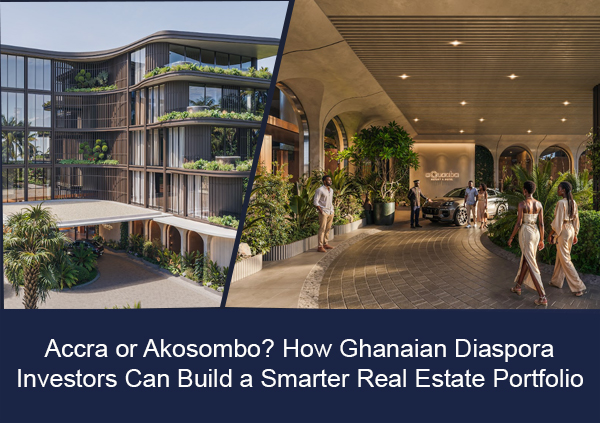
This is especially important when comparing Quao Realty's urban developments in Accra with its hospitality-focused aQuaaba resort model in Akosombo. One Elm, Manora, The Autograph, and aQuaaba do not solve the same investor problem. Each one speaks to a different investment objective.
For diaspora investors, the best approach is not to choose blindly between Accra and Akosombo. The stronger strategy is to understand how each asset can support capital preservation, rental income, lifestyle value, passive management, and long-term portfolio growth.
Why Diaspora Investors Need a Portfolio View
Many diaspora buyers begin with one simple idea: buy a good property in Ghana. That is a reasonable starting point, but it is not enough for serious investment planning.
A real estate portfolio should balance different needs. It should protect capital, generate income, manage risk, support future resale, and remain practical to own from abroad.
This is where asset comparison matters. A studio in Airport Residential does not behave the same way as a design-led apartment in Cantonments. A resort suite in Akosombo does not behave like a city apartment. A short-stay rental does not carry the same operational burden as a fully managed resort model.
The investor must first decide what problem the asset is meant to solve.
Is the goal immediate rental income? Long-term appreciation? Prestige? Passive ownership? Lifestyle access? Diversification away from Accra? Or a balanced mix of all these?
Once that question is clear, the right asset becomes easier to identify.
Hospitality Income Sleeve: aQuaaba Resort Hotel
For investors seeking a more passive, hospitality-backed opportunity, aQuaaba Resort Hotel offers a different path from traditional Accra apartments.
Located in Akosombo, aQuaaba is positioned around leisure travel, lakefront hospitality, wellness, destination events, retreat demand, and professional resort management. It is designed for investors who want exposure to Ghana's growing tourism economy without having to personally manage a short-let property.
For diaspora buyers looking to add a leisure-income sleeve to an Accra-focused portfolio, aQuaaba offers a direct way to explore managed resort investment in Ghana.
The Four Asset Types in Simple Terms
Quao Realty's portfolio gives investors four different ways to think about Ghana real estate.
One Elm fits the Airport Residential investment story. It is an urban apartment development positioned for business travellers, corporate tenants, diaspora buyers, upper-income residents, and serviced-living demand. It is best understood as an urban core asset with strong location fundamentals.
Manora Residence also sits in Airport Residential, but its public positioning is especially clear for buy-to-rent investors. With compact unit options, strong amenities, and property management support, Manora is built for investors who want prime Accra exposure with a rental-logic approach.
The Autograph is different. It is a Cantonments trophy-style asset. Its value is tied to design identity, prestige, scarcity, diplomatic demand, and long-term capital positioning. It may appeal more to buyers who want status, architecture, and appreciation potential than to those seeking only immediate yield.
aQuaaba is not a normal apartment project. It is a managed hospitality asset in Akosombo. Its appeal comes from resort operations, leisure demand, pooled income mechanics, and hands-free ownership. It should be assessed like a hotel-linked investment, not a regular condo.
That difference matters. A smart investor does not judge all four assets by the same yardstick.
Urban Accra Assets: The Core of the Portfolio
For most diaspora investors, prime Accra remains the core of the Ghana property portfolio.
The reason is simple. Accra has stronger resale depth, more familiar property structures, easier comparability, clearer rental demand, and a wider pool of buyers. Airport Residential and Cantonments remain among the most trusted investment locations because they attract professionals, diplomats, frequent travellers, corporate tenants, affluent residents, and diaspora buyers.
This gives urban assets an important role: capital preservation and long-term wealth compounding.
Urban apartments can be leased long term, used as serviced apartments, held for appreciation, occupied personally during visits, or resold into a broader market. This flexibility is important for investors living abroad.
However, urban assets also require careful management. Short-stay rentals can generate attractive income, but they involve guest turnover, cleaning, maintenance, utilities, platform commissions, pricing, and local supervision. Long-term leases are usually easier to manage, but may produce lower gross returns.
This is why professional property management is becoming central to diaspora real estate ownership.
Airport Residential Income Asset: Manora Residence
For diaspora investors seeking prime Accra exposure with a rental-logic approach, Manora Residence presents a strong Airport Residential opportunity.
Located close to Kotoka International Airport, Manora is designed for professionals, frequent travellers, business guests, residents, and investors who value convenience and managed ownership. Its unit mix, amenities, co-working areas, rooftop lifestyle spaces, and Q5 property management support make it especially relevant for buy-to-rent buyers.
For investors seeking a city-based asset with strong tenant appeal, Manora Residence offers a practical entry point into managed Accra rental property.
Airport Residential: Yield, Convenience, and Rental Velocity
Airport Residential remains one of Accra's most practical investment locations. Its strength comes from access.
It is close to Kotoka International Airport, key business districts, embassies, restaurants, hotels, offices, and major roads. This makes it attractive to business travellers, consultants, expatriates, corporate tenants, diaspora visitors, airline-linked professionals, and short-stay guests.
For income-focused investors, this matters because the location supports both long-stay and short-stay demand.
Compact units such as studios and one-bedroom apartments can be especially attractive because they reduce the entry ticket while still giving the investor access to a premium rental market. Smaller units are often easier to furnish, easier to price, and easier to rent to frequent travellers and young professionals.
This is why Manora and One Elm fit the urban income sleeve. They are built around high-access urban living, amenity convenience, and flexible rental demand.
Cantonments: Prestige, Scarcity, and Long-Term Value
Cantonments has a different investment logic from Airport Residential.
While Airport Residential is driven heavily by movement, travel, and convenience, Cantonments is driven by prestige, diplomatic proximity, perceived security, lifestyle quality, and long-term scarcity.
Buyers in Cantonments are often looking for more than rental yield. They want an address. They want identity. They want a property that can hold value because the location is difficult to replicate.
This is where The Autograph becomes relevant. A design-led development in Cantonments can appeal to diplomats, professionals, families, executives, diaspora buyers, and investors who want a more prestigious Accra holding.
Its investment strength may not be only in immediate income. It may also be in long-term capital appreciation and resale appeal.
Prestige and Scarcity Asset: The Autograph
For diaspora buyers seeking a premium Accra address with design identity and long-term capital appeal, The Autograph offers a distinctive Cantonments opportunity.
Located on Josif Broz Tito Street, The Autograph is centred on architecture, exclusivity, lifestyle amenities, smart access, concierge services, wellness spaces, rooftop living, and the prestige of one of Accra's most respected neighbourhoods.
For investors who want a trophy-style city asset with strong owner-occupier and rental appeal, The Autograph offers a refined route into Cantonments real estate.
Akosombo: The Leisure Income Sleeve
Akosombo plays a very different role in a diaspora investor’s portfolio.
It is not primarily about city convenience or diplomatic housing. It is about hospitality, tourism, weekend travel, lakefront leisure, corporate retreats, wellness, events, and destination experiences.
This makes aQuaaba an income diversification asset rather than a direct substitute for an Accra apartment.
A resort property in Akosombo serves a different demand engine. It can benefit from domestic tourism, diaspora holiday travel, couples’ retreats, family escapes, group bookings, conferences, weddings, and leisure experiences.
For investors, the appeal is that this demand is not exactly the same as that for urban apartments. If Accra's short-let market becomes crowded, a strong resort may still attract guests because people travel there for a different reason.
That is real diversification.
Why aQuaaba Should Be Underwritten Differently
aQuaaba should not be assessed like a normal apartment purchase.
In an apartment, the investor usually focuses on rent, tenant demand, service charges, property management, resale value, and location comparables. In a resort-hotel model, the investor must also focus on hospitality operations.
The key questions are different.
How strong is the operator? How will room revenue be pooled? What costs are deducted before owner distributions? How often are returns paid? How are owner-use nights handled? What happens during the low season? How are maintenance reserves funded? Can the owner resell? Who approves the buyer? What reports will owners receive?
These questions matter because the investor's income depends heavily on the resort's performance as a hospitality business.
This is why aQuaaba can be powerful but must be treated with proper investment discipline.
The Power of Managed Ownership
One of the most attractive aspects of professionally managed real estate is the reduced burden on the owner.
Many diaspora investors want Ghanaian property, but they do not want to chase tenants, coordinate repairs, follow up with cleaners, manage bookings, handle utilities, or resolve guest issues from abroad.
A managed model can solve part of that problem. In an urban property, this may come through a property management company that handles tenant placement, rent collection, maintenance, and furnishing support.
In a resort model, it may go even further. The operator may handle the entire hospitality experience, including bookings, housekeeping, guest service, marketing, maintenance, and revenue management.
For investors living outside Ghana, this is not a minor benefit. It can be the difference between an asset that works and an asset that becomes stressful.
Cash Flow Versus Capital Appreciation
Different assets create value in different ways.
Manora is more income-efficient because of its Airport Residential location, compact unit sizes, buy-to-rent positioning, and professional management support. It is suitable for investors who want practical rental performance in a prime city location.
One Elm also fits the Airport Residential income and capital-preservation story, especially for investors looking for an urban apartment with broad tenant appeal.
The Autograph is more prestige-led. It is likely to appeal to investors who want a stronger design identity, scarcity of Cantonments, and long-term appreciation potential.
aQuaaba is more cash-distribution oriented. Its value is tied to resort performance, leisure demand, professional operation, and the ability to distribute income from hospitality activity.
These differences are important. An investor looking for immediate income should not evaluate a prestige asset the same way as a resort income asset. An investor looking for long-term appreciation should not judge a design-led Cantonments property only by short-term yield.
A Smarter Portfolio Mix
For many diaspora investors, the best strategy is a barbell approach.
This means keeping the majority of capital in urban Accra assets for title familiarity, resale depth, tenant demand, and capital preservation, while adding a measured Akosombo hospitality sleeve to diversify income.
A conservative investor may prefer a larger allocation to One Elm and Manora, with smaller exposure to The Autograph and aQuaaba. This creates a portfolio focused on easier resale, stronger urban demand, and lower niche-market risk.
A balanced investor may combine Manora's income logic, The Autograph’s prestige value, and aQuaaba’s hospitality-income diversification. This gives the investor exposure to both city demand and leisure demand.
A growth-focused investor may allocate more to The Autograph and aQuaaba, accepting construction timelines, operator dependence, and lower liquidity in exchange for stronger long-term upside and differentiated demand.
The key point is simple: aQuaaba should usually complement urban Accra assets rather than replace them entirely.
What Diaspora Investors Should Check Before Buying
Before buying any real estate asset in Ghana, diaspora investors must take due diligence seriously.
For urban apartments, investors should review the title or lease documents, building approvals, payment schedule, construction timeline, service charge structure, furnishing requirements, property management agreement, rental assumptions, and resale conditions.
For a resort-hotel asset, investors should go further. They should request the management agreement, revenue waterfall, owner-use rules, reserve policy, reporting format, audit rights, tax treatment, exit process, and details of the hospitality operator's responsibilities.
Investors should also understand whether projected returns are guaranteed, targeted, or illustrative. These are not the same thing.
Independent legal, tax, and property advice is essential. Diaspora investors should not rely only on brochures, sales conversations, or social media content.
Regulation and Management Matter
Ghana's property market is becoming more structured, and investors should welcome that development.
Accommodation businesses, serviced apartments, and short-stay rentals may require proper licensing, inspection, and compliance with tourism standards. This is especially relevant for investors planning to operate short-term rentals or hospitality-style units.
For diaspora buyers, regulation is another reason to use experienced developers and property managers. A professionally managed asset can help reduce compliance risk, operational mistakes, and avoidable stress.
Good management is not just about collecting rent. It is about protecting the asset, maintaining standards, properly handling guests or tenants, and keeping the investment professionally positioned.
Exit Strategy Should Come First
Many investors think about exit only when they are ready to sell. That is a mistake.
An exit strategy should be considered before acquisition.
Urban Accra apartments usually have broader resale potential because the buyer pool includes owner-occupiers, investors, corporate landlords, diaspora buyers, and local professionals.
A resort-linked investment may have a narrower resale market because the buyer must understand and accept the operator-managed hospitality model. That does not make it unattractive, but it means liquidity should be assessed carefully.
Before buying, investors should ask: who is the future buyer, how will the asset be valued, can it be transferred, are there resale restrictions, and does the developer or operator have a right of first refusal?
A beautiful investment with no clear exit path can become difficult later.
Which Asset Fits Which Investor?
For investors who want practical rental performance and city convenience, Manora may be the strongest fit.
For investors seeking a broader urban-core asset in Airport Residential, One Elm fits the prime Accra rental and capital-preservation story.
For investors who care about prestige, design identity, Cantonments scarcity, and long-term value, The Autograph is the stronger match.
For investors seeking professionally managed hospitality income and exposure to Ghana's leisure economy, aQuaaba offers the clearest resort-backed opportunity.
The best choice depends on the investor’s goals, time horizon, liquidity needs, risk tolerance, and desire for passive management.
Final Thoughts
Ghanaian diaspora investors should not treat all real estate opportunities as the same. A prime Accra apartment, a Cantonments trophy residence, and an Akosombo resort asset each play different roles.
The strongest strategy is to build a portfolio, not just buy a property.
Urban Accra assets such as One Elm, Manora, and The Autograph can provide capital preservation, rental demand, resale depth, and long-term appreciation. aQuaaba can add exposure to hospitality income, leisure demand, weekend travel, corporate retreats, and Ghana’s growing tourism economy.
For most diaspora investors, the smartest approach is a balance: keep Accra as the core and use Akosombo as a measured diversification sleeve.
That way, the portfolio is not dependent on a single city, tenant type, rental model, or source of demand.
When selected carefully and backed by proper due diligence, these assets can work together to create a stronger, more resilient Ghana real estate portfolio.
Latest Stories
-
Mahama tours flood-hit Hohoe communities, presents relief items
2 minutes -
Baffour Awuah should be granted bail to continue EOCO probe – Boakye Ayarko
5 minutes -
I wasn’t going to let others die, says Indian pilot who opened cockpit door during attack
8 minutes -
GNFS removes large bee swarm from metal container at Suhum-Okorase
9 minutes -
Mahama reaffirms healthcare commitment as Global Mercy begins 10-month Ghana mission
11 minutes -
Iran urges Iraq to lift flight ban amid US sanctions
21 minutes -
GIBA calls for constitutional protection of media freedom in ongoing review
28 minutes -
Revealed: Carlos Queiroz resigned from Black Stars job; he wasn’t sacked
29 minutes -
10 years, 2 cars and a motorbike: Studio 7 Clinic & Med Spa rewards loyal staff
38 minutes -
Schandorf Writes: Is the galamsey fight lost? An open letter to Oliver Barker-Vormawor
46 minutes -
Fr Andrew Campbell honoured among 100 Africa Most Influential Persons in Rwanda
1 hour -
Ghana to mark World Cleanup Day with National Sanitation Day on October 3
1 hour -
Ignite Social Enterprise to partner Ghanaian watch manufacturer to boost global sales
2 hours -
Ignite Social Enterprise does not condone fraud – Bola Ray
2 hours -
Mr Eazi returns with new single ‘Comfort’ featuring Moliy
2 hours