

Audio By Carbonatix
The Economic Community of West African States (ECOWAS) has set an ambitious target of achieving regional rice self-sufficiency by 2035. It is therefore urging governments, investors and development partners to accelerate financing for a sector it says holds the key to West Africa's food security and agricultural transformation.
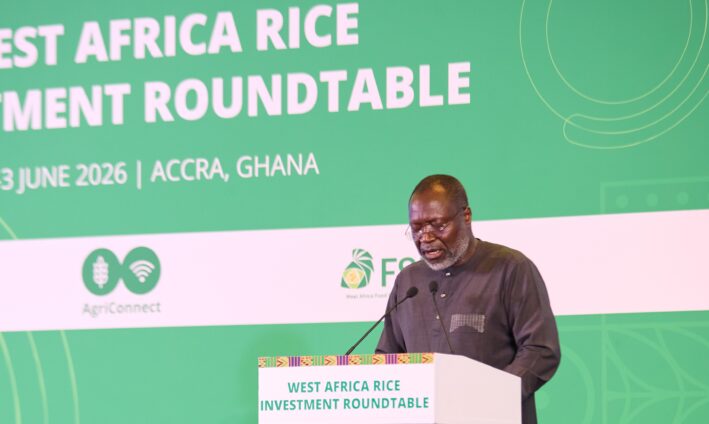
Speaking at the opening of the West Africa Rice Investment Roundtable in Accra on Tuesday, June 2, 2026, the President of the ECOWAS Commission, H.E. Dr. Omar Alieu Touray, said the region can no longer afford to depend heavily on imported rice despite its vast agricultural potential.
"We cannot keep importing what we can grow ourselves," he told the gathering, adding that "This roundtable marks an important milestone in implementing the ECOWAS Rice Agenda and our collective ambition to achieve rice self-sufficiency in West Africa," Dr. Touray said.
According to ECOWAS, the region currently produces only 61 percent of the rice it consumes. Rice output increased by 44 percent between 2008 and 2024. But rapid population growth, urbanisation and changing consumption patterns have outpaced production. The supply gap keeps growing.
For Dr. Touray, that deficit represents more than a challenge, arguing that it is an opportunity to increase domestic production, strengthen regional value chains, attract investment and accelerate agrifood systems transformation across West Africa.
Those opportunities underpin a long-standing ECOWAS strategy to make rice a cornerstone of regional food security and economic development. Rice has been a priority under the ECOWAS Agricultural Policy (ECOWAP) for more than a decade. In 2014, the Commission launched the ECOWAS Rice Offensive to complement national rice development strategies. More recently, in December 2024, ECOWAS Heads of State adopted the Regional Rice Roadmap (2025-2035), providing a common framework to guide investments and policy interventions across member states.
To strengthen coordination, the Commission established the ECOWAS Rice Observatory, bringing together governments, farmer organisations, research institutions, development partners and private sector actors to monitor progress and support implementation.
Dr. Touray noted that member states have since developed National Rice Investment Action Plans and country-specific investment pipelines to identify priority projects and financing opportunities. He acknowledged the support of the World Bank and the African Development Bank in advancing the initiative.
Despite the progress, several structural challenges continue to constrain the sector. Low productivity. High production costs. Inefficient milling systems. Post-harvest losses. Limited access to finance. Insufficient private sector investment.
He stressed that addressing those challenges would require moving beyond policy discussions to concrete action.
"This roundtable must therefore serve as a catalyst for action," he said. "It must strengthen investor confidence, reinforce partnerships, accelerate financing for bankable opportunities, and help build a more competitive, resilient and self-sufficient regional rice economy."
The ECOWAS agricultural policy is currently being reviewed to align with the Kampala Declaration on agricultural transformation. For the first time, the review process includes consultations with nine stakeholder groups, including farmers, researchers, women, youth, financial institutions, private sector representatives and other non-state actors. Dr. Touray described the process as inclusive and participatory.
"Our ambition is clear: to build more competitive, inclusive and sustainable agrifood systems that strengthen food sovereignty, create economic opportunities, contribute to shared prosperity and progressively achieve regional rice self-sufficiency by 2035," he said.
He also commended Ghana for hosting the roundtable and praised the country's leadership in promoting agricultural development and regional integration.
Dr. Touray concluded with a call for measurable outcomes from the discussions.
"The success of this roundtable will ultimately be measured not by the quality of our discussions, but by the progress we deliver for our farmers, our businesses and our communities," he said.
The two-day roundtable has brought together ministers, investors, financial institutions, development partners and private sector players to mobilise investment for the regional rice agenda. The event is being organised by the ECOWAS Commission in partnership with the World Bank, the African Development Bank and other technical and financial partners. Ghana was represented by Vice President Prof. Jane Naana Opoku-Agyemang.
Latest Stories
-
Mahama urges African governments to treat healthcare as an investment, not budget cost
20 minutes -
Bawumia congratulates John Boadu and new NPP executives, pledges support ahead of 2028
21 minutes -
‘No talent should be left out’ – Bawumia pledges inclusive NPP campaign for 2028
27 minutes -
Prof. Mike Oquaye recounts how he blocked Special Prosecutor’s attempt to arrest Bawku Central MP
43 minutes -
Make health sovereignty a priority for Africa – Mahama
54 minutes -
Dorimon Naa, Wa West DCE lead massive clean-up exercise; threaten sanctions against recalcitrant residents
1 hour -
Photos From Adom FM Y2K Jam
1 hour -
Praye Tiatia steals the show at Adom FM Y2K Jam [Watch]
1 hour -
Boakye Agyarko congratulates John Boadu, pledges support for NPP leadership
2 hours -
Antwi HiMight thrills fans with Antwi ne Antwi hits at Adom FM’s Y2K Jam [Video]
2 hours -
Amb. Edward Boateng congratulates Boadu, Kodua on election wins
2 hours -
John Boadu pledges to rebuild NPP from grassroots and restore ‘winning machinery’
2 hours -
Ashaiman Assembly deploys monitoring system to curb dumping in storm drain
2 hours -
John Boadu must rebuild, unite NPP for 2028 – Edward Boateng
2 hours -
Executive intimidation of opposition undermines separation of powers – Prof Oquaye
3 hours