

Audio By Carbonatix
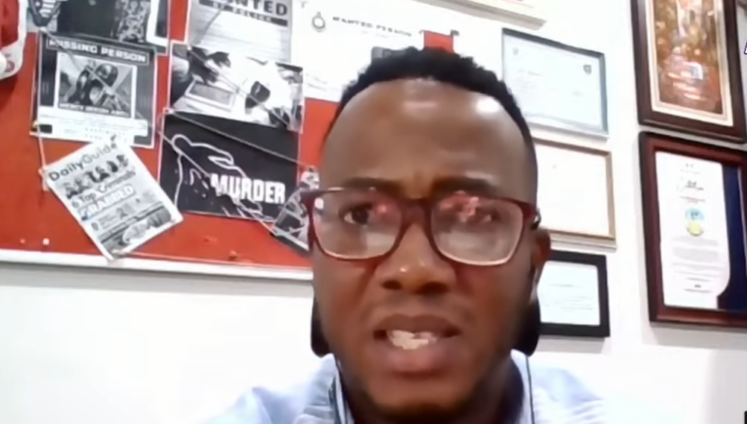
A criminologist at the Kwame Nkrumah University of Science and Technology (KNUST), Dr Jones Opoku-Ware, has called on Ghana to tighten border security, strengthen family values, and expand community support systems to tackle the country's growing drug problem.
Speaking on Joy FM's Super Morning Show on Monday, July 27, during a discussion about the JoyNews Hotline documentary, Deadly Doses II, Dr Opoku-Ware said Ghana's drug problem had evolved into a national crisis that requires more than law enforcement.
Responding to a question on what could be done to solve the problem and restore sanity to the system, he said the country needed a coordinated response involving multiple sectors.
"So, you know, this drug issue in this country. I think it's a multi-sectoral approach that has to be employed," he said.
Dr Opoku-Ware said one of the first steps should be to disrupt the operations of international drug trafficking syndicates exploiting Ghana's weak border controls.
According to him, intelligence and research show that transnational criminal networks are working closely with local groups to move drugs into the country through poorly secured borders.
"We must begin looking at what we call the transnational cartels because, as it were, based on intelligence and based on studies, we know that when it comes to the movement of drugs in this country, the borders are porous," he said.
He explained that the porous nature of Ghana's borders had made it easier for drug traffickers to transport illegal substances while making the work of security agencies much more difficult.
"Because the borders are very porous, it has enabled these transnational cartels to work with certain local cartels within the country to move these drugs across our borders in a very, very easy way. Ways that it becomes very difficult for even the security agencies to track."
The criminologist said some of the trafficking networks have links to Nigeria, Latin America and parts of Asia. He cited Tramadol as one example of a drug that has been known to enter Ghana from countries such as India.
"At this stage, we may have to find a way to seal this porousness of our borders so we can track these movements of the cartels and then have a firm grip on them," he added.
Beyond border security, Dr Opoku-Ware said Ghana must examine the role of families in preventing young people from abusing drugs.
He said that many young people involved in substance abuse were struggling with identity issues because they had not received proper guidance and values during childhood.
"As a criminologist and somebody who is a criminal psychologist, I'm just beginning to now think that there may be a problem with probably how our kids are being raised," he said.
He questioned whether changes in family structures were contributing to the increasing number of young people abusing drugs.
"What are the families doing? Is that a problem within our family system as opposed to how our kids were raised over the period?"
According to him, families have a responsibility to build children's confidence and values from an early age so they are less likely to be influenced by peers later in life.
"Every child, it is the duty of the family to give this kid an identity," he said.
Dr Opoku-Ware said many young people only begin searching for a sense of belonging after entering secondary school, where peer groups often shape their identity instead of their families.
"I think that there is a lapse in the way that family systems have been over the years now. We must begin going back and looking at how family systems are working and how we are raising the kids and imbibing in them the right set of values."
The criminologist also urged the government to expand community-based interventions to areas most affected by drug abuse.
He welcomed efforts by the government to establish community social support systems in some Zongo communities, describing the initiative as a step in the right direction.
"I was very happy to hear the interior minister say that now, in places like the Zongos, they are having these community social support systems, which I think are very good. It must be replicated across the country, especially in these drug hotspots," he said.
He explained that communities are often best placed to identify local problems and help prevent crime and substance abuse.
"Communities are the best people to help us deal with crime," he stated.
Dr Opoku-Ware also called for sustained public education through schools and community campaigns to discourage drug abuse and promote healthy lifestyles.
Earlier in the interview, he warned that Ghana's drug problem had changed significantly in recent years, with users increasingly mixing prescription medicines, painkillers and cough syrups to create new substances that are difficult for authorities to monitor.
"It is not just a criminal act as probably we used to have it sometimes, but now it is becoming a public, or in fact, it's even become a public health crisis for which all of us as a country have to be very much worried about," he said.
Latest Stories
-
T-bills auction: Government exceeds target marginally; yield on 91-day bill remains unchanged
1 hour -
GPL 2026/27: 10-man Aduana hand Kotoko defeat in Kumasi
2 hours -
GPL 2026/27: Medeama ease past Basake Holy Stars
2 hours -
Appiah Adomako writes: Why DVLA must stop treating every expired licence holder as delinquent
2 hours -
Localization must transfer decision-making power, not just project responsibilities
2 hours -
Modernising Ghana’s traditional markets through the 24-Hour Economy markets initiative
2 hours -
New economy will boost local production and create jobs – Finance Minister
3 hours -
Real-Time VAT on cross-border digital services – not a new tax and does not violate double taxation principle
3 hours -
Digitalisation, AI key to Ghana’s tourism transformation – GHATOF
4 hours -
Stronger GTA-private sector partnership needed to grow tourism – GHATOF
4 hours -
Amazon eyes Ghana for broadband expansion after talks with Mahama
4 hours -
National Investment Quiz 2026: Six schools qualify for quarter-finals
5 hours -
‘Do not let Russia pay for its madness with lives of your people’ – Zelensky to Ghana, 46 other countries
5 hours -
6,079 promotion cases fully processed and paid – CAGD says amid nationwide teachers’ strike
5 hours -
Teacher unions to meet government Monday over nationwide strike
6 hours