

Audio By Carbonatix
On the night I spent exploring the town of Elubo for my story "In the Dark: The security risk Ghana is ignoring at Elubo” , what surprised me most was not the complaints from community members about the unseen illegal crossings but rather the dark stretches of frontier that no patrol vehicle, no checkpoint lights, and no border guard could realistically cover.
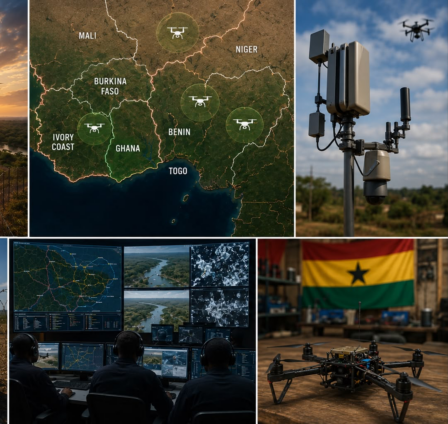
Ghana's land borders alone stretch for more than 2,090 km, running through forests and waterways that were never designed with modern security in mind. That exposure left me with an uncomfortable question that has only grown louder in the months since: how does a country with limited manpower and an overstretched budget monitor a border it cannot physically patrol? The answer being adopted from Kyiv to Bamako is the same. You put eyes and firepower in the sky where needed.
This is not a hypothetical scenario. It is already taking place on the continent. Jihadist groups such as Jama'at Nusrat al-Islam wal-Muslimin (JNIM) have been documented flying kamikaze drones deep within the Sahel, and their reach now extends to the borders of Togo, Ivory Coast, and Benin. In January 2026, an Islamic State affiliate reportedly used kamikaze drones in a single coordinated assault on Niamey's international airport in Niger. Benin recorded its deadliest jihadist attack in years, roughly 300 kilometres from Accra.
The war Ghanaians regarded as someone else's, playing out from a distance on screen, is now drawing near with drones.
What Ukraine Has Taught the World About Drone Warfare
Nowhere has the transformative power of drones been more clearly demonstrated than in the Russia-Ukraine war, now in its fifth year. A 2026 study by Dr. Fred P. Hoffman, Dr. Behsat Ekici, and Brock Ruth of Mercyhurst University's Intelligence Studies Department, published in the Croatian defence journal Strategos, asks a very important question every security agency on the continent should also be asking: does the evolution of drone warfare in Ukraine amount to a mere revolution in military affairs (RMA) or a full military revolution (MR)?
The difference is worth making here. A revolution in military affairs (RMA), the authors explain, refers to technological, tactical, doctrinal, or organisational changes confined to the military sphere. New weapons used in familiar ways. A military revolution goes further: it redefines not just how wars are fought, but how militaries are organised and how states themselves function. Citing the Pentagon strategist Andrew Krepinevich's four criteria: technological change, military systems evolution, operational innovation, and organisational adaptation — Hoffman, Ekici, and Ruth conclude, based on interviews with ten drone-warfare specialists across Western militaries and intelligence services, that Ukraine's experience meets all four. In other words, drone warfare is not a passing trend. It represents a genuine revolution, on the scale of the machine gun in WWI or the aircraft carrier in WWII.
The figures backing this up are striking. Ukraine reportedly manufactured about 2.2 million small first-person-view (FPV) drones in 2024 alone, plus around 100,000 larger long-range models, with most of the ones used by its troops domestically manufactured. These first-person-view drones, which cost just $500, now account for a large share of Russian casualties. The Strategos study puts it near 80 percent, making them deadlier than artillery on the battlefield. A Ukrainian interceptor drone built for roughly $1,600 has been used to shoot down Russian reconnaissance drones worth tens of thousands of dollars each. As one Kyiv-based electronic-warfare executive quoted in the study put it, a single guided missile can cost a million dollars and kill a dozen people, but that same amount buys ten thousand drones capable of far more damage.
This is the math that should concern every security agency in Africa. It is exactly the math that Sahelian jihadist groups are continually exploiting against forces that, in many cases, still rely on foot patrols and fixed checkpoints.
Drones Do Not Just Win Wars— They Change How States Behave
If Ukraine's example demonstrates why drones are important on the battlefield, the newest and perhaps most important contribution to this topic explains something security agencies rarely stop to consider: how drones shape decision-making itself. In his 2025 book The Remote Revolution: Drones and Modern Statecraft, MIT political scientist Dr. Erik Lin-Greenberg overturns a widely held assumption that cheap, low-cost drones make leaders quicker to strike and push crises closer to war.
Drawing on original wargames, survey experiments, and case studies of American and Israeli drone operations, Lin-Greenberg argues that because drone missions carry no risk of a pilot being captured or killed, they lower the political cost of using force, but that same low cost also makes those operations far less likely to spiral into wider, more intense conflict than a comparable mission flown by a drone would. In his view, drones add a new step to the escalation ladder, giving states a more convenient way to respond. He argues this amounts to nothing less than a revolution in how modern states conduct their affairs.
For security agencies in West Africa, this should not be taken just as an academic point but as a policy tool in itself. A Ghanaian or Nigerian security service equipped with surveillance and light-strike drones would have graduated options for responding to a cross-border incursion or a smuggling convoy. These are options that do not require sending troops, risking soldiers' lives, consuming time, or triggering a diplomatic incident with a neighbouring state. Lin-Greenberg's research suggests the more likely outcome is drone-enabled restraint, provided the doctrine and command structure around the technology are solid. That is the one condition West African security agencies cannot afford to skip.
The Threat Is Already at the Gate
Fortunately, Ghana has not experienced any jihadist attacks like Mali, Burkina Faso, and increasingly Benin. Even though conflicts in Bawku and the north have flared up now and then, it has managed to prevent jihadist violence. Security analysts monitoring the Sahel warn that armed-drone use by militant groups is expected to keep expanding through 2026, with JNIM already the dominant user of armed drones in the region. It is expanding its activity into western and southern Burkina Faso and Mali, areas right on the border with Ghana, Ivory Coast, Togo, and Benin.
The withdrawal of French and American forces from Niger, and the closure of a key Western drone and intelligence hub there, has left a vacuum that Sahelian juntas have filled with a patchwork of alternative partners: drones sourced from the UAE, training support from Morocco, and other ad hoc arrangements. Western countries have moved to what is now described as an "over-the-horizon" strategy. Instead of focusing on the Sahel's interior, they're now backing coastal countries like Ghana, Ivory Coast, and Benin as the new front line. Ghana and its coastal neighbours now need stronger drone and surveillance abilities of their own, instead of relying on outside support due to this new shift.
Turning the Lessons Into Policy
This does not mean turning Ghana's security architecture into a smaller replica of the Ukrainian battlefield. Instead, it means being more careful and disciplined. That is, adapting the proven lessons of Ukraine's drone revolution and the strategic thinking of Lin-Greenberg's escalation research and turning them into an approach that fits West Africa's actual threats: border crossings by armed groups, communal violence, clashes linked to illegal mining (galamsey), piracy in the Gulf of Guinea, and extremism spreading south from the Sahel.
What we've seen points to several concrete steps.
- Layered aerial surveillance of the northern border regions (Upper East, Upper West, and Savannah), using low-cost fixed-wing and quadcopter reconnaissance drones to close the blind stretches that undercut checkpoint-based patrolling.
- A domestic drone-assembly and maintenance capacity, rather than reliance on costly imported systems, following Ukraine's example of building a low-cost, locally serviceable fleet rather than a small number of expensive, hard-to-replace platforms.
- Investment in counter-drone and electronic-warfare capability, since the same technology available to Ghana's security services is equally available and increasingly used by armed groups and criminal networks operating along the borders.
- Clear rules of engagement and command authority for drone use, so that the flexibility Lin-Greenberg identifies as de-escalatory is preserved by doctrine and does not collapse into unaccountable or indiscriminate use.
- Regional intelligence-sharing on drone sightings and incidents among Ghana, Ivory Coast, Togo, and Benin, mirroring the cross-border coordination that has allowed jihadist groups themselves to operate across borders.
- Dedicated training pipelines for drone operators and analysts, building the kind of specialised, rapidly-trainable workforce that Ukraine's drone schools have shown can be stood up quickly and cheaply relative to conventional pilot training.
The Cost of Waiting
Security agencies often judge how ready they are by counting personnel and vehicles. But Ukraine's experience and the growing drone threat spreading from the Sahel toward Ghana's border show that this way of measuring readiness is outdated. A border can now be breached without anyone crossing it in person; it can be surveilled and struck from several kilometres away by an enemy who never sets foot on the ground. West African security agencies that continue to plan primarily around foot patrols and manned aircraft will end up as Ukrainian and Sahelian forces already have, outpaced by enemies who adapted first.
The good news is that this is one of the few areas in modern defence where getting started does not cost too much. Unlike fighter jets or navy ships, building real drone capability doesn't need massive spending programs. What it needs is a clear strategy and a local system for maintaining and building the equipment. Not forgetting the political will to treat drones as a core part of national security. Ghana and West Africa have a good reason and growing chance to build this capability now before the threat fully arrives.
The kilometres between Burkina Faso and Accra used to be seen as a safe distance. Today, as this piece has shown, they should be seen as a warning instead and as a window of time that's still open to invest in smart and low-cost drone security before that window closes on us.
Latest Stories
-
Mahama urges African governments to treat healthcare as an investment, not budget cost
20 minutes -
Bawumia congratulates John Boadu and new NPP executives, pledges support ahead of 2028
21 minutes -
‘No talent should be left out’ – Bawumia pledges inclusive NPP campaign for 2028
27 minutes -
Prof. Mike Oquaye recounts how he blocked Special Prosecutor’s attempt to arrest Bawku Central MP
43 minutes -
Make health sovereignty a priority for Africa – Mahama
54 minutes -
Dorimon Naa, Wa West DCE lead massive clean-up exercise; threaten sanctions against recalcitrant residents
1 hour -
Photos From Adom FM Y2K Jam
1 hour -
Praye Tiatia steals the show at Adom FM Y2K Jam [Watch]
1 hour -
Boakye Agyarko congratulates John Boadu, pledges support for NPP leadership
2 hours -
Antwi HiMight thrills fans with Antwi ne Antwi hits at Adom FM’s Y2K Jam [Video]
2 hours -
Amb. Edward Boateng congratulates Boadu, Kodua on election wins
2 hours -
John Boadu pledges to rebuild NPP from grassroots and restore ‘winning machinery’
2 hours -
Ashaiman Assembly deploys monitoring system to curb dumping in storm drain
2 hours -
John Boadu must rebuild, unite NPP for 2028 – Edward Boateng
2 hours -
Executive intimidation of opposition undermines separation of powers – Prof Oquaye
3 hours