

Audio By Carbonatix
The High-Level Conference on Governance, Critical Minerals, and Conflict in Africa has ended with a strong call for African governments to adopt a new governance framework that places transparency, democratic accountability, industrialisation and citizen participation at the centre of the continent's critical minerals agenda.
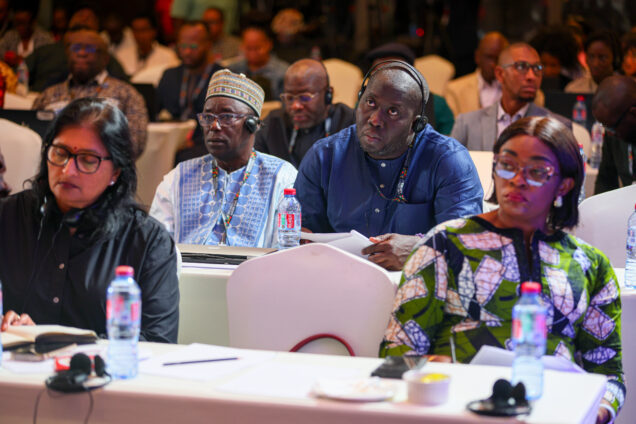
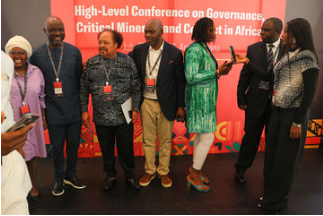
The three-day conference, held from July 27 to 29 at the Kempinski Hotel Gold Coast City in Accra and convened by the Open Society Foundations (OSF), brought together senior government officials, representatives of the African Union (AU) and Regional Economic Communities (RECs), parliamentarians, civil society organisations, traditional leaders, mining communities, researchers, development partners, philanthropic organisations and private sector actors from across the continent.
Against the backdrop of rising global demand for critical minerals needed for the energy transition and advanced technologies, participants examined how Africa can ensure its vast mineral wealth contributes to inclusive development, democratic resilience, and sustainable peace rather than conflict and inequality.
Delivering the closing reflections, the Programme Manager for Transformative Peace in Africa at the Open Society Foundations, Tem Mbuh, said Africa's future in the global critical minerals economy would depend not on the abundance of resources beneath its soil but on the quality of governance surrounding them.
Using his native Cameroon as an example, Mr Mbuh cited figures from the country's national mining company, SONAMINES, showing that while only 148 kilogrammes of gold were officially exported between 2021 and 2025, more than 44 tonnes of Cameroonian gold were recorded in Dubai over the same period, representing an estimated US$3.4 billion in lost value.
He described the disparity as evidence of the enormous governance challenges confronting the continent's extractive sector.
"For me, the conversations we have had over the last three days have not been abstract debates about governance, critical minerals, or conflict. They have been a mirror held up to realities we know too well across our continent," he said.
Mr Mbuh said the example underscored the need for African governments to fundamentally rethink how mineral resources are governed if the continent is to benefit from growing global demand.
"A strong consensus emerged from our deliberations, namely, that the future of Africa's critical minerals is not fundamentally a question of geology. It is a question of governance."
According to him, the conference identified five strategic priorities: recognising critical minerals as a governance issue rather than simply a mining issue; integrating peacebuilding into mineral governance; promoting value addition and industrialisation instead of exporting raw minerals; placing communities at the centre of decision-making; and strengthening regional cooperation through African institutions.
Mr Mbuh urged governments to move beyond collecting royalties from mineral extraction and instead channel mineral revenues into industrialisation, technology, education, environmental restoration, and community development.
He also called for stronger enforcement of mining laws, greater citizen participation, protection of civic space and accelerated implementation of the Africa Mining Vision and African Union critical minerals policies.
"We should remember that history rarely presents nations and continents with moments such as this. Africa's critical minerals must not become another chapter in the history of extraction. They must become the foundation of democratic renewal, transformative peace, and inclusive development."
He stressed that achieving that vision would require closer collaboration among governments, regional institutions, civil society organisations and the private sector to ensure Africa's mineral wealth delivers lasting benefits to its people.
Building on the call for stronger governance and collective action, Chief Operating Officer of the Open Society Foundations, Leela Ramdhani, described the conference as a timely platform that had brought together policymakers, researchers, civil society organisations, mining communities, and private sector leaders to forge new partnerships around one of Africa's most pressing governance challenges.
She said the discussions reinforced the urgency of developing coordinated and inclusive governance systems capable of ensuring that Africa's abundant critical mineral resources become a source of prosperity and sustainable development rather than conflict and exploitation.
According to Ms Ramdhani, Africa stands at a defining historical moment, with the continent uniquely positioned to play a central role in the global transition to renewable energy, digital technologies, and advanced manufacturing.
She cautioned, however, that mineral wealth alone would not guarantee prosperity.
"The benefits will ultimately depend on the integrity of governance systems, the strength of democratic institutions, and the meaningful participation of communities that have historically been marginalised in decisions concerning their natural resources," she said.
Ms Ramdhani observed that intensifying geopolitical competition for strategic minerals presents both opportunities and risks for Africa, making it imperative for governments to adopt integrated governance frameworks linking mineral development with agriculture, climate action, education, health, infrastructure, technology, energy, and broader economic transformation.
She also urged African governments to align national policies with continental frameworks to ensure the continent captures greater value from its resources instead of continuing to export raw materials while importing finished products.
Reflecting on the conference deliberations, she said participants had been reminded that the so-called resource curse was not inevitable.
"We have been reminded of a simple truth: the so-called resource curse is not a natural fate but a consequence of power."
For decades, she noted, Africa has exported unprocessed raw materials while communities continue to bear the environmental, social, and economic costs of poorly governed extraction.
"Minerals do not create conflict; unequal systems of extraction do," she stressed.
Ms Ramdhani argued that addressing those structural inequalities would require more than stronger partnerships, calling instead for a fundamental shift in bargaining power between mining companies and host communities, African states and multinational corporations, and global finance and local production.
She maintained that communities should no longer be viewed as passive beneficiaries but as central partners in determining how mineral resources are governed, how benefits are shared, and how development priorities are defined.
Describing the global race for critical minerals as more than an economic opportunity, Ms Ramdhani said it represented "a test of sovereignty, democracy, global cooperation, and our claims to equal humanity."
She urged African leaders to use the current moment to strengthen domestic industrial capacity, democratise control over mineral wealth, and ensure that the global green transition does not reproduce old patterns of dependency.
Reaffirming the Open Society Foundations' commitment to the agenda, she said the organisation would continue supporting institutions and individuals working to promote accountable governance, defend shared natural resources, and advance development centred on justice and human dignity.
Concluding her address, Ms Ramdhani urged African leaders to think beyond immediate political and economic interests.
"If Africa's mineral wealth is to become a blessing rather than another chapter in a history of extraction, we must look beyond ourselves and beyond the present moment. We do not inherit the earth and its resources from our ancestors; we borrow them from our children."
The conference concluded with delegates endorsing a new continental governance compact built on democratic accountability, the rule of law, transparent and equitable resource governance, conflict prevention, value addition and industrialisation, and stronger regional cooperation through existing African institutions.
Among its key recommendations was a call for African countries to move beyond exporting raw minerals by investing in beneficiation, refining, manufacturing, research, innovation, and skills development to build competitive regional value chains capable of generating quality employment and long-term economic transformation.
Participants also urged governments to recognise mining communities as partners in mineral governance by strengthening their participation in decisions affecting land rights, livelihoods, environmental protection, and benefit-sharing while accelerating the implementation of African Union mining and critical minerals policies.
To ensure that the conference's recommendations translate into action, delegates adopted an implementation and accountability framework that prioritises integrated national critical minerals strategies, transparency and revenue governance, parliamentary oversight, protection of mining communities, conflict prevention, action against illicit mineral flows, regional industrialisation and stronger cooperation through the African Continental Free Trade Area (AfCFTA).
Participants further agreed to establish a continental follow-up and accountability mechanism to monitor implementation, engage key African institutions, and identify priority countries and mineral corridors for collaborative action.
The conference reaffirmed a commitment to ensuring that Africa's critical minerals are governed in ways that strengthen democratic institutions, promote economic sovereignty, drive industrial transformation, prevent conflict, and deliver lasting benefits for African citizens.
Latest Stories
-
‘Our missing players are more important’ – Gambia coach fires shot at Ghana
58 minutes -
Today’s front pages: Tuesday, September 29, 2026
1 hour -
Ghana ‘showing up differently’ on global stage – Joyce Bawah Mogtari
1 hour -
Ghana’s tuna industry in crisis as 20 hook-and-line vessels collapse
2 hours -
South Tongu MP launches apprenticeship programme for 159 young people
2 hours -
The Pusiga connection behind Gertrude Atongi’s work in New York
3 hours -
Teachers took promotion exams in December to beat government clearance deadline – GNAT
3 hours -
NPA launches 2026 staff welfare week with focus on teamwork and employee wellbeing
3 hours -
Ghana, Saint Kitts and Nevis sign labour deal to strengthen protections for Ghanaian nurses
3 hours -
Delayed promotions put teachers’ retirement benefits at risk – GNAT
3 hours -
No ‘Bawumia candidates’ in NPP executive elections – Anthony Karbo
3 hours -
Over 3,000 displaced as flooding overwhelms Hohoe communities
3 hours -
Sunyani East NPP executives begin reconciliation drive ahead of 2028 polls
3 hours -
Agric Minister engages Ga Mantse on agriculture transformation agenda
3 hours -
Aayalolo expansion targets private car users, not trotro operators – Mahama Ayariga
3 hours