

Audio By Carbonatix
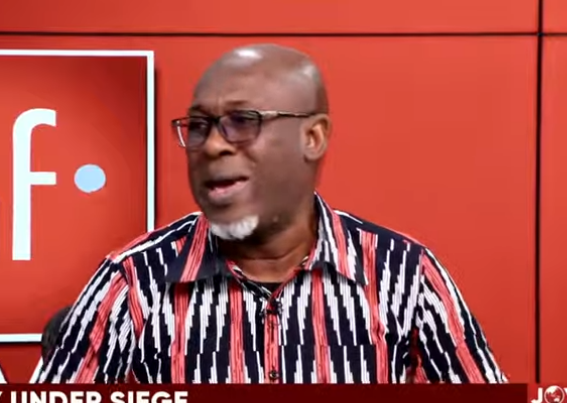
Senior lawyer and Vice-President of IMANI Africa, Kofi Bentil, has urged Ghanaians to respect citizens who take to the streets to demonstrate, even when they disagree with the protesters’ political views or demands.
Mr Bentil said protesters and activists play a crucial role in defending democratic freedoms because they are often willing to put themselves on the line to challenge authority and push the boundaries of civic liberties.
“When you see people demonstrating, whether you agree with them or not, first have the respect for the fact that they put themselves on the line to push the boundaries of our democracy,” he said.
Speaking on JoyNews’ Newsfile on Saturday, Mr Bentil was commenting in the wake of the New Patriotic Party’s (NPP) “Democracy Under Attack” demonstration in Accra.
Thousands of NPP supporters and party leaders took to the streets on Thursday to protest what the opposition party described as threats to Ghana’s democratic institutions under the governing National Democratic Congress (NDC).
The demonstration culminated in the presentation of a petition at the forecourt of Jubilee House, the seat of government.
The NPP delegation was led by Minority Leader Alexander Afenyo-Markin, General Secretary Osei Kyei-Mensah-Bonsu and the Chief of Staff to NPP flagbearer Dr Mahamudu Bawumia.
The party had earlier submitted a separate petition to the Supreme Court.
Mr Bentil's principal message was that disagreement with the substance of a demonstration should not translate into disrespect for the people exercising their democratic rights.
“You may not agree with them, but respect their activism,” he said.
He argued that activists are an important part of the democratic process because their willingness to challenge those in authority helps ensure that citizens' freedoms are not gradually restricted.
“It is the activist you saw on the road who pushed the boundaries of freedom and democracy and make your liberty assured,” he said.
For Mr Bentil, the value of activism lies partly in its ability to test the limits of political power.
A demonstration may be inconvenient to the government or unpopular with sections of society, he suggested, but the act of protesting can nevertheless strengthen democracy by forcing institutions and those in authority to respond to public concerns.
The NPP's demonstration was organised under the theme “Democracy Under Attack”, with the party accusing the NDC government of undermining democratic principles and weakening key state institutions.
The party mobilised a large crowd of supporters in Accra, with senior party figures joining the protest.
At the end of the demonstration, the party presented a petition at Jubilee House after earlier submitting another petition to the Supreme Court.
The NPP's decision to take its concerns to the streets reflects its broader opposition to what it considers the excessive use of state power and the weakening of institutions that are supposed to protect constitutional democracy.
The senior lawyer also warned that an attack on democracy does not necessarily arrive through a sudden or dramatic event.
“When you talk about an attack on democracy, never in the history of mankind happens suddenly. It creeps on you as a nation,” he said.
Mr Bentil referred to a lecture he delivered in Germany, where he discussed historical examples of democratic systems being weakened from within.
He cited Adolf Hitler and Benito Mussolini, arguing that they used democratic principles and political processes to gain power before subsequently using laws and state institutions to undermine constitutionalism.
“I was explaining to the white people that Hitler and Mussolini used democratic principle to enter office and then when they got into office, they used laws and other that are supposedly part of the democratic system to cancel out constitutionalism and the democracy they had,” he said.
His broader warning was that citizens should not assume that democracy can only be threatened by an outright coup, the suspension of a constitution or the abolition of elections.
According to him, democratic freedoms can also be eroded incrementally through actions that may initially appear isolated or insignificant.
“And everywhere people had been oppressed, it starts slowly,” he added.
Mr Bentil therefore urged Ghanaians to pay attention to developments that could gradually restrict civic freedoms or weaken institutions responsible for protecting constitutional rights.
“We have a creeping situation which can get worse,” he warned.
Mr Bentil also linked his defence of protesters to an experience he said he had during the NPP demonstration.
He claimed that he was assaulted by police officers while attempting to get close to the gate of Jubilee House.
“This is an improvement because I was beaten up. I had been attacked by policemen trying to get close to Jubilee House gate,” he said.
For Mr Bentil, the experience reinforced the need to defend activism regardless of the political identity of those involved.
His argument is that citizens should not have to support a particular political cause before being entitled to exercise their democratic rights.
The IMANI Africa Vice-President emphasised that the protection of democratic rights cannot be conditional on public agreement with the protesters.
“When you see people demonstrating, whether you agree with them or not, first have the respect for the fact that they put themselves on the line to push the boundaries of our democracy,” he said.
The principle, he suggested, should apply equally to demonstrations organised by opposition parties, civil society groups, labour organisations or other sections of the public.
If citizens are allowed to protest only when their cause is popular, then the right to protest becomes dependent on public approval rather than being treated as a constitutional freedom.
Mr Bentil's position is therefore that democratic tolerance requires people to distinguish between rejecting a protester's message and respecting their right to express it.
A person may disagree with the NPP's assertion that Ghana's democracy is under threat while still acknowledging the party's right to organise a peaceful demonstration.
Mr Bentil also raised concerns about what he described as selectivity in the administration of justice.
He questioned why certain individuals appeared to be singled out for what he considered special treatment.
“Today, there are questions of why are some people being singled out for that special treatment,” he said.
“So I think as a matter of fact there is some selectivity in justice.”
Mr Bentil's warning about a “creeping situation” also places responsibility on citizens to recognise potential threats before they become entrenched.
He argued that democratic decline often begins gradually, allowing societies to become accustomed to restrictions or institutional practices that might previously have been considered unacceptable.
For that reason, he believes citizens should remain vigilant about the treatment of protesters, the conduct of security agencies, the independence of state institutions and the consistent application of justice.
His appeal is for Ghanaians to recognise the importance of activism even when they disagree with the cause being advanced.
“You may not agree with them, but respect their activism,” he said.
Latest Stories
-
GMA rejects claims its vessel monitoring system is ineffective
6 minutes -
I was close to joining Liverpool in 2016 – Mbappe
18 minutes -
Ministry of Sports and Recreation holds national validation workshop on National Sports Policy Draft
22 minutes -
‘Do you want me to be happy with this poor performance?’ – Bono East Minister fumes over Kintampo market project with less than 1% work done
29 minutes -
London screening honours Nkrumah and 103 years of Ghana cinema
33 minutes -
Founder’s Day: Is Nkrumah’s glory fading? – Nkrumah’s iconic fountain at Circle runs dry
34 minutes -
GHS calls for stronger systems to ensure safe care for NCD patients
34 minutes -
Kufuor calls for Africa’s resources and youthful population to be transformed into opportunities
36 minutes -
Mahama administration not clamping down on free speech – Shamima Muslim
45 minutes -
Ghana TVET Service, UNESCO, KPMG, Microsoft to train 100,000 facilitators in AI
53 minutes -
Kejetia traders demand controls as shop owners resell spaces at inflated prices
54 minutes -
Fix Ghana Maritime Authority surveillance system instead of ‘threatening’ NPP – Dennis Aboagye tells NDC
1 hour -
Poor land acquisition for development projects pushing people into poverty – Prof Helen Essandoh
1 hour -
‘This is what we expect from a statesman’ – Brazilian President commends Mahama for leading global reparatory justice push
1 hour -
Government would be helpless if it relies on NPP for drug intelligence – Miracles Aboagye
2 hours