

Audio By Carbonatix
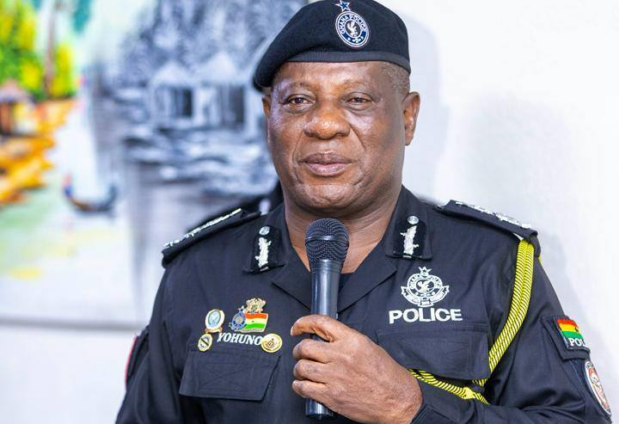
Inspector-General of Police (IGP) Christian Tetteh Yohuno has called on Christian and Muslim leaders across Ghana to use their moral authority to de-escalate growing religious tensions, warning that provocative speech, vigilante retaliation and violence could undermine the country’s long-standing reputation for peaceful coexistence.
Speaking at an engagement between the IGP, the Police Management Board (POMAB) and religious leaders on Friday, August 14, Mr Yohuno said Ghana was facing a moment of “profound tension” as religious friction intensified across both traditional and digital media platforms.
He said the recent incidents, including provocative comments about the Holy Prophet Muhammad, calls for extrajudicial violence and the assault of a handcuffed Christian cleric, had tested the country’s commitment to tolerance and the rule of law.
“We gather in a moment of profound tension, a moment where the foundational peace of our beloved republic is being severely tested,” the IGP said.
According to him, the developments of the past week had left many Ghanaians deeply concerned, particularly because the incidents had crossed religious lines and threatened to inflame relations between the country’s two major faith communities.
Mr Yohuno said the Ghana Police Service had moved to investigate the incidents and had taken several suspects into custody.
He disclosed that the Islamic cleric alleged to have called for extrajudicial killings had been arrested. A Christian cleric accused of making allegedly blasphemous statements had also been arrested for investigation, while the individual captured on video allegedly slapping a handcuffed pastor had likewise been apprehended.
He said all three were currently on bail while investigations continued.
The IGP stressed that the police had acted to ensure that the allegations were dealt with through the appropriate legal channels rather than allowing individuals or groups to take the law into their own hands.
“The police have acted proactively and set the wheels of justice in motion,” he said.
However, Mr Yohuno cautioned that policing alone could not resolve the deeper social and religious tensions generated by the incidents.
“Police action alone cannot heal a fractured spirit,” he said. “Law enforcement can restrain hands, but only faith, leadership and conscience can heal hearts.”
The IGP's central message was that neither religious provocation nor anger could justify violence.
“Violence will not fix what words have broken,” he said, adding that “vigilante retribution will never replace the rule of law in Ghana.”
He urged citizens who believe that an offence has been committed to report it to the appropriate authorities rather than seeking personal revenge.
Mr Yohuno said allowing individuals to punish alleged offenders themselves would weaken Ghana’s constitutional order and threaten the stability that the country had built over generations.
“No civilised society can survive when individuals take the law into their own hands,” he said.
Addressing the Muslim community, the IGP acknowledged the deep reverence Muslims have for the Holy Prophet Muhammad and said the anger caused by insults against the Prophet was understandable to people of sincere faith.
“The Prophet is revered, beloved and central to the life of every Muslim,” he said.
However, he appealed to Muslims not to allow anger or provocation to lead to violence.
Drawing on Islamic teachings, Mr Yohuno said the Qur'an encouraged believers to respond to hostility with wisdom, restraint and peaceful conduct rather than mob action or bloodshed.
He referred to Qur'anic teachings concerning engaging others “in the way that is best” and to Surah Al-Furqan 25:63, which describes the servants of the Most Merciful as those who respond to harsh words with peace.
He also invoked the example of the Prophet Muhammad, particularly his patience and forgiveness in the face of persecution and personal insults.
“To call for the summary execution of a fellow citizen or to assault a handcuffed suspect does not honour the dignity of the Holy Prophet, peace be upon him,” Mr Yohuno said.
Rather, he argued, such conduct undermined the message of mercy and compassion associated with the Prophet.
The IGP also appealed to Christian leaders and believers to exercise restraint in their public speech and avoid deliberately provoking religious sensitivities.
He said freedom of expression should not be treated as a licence to desecrate the sacred beliefs, symbols or prophets of another faith.
Referring to the Bible, he cited Romans 12:18, which calls on believers, “if it is possible”, to live at peace with everyone.
He also referred to the teaching in Colossians 4:6 that speech should be gracious and carefully considered.
Mr Yohuno said deliberately provoking religious hatred, insulting beliefs held sacred by millions or encouraging hostility towards another faith was inconsistent with the values of Christian witness.
“True Christian witness is found in love, peace and patience,” he said.
A significant part of the IGP's appeal was directed at religious leaders, whom he described as possessing considerable influence over their congregations and the wider public.
He noted that worshippers listened to sermons, followed religious leaders on social media and often took cues from their conduct.
“At this fragile moment, your words can either act as water upon an emerging fire or as petrol upon dying embers,” he told the religious leaders.
Mr Yohuno therefore urged Christian and Islamic leaders to publicly demonstrate unity rather than merely speaking about tolerance.
He called for leaders of both faiths to appear together, issue joint statements and engage communities collectively to reassure citizens that religious differences did not constitute a threat to national cohesion.
He also urged the leaders to work towards strengthening public confidence in statutory institutions and the justice system.
The IGP said Ghana's religious diversity should be regarded as a source of national strength rather than a fault line capable of dividing communities.
He reminded religious leaders that Christians and Muslims had historically lived and worked together as neighbours, classmates, colleagues, traders and members of extended families.
“Christians and Muslims in this country are not strangers to one another,” he said.
He argued that religious identity should not erase the social bonds that had existed between communities long before the recent escalation in religious discourse.
Mr Yohuno encouraged religious leaders to particularly focus on young people, who he said could be influenced by inflammatory content circulating online.
He urged them to teach the youth that peaceful coexistence was not a sign of weakness but an important component of responsible citizenship.
The IGP's comments also highlighted the growing role of digital platforms in amplifying religious disputes.
He cautioned against online harassment and inflammatory commentary, alongside physical violence and mob justice.
He said citizens should resist the temptation to respond immediately to provocative material circulating online and should instead allow the appropriate institutions to investigate allegations and determine whether an offence has occurred.
Mr Yohuno warned that Ghana should not take its peace for granted.
He pointed to conflicts elsewhere in West Africa where small disputes had been allowed to escalate into wider communal violence, destroying communities, markets, schools and places of worship.
“We see nations where small sparks are allowed to fester until they grow into infernos of civil strife,” he said.
He argued that Ghana had avoided such outcomes not because its people were immune to disagreement, but because previous generations had repeatedly chosen dialogue and coexistence over confrontation.
“Ghana has been spared this tragedy, not because we are immune to disagreement, but because generations before us chose to dialogue over destruction and brotherhood over war,” he said.
Latest Stories
-
Nana B passport claims a diversionary tactic — Abu Jinapor
53 minutes -
Pope Leo diagnosed with cancer as doctors remove lobe of lung, Vatican says
54 minutes -
Legal Aid Commission takes free legal services to Techiman main lorry terminal
58 minutes -
Nana B denies seeking passport favour, accuses Ablakwa of failing to account for GH¢16.4m
1 hour -
Young girls demand climate action, stronger protection against child marriage
1 hour -
Ex-gang boss sentenced to 40 years for orchestrating Tupac Shakur’s murder
1 hour -
From near-deferral to three awards: UMaT graduate’s academic journey
1 hour -
Atta Akyea denies seeking presidential pardon for Wontumi in galamsey case
2 hours -
Photos: Mahama commissions 85-bed Police Hospital ward, donates two ambulances
2 hours -
GTEC directs Ghana’s public universities to reopen by October 16 and begin lectures on October 19
2 hours -
Star Oil donates GH¢1million towards construction of new CID facility
2 hours -
Court hands Adjetey Sowah, two others lifetime bans after Amputee Football legal dispute
2 hours -
NDC appoints Julius Kwame Anthony as a Deputy Communications Director
2 hours -
Ghana repatriates 120 Nigerians rescued from suspected cybercrime centres
2 hours -
NPP rejects Emelia Agbenyo’s appointment as Deputy EC Chair, demands withdrawal
2 hours