

Audio By Carbonatix
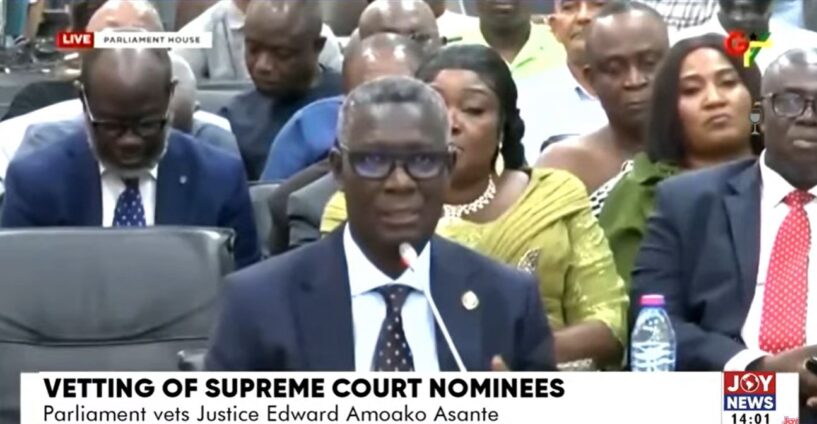
Supreme Court nominee Justice Edward Amoako Asante has urged persons held in police custody beyond the constitutionally prescribed 48-hour period to seek redress through the courts.
He said legal action by suspects and their lawyers could help strengthen enforcement of constitutional safeguards against prolonged and unlawful detention.
Justice Amoako Asante made the remarks when he appeared before Parliament’s Appointments Committee on Thursday, August 27, 2026, during his vetting for appointment to the Supreme Court.
Responding to questions about the effectiveness of Ghana’s constitutional protections for arrested persons, he questioned why individuals who remain in police custody beyond the 48-hour limit do not routinely challenge such detention in court.
“I have always had the notion of why suspects have not sued the police for keeping them for times on end after the 48 hours,” he said.
Article 14(3) of the 1992 Constitution provides that a person arrested or detained in connection with a criminal offence who is not released must be brought before a court within 48 hours after the arrest.
Justice Amoako Asante said the constitutional protection should not remain merely a provision on paper but should be actively enforced through the courts.
“These are things that people should be doing for us to know that the courts are able to confirm what is in the Constitution for those things to happen,” he stated.
He also rejected the suggestion that Ghana necessarily requires additional legislation to deal with prolonged detention, pointing to existing legal provisions that provide avenues for persons whose rights have been breached.
“I do not think that is necessary in our circumstances. Act 30 is clear. It is there then to reinforce,” he said, referring to the Criminal and Other Offences (Procedure) Act, 1960 (Act 30).
For Justice Amoako Asante, lawyers have an important role to play in testing unlawful detention before the courts.
He argued that legal practitioners representing suspects should be prepared to challenge authorities when their clients are kept in custody beyond the permitted period.
“It is people or lawyers who have not sued those who have detained their people beyond the time on behalf of their clients,” he said.
He believes successful cases could have a broader effect beyond providing relief to individual suspects.
According to him, court declarations and financial awards against authorities responsible for unlawful detention could serve as a deterrent and encourage greater compliance with the constitutional limit.
“So if you take action and the court declares…awards against those who have done so, then it will be fine so that everybody knows that you cannot just get people, keep them and all that,” he added.
Latest Stories
-
Collapsed glacier likely caused deadly Nepal-Tibet floods, scientists say
4 minutes -
The Cyrus Lesson: Why Ghana must look beyond religion in choosing its next leader
10 minutes -
I have no problem with public tribunals; they’re constitutional – Anthony Forson
20 minutes -
GRA boss supports mothers’ hostel, donates pickup to Upper Denkyira East Police
27 minutes -
NSMQ 2026: St. John’s School beat Benkum SHS, Nandom SHS to secure quarter-finals spot
34 minutes -
Minifootball Association of Ghana unveils women’s national team ahead of inaugural AFCON
35 minutes -
Appointments Committee recommends approval of three Supreme Court nominees
35 minutes -
NSMQ 2026: St. Hubert Minor Sem. reclaims lost seed, sends Mawuli School packing to book quarter-final spot
36 minutes -
Beyond “what do you bring to the table?”: Rethinking what partners bring to relationships
38 minutes -
NSMQ 2026: Mfantsiman Girls’ back in the quarter-finals after 10 years, snatches spot from St. James
40 minutes -
Education Ministry to amend law to restore faith-based representation on GES Council
44 minutes -
Teacher unions demand automatic salary placement for newly promoted teachers
45 minutes -
Asawase fire: NADMO stops victims from rebuilding burnt homes
46 minutes -
SYPALA 2026: ‘Anti-corruption without enforcement is meaningless’ — Senanu
1 hour -
ICT, afternoon court sittings can help clear case backlog – Supreme Court nominee
1 hour